Books That Make You Sound Brilliant at Dinner Parties (Without Being That Person)


There’s a fine line between sounding well-read and sounding like the person everyone desperately hopes won’t sit next to them again. The goal isn’t to flex intelligence — the goal is to drop a line or two that shows you’ve thought deeply about things beyond your daily to-do list. And honestly, that’s what good books do: they give you a richer inner life and enough conversational gold to carry you through any dinner where someone inevitably asks, “So, what are you reading lately?”
This list pulls together books that spark lively conversation, help you hold your own with smart people, and expand the way you see the world — without requiring a PhD or ten hours of Wikipedia backups. Each book gives you something memorable, something conversation-worthy, and something that quietly signals, Yes, I read things other than emails. Here are the first five books.
1. Sapiens — Yuval Noah Harari

Yuval Noah Harari’s Sapiens is the book people quote when they want to sound informed about history, psychology, economics, and the human condition — all in the same breath. It’s dense in ideas but surprisingly easy to digest, which is why it shows up on so many “smart people’s bookshelves.” Harari explores how humans became dominant through shared myths, cooperation, and the strange superpowers that come from telling stories — not fairy-tale stories, but the societal narratives that shape money, religion, nations, and culture. It’s the kind of book that makes you rethink everything you assumed was “just the way things are.”
The shorter takeaway: mention how Harari argues that humans rule the planet because we believe in the same fictional structures, and you’ll instantly sound like someone who reads beyond headlines.
2. Thinking, Fast and Slow — Daniel Kahneman

This is the book for anyone who’s ever wondered why humans are such a mess of contradictions. Kahneman — a Nobel Prize–winning psychologist — breaks down how our brains operate on two systems: the fast, impulsive one and the slow, deliberate one. Dinner-party gold? You can casually reference cognitive biases, the mental shortcuts that lead us astray, or talk about how our intuitions often trick us into believing we’re being rational when we’re absolutely not. The beauty of this book is that it gives you language for behaviors you’ve already seen in yourself and everyone else.
Short version: dropping the phrase “confirmation bias” or “System 1 vs. System 2 thinking” in conversation makes you sound like you actually understand human behavior — not just that you reposted a psychology infographic once.
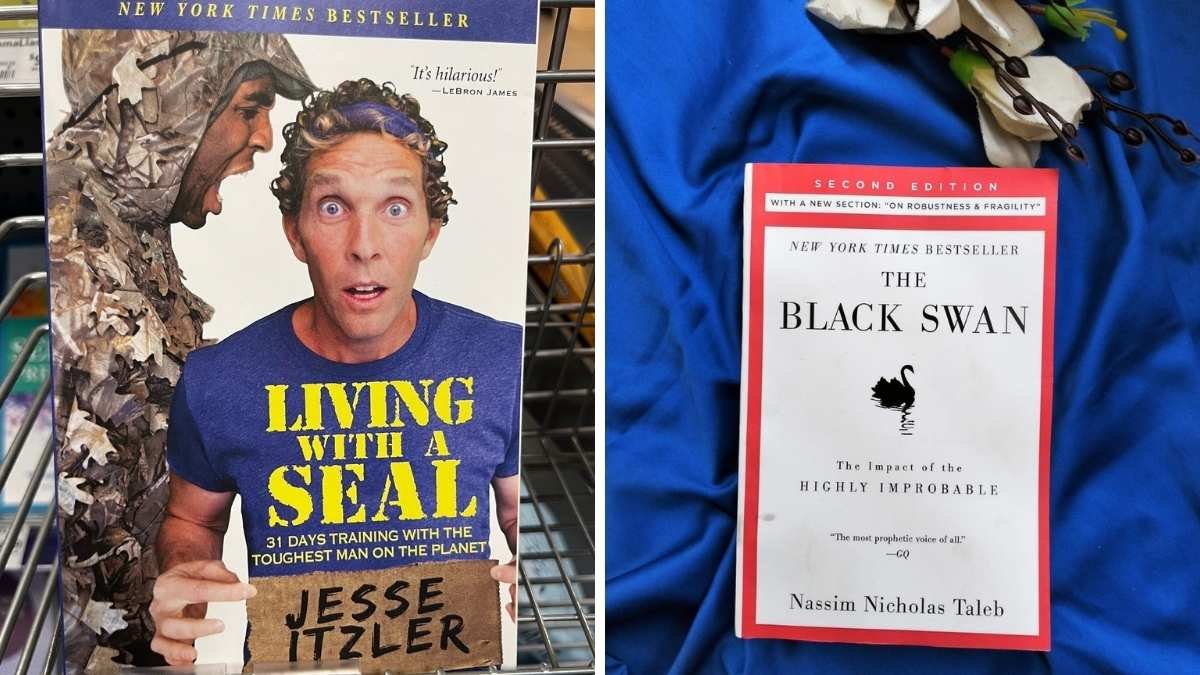
3. The Black Swan — Nassim Nicholas Taleb

The Black Swan is built around one brilliant point: major events that shape the world are rare, unpredictable, and deeply consequential — far more than the ordinary events we obsess over. Taleb argues that we’re awful at predicting the future because we rely too much on past patterns and too little on acknowledging radical uncertainty. If you want to sound sharp at a dinner party, casually referencing “black swan events” instantly signals you’re someone who thinks about risk, probability, and complex systems beyond the surface level.
The conversational nugget: Taleb reveals how humans create neat stories to explain chaotic events, even when those stories are completely delusional. Mentioning this makes you sound insightful without sounding smug.
4. Quiet — Susan Cain

If you’ve ever felt drained after too much socializing, Susan Cain’s Quiet is the book you didn’t know you needed. It explores how society undervalues introverts, why we equate loudness with leadership, and how quieter people contribute more deeply than they often get credit for. Cain argues that the world is built for extroverts — open-plan offices, group brainstorming, constant communication — and that we underestimate the power of deep thinking and internal clarity. This book resonates with people because it explains something many have felt but never articulated.
The quick dinner-party idea: saying something like “Cain shows how introverts thrive through depth, not volume” gives you an elegant way to make a relatable point — especially if you’re surrounded by people talking over each other.
5. The Righteous Mind — Jonathan Haidt
Jonathan Haidt’s The Righteous Mind is the diplomatic handbook for understanding why smart, good people can disagree so fiercely about politics, morality, and culture. Haidt — a moral psychologist — explains how our moral foundations differ and why debates often feel impossible: we’re arguing from different instinctive frameworks, not from raw logic. What makes this book powerful is its central idea: morality is intuitive first and rational second, meaning we justify our positions after our emotions choose them. During any heated discussion, this insight is priceless.
What to mention casually: Haidt reveals how people aren’t divided because of facts but because of the moral lenses they use, which instantly elevates any conversation about current events without dragging it into lecture mode.
6. The Wisdom of Insecurity — Alan Watts

Alan Watts has a way of taking complicated philosophical ideas and presenting them in a way that feels both modern and practical. The Wisdom of Insecurity is one of his sharpest works: a reflection on why humans struggle so much with being present, and how our constant chase for stability creates the very anxiety we want to escape. Watts argues that life is inherently uncertain and that the more we cling to guarantees, the more stressed and disconnected we become. It’s the kind of book that quietly reveals how much of our suffering comes from resisting the rhythm of life rather than flowing with it. The takeaway feels timeless: uncertainty isn’t the enemy — our fear of it is.
In conversation, referencing Watts’ idea that security is often a psychological illusion instantly signals depth without sounding preachy.
7. Guns, Germs, and Steel — Jared Diamond

Jared Diamond’s Pulitzer-winning book explores one of the most ambitious questions ever asked: why did some civilizations advance faster than others? Instead of focusing on intelligence or cultural superiority, Diamond breaks the issue down into geography, resources, agriculture, and the spread of disease. He makes a compelling case that environmental advantages, not inherent differences, shaped the global balance of power. The result is a sweeping view of human history that shifts blame away from simplistic explanations and toward a more scientific, interconnected understanding of how societies evolve.
At a dinner party, being able to say that Diamond links global inequality to geographic luck rather than human superiority is the sort of insight that lands well across any crowd.
8. Outliers — Malcolm Gladwell

Gladwell’s Outliers digs into what makes people exceptionally successful — and spoiler: it’s not just talent or hard work. It’s timing, cultural background, opportunity, and thousands of hours of deliberate practice stacked on top of one another. Gladwell has a gift for turning research into engaging storytelling, and here he makes a bigger point: success is rarely a solo achievement. The stories of tech founders, athletes, and cultural icons highlight how circumstances and systems shape outcomes more than raw genius does.
The quick conversational takeaway: referencing the “10,000-hour rule” or explaining how environment shapes opportunity shows people you think critically about success and don’t buy into simplistic narratives.
9. The Sixth Extinction — Elizabeth Kolbert

Elizabeth Kolbert’s Pulitzer Prize–winning book is a powerful blend of science, history, and urgent storytelling. It explores the five major extinctions that have reshaped life on Earth — and then argues that we’re currently triggering the sixth one. What makes the book so compelling is how Kolbert breaks down complex ecological science into stories about frogs, coral reefs, bats, and ancient species, showing how human activity has accelerated changes in biodiversity loss at an unprecedented scale. It’s sobering but fascinating, the kind of book that expands your perspective on our place in the world.
For conversation, the simple statement that humans are now a geological force reshaping the planet is enough to spark thoughtful discussion without sounding like you’re lecturing.
10. The Book of Joy — Dalai Lama, Desmond Tutu & Douglas Abrams

This book brings together two of the most respected spiritual figures of the modern era — the Dalai Lama and Archbishop Desmond Tutu — for a series of conversations about joy, suffering, compassion, and resilience. What makes it powerful isn’t just their wisdom; it’s their warmth, humor, and deep understanding of human struggle. They explore how joy is a skill, not an accident, and how we can cultivate it even in the face of hardship. Their insights blend spirituality with psychology, making the book surprisingly grounded and universally accessible.
At a dinner party, referencing their idea that joy and suffering are intertwined gives you a thoughtful, human point that resonates across cultures and beliefs.
11. The Gene: An Intimate History — Siddhartha Mukherjee

Siddhartha Mukherjee is one of those rare writers who can turn dense science into genuinely compelling reading. The Gene traces the history of genetics — from early theories to modern breakthroughs — and explains how this tiny molecular script shapes everything about who we are. Mukherjee weaves together science, personal stories, medical history, and the ethical dilemmas that come with genetic power. What makes the book stand out is how clearly it shows the link between biology and identity, and why genome research is changing everything from medicine to morality. It makes you sound informed without needing a lab coat or medical degree.
In conversation, mentioning Mukherjee’s idea that genes are “whispers” that guide but don’t fully define us is a smart, digestible insight that lands well across all kinds of audiences.
12. Freakonomics — Steven D. Levitt & Stephen J. Dubner

Freakonomics is the book that made economics fun — not because it simplifies things, but because it reveals the strange ways incentives drive human behavior. Levitt and Dubner dive into questions people rarely ask: What do sumo wrestlers and schoolteachers have in common? Why do drug dealers still live with their mothers? How much does your first name actually shape your future? The authors use data to uncover the hidden logic behind everyday decisions. It’s playful but insightful, and it teaches you how to think critically about cause, effect, and the stories we believe.
At a dinner party, referencing the book’s theme that “people respond to incentives — sometimes in unexpected ways” is all you need to spark a sharp, engaging conversation.
13. A Short History of Nearly Everything — Bill Bryson

Bill Bryson somehow managed to take the history of the entire universe — from the Big Bang to modern humans — and turn it into a surprisingly witty, endlessly fascinating read. The book covers physics, chemistry, biology, evolution, geology, astronomy, and everything in between, all through Bryson’s curious, charming lens. It’s essentially a crash course in how the world works, written in a way that makes even the most intimidating concepts feel approachable. His ability to highlight the strangeness and wonder of scientific discovery makes the book both educational and entertaining.
In conversation, simply mentioning how Bryson shows that science is full of accidents, mysteries, and near-misses gives you an easy entry point into almost any topic.
14. The Better Angels of Our Nature — Steven Pinker

Pinker’s massive but compelling book argues something surprising: violence has declined dramatically over human history. Despite the chaos of the modern world, Pinker shows — through data, psychology, and historical trends — that we are living in one of the safest eras humanity has ever seen. He dives into the causes behind this shift: stronger institutions, increased empathy, literacy, economic interdependence, and the “civilizing process.” Whether readers agree or not, the book’s central idea — that the world is not as dark as it appears — is both comforting and conversation-worthy.
The easy takeaway: mentioning Pinker’s argument that violence has dropped for centuries due to cultural evolution sounds smart without being heavy-handed.
15. The Undoing Project — Michael Lewis

Michael Lewis (author of Moneyball and The Big Short) tells the story of the extraordinary friendship between psychologists Daniel Kahneman and Amos Tversky — two men whose research reshaped economics, decision-making, and modern psychology. The Undoing Project blends biography with science, showing how their studies on judgment and human error changed everything from medicine to finance. Lewis makes their work accessible while illustrating how profoundly our minds mislead us. It’s the perfect book for anyone fascinated by the intersection of personality, brilliance, and flawed reasoning.
The conversational gem: the book highlights how humans think in shortcuts, and those shortcuts often betray us, a point that fits naturally into almost any discussion about choices or behavior.