Stop “attention residue” when interrupted.
60-Second Rule: Write a note to your future self before closing the laptop.
- Where are you?
- What is the NEXT step?
- What was the challenge?


You know that feeling? You’re sitting at your desk—or maybe the kitchen table—and you have a browser tab open for work, your phone is buzzing with a text from your partner, Slack is pinging about a meeting that definitely could have been an email, and somewhere in the back of your mind, you’re reminded you forgot to defrost chicken for dinner.
And you just… freeze.
It feels like your brain has turned to static. You might even worry, Is this early-onset something? Am I losing it?
I need you to hear this: You are not broken. You aren’t losing your edge. But you are fighting a biological war with the wrong weapons.
If you are over 35, your brain has changed. The way you used to work—brute-forcing your way through twelve open tabs and three conversations at once—doesn’t work anymore. Not because you’re slower, but because your brain has evolved into a different kind of machine. One that the modern world is actively sabotaging.
Here is the truth about what is happening to your attention, why “multitasking” is a lie we’ve been sold, and how to actually reclaim your focus without moving to a cabin in the woods.

There’s a name for that static in your head. It’s called Attention Residue.
It sounds like a cleaning product, but it’s actually a concept coined by Dr. Sophie Leroy, a business professor who figured out why we feel so scattered. Here’s the gist:
When you switch from Task A (writing a report) to Task B (checking an email), your brain doesn’t just snap over cleanly. It’s not a light switch. It’s more like Velcro. A piece of your attention “sticks” to the first task. You might be looking at the email, but your brain is still processing the report in the background.
Dr. Leroy compares it to a computer with too many open windows. You know when you have 50 tabs open and your laptop starts wheezing and the cursor gets laggy? That’s your brain on multitasking. You aren’t stupid; you just have no RAM left.
And here is the scary part: It makes us worse at everything.
Research shows that people operating with this “residue” makes significantly worse decisions. In hiring simulations, people who cleared their residue were 79% more likely to pick the best candidate than those who tried to juggle tasks.
So when you feel “foggy” during a 3 PM meeting, it’s not just the lunch slump. It’s because your brain is still secretly trying to finish the three emails you read five minutes ago.
“Okay,” you might say, “but I used to do this all the time in my 20s and I was fine.”
You were. And here is why.
Your brain trades one superpower for another as you age.
The Conflict: The modern workplace is built for the Ferrari (speed, notifications, quick switching). But you are now driving a semi-truck (heavy load, massive power, hard to turn). When you try to drive a semi-truck like a Ferrari, you strip the gears.
If you’re in this age bracket, you aren’t just dealing with work. You might be part of the “Sandwich Generation”—squeezed between raising kids and caring for aging parents.
47% of adults aged 40-59 are caring for a parent while supporting a child. This adds a massive “invisible load” of cognitive tasks (scheduling doctors, carpools, emotional management) that runs in the background 24/7, eating up that precious RAM.
Your superpower is Fluid Intelligence ($G_f$).
Raw processing speed. Fast, twitchy, and able to weave through distractions.
You trade speed for Crystallized Intelligence ($G_c$).
This is Wisdom & Pattern Recognition. Connecting dots a 20-year-old can’t even see.
🏢 Workplace: Built for the Ferrari (notifications, speed).
🚛 You: Driving a powerful Semi-truck.
Trying to drive a semi like a Ferrari strips the gears!
Squeezed between raising kids and caring for aging parents.
A massive “invisible load” eating up your precious RAM.

Let’s kill this myth right now: Multitasking does not exist.
The word was invented in the 1960s to describe computers, not people. When you think you are multitasking, you are actually just task-switching really, really fast.
Every switch costs you energy. It floods your system with cortisol (the stress hormone) and burns through glucose (brain fuel). This is why you can sit in a chair all day, not move a muscle, and feel physically exhausted by 5 PM. You run a marathon in your head.
I hate to break it to you, but you probably aren’t. Researchers at the University of Utah found that about 2.5% of people are “Supertaskers” who can actually do this without performance dropping. The other 97.5% of us just think we are good at it, while our IQ drops by about 10-15 points (roughly the same as missing a night of sleep).
If you think, “maybe I just need to try harder,” look at the data. The environment is rigged against you.
The State of Our Attention (2023-2025 Data)
| The Stat | What It Means | Origin |
| 47 Seconds | The average time we spend on a screen before switching. Less than a minute. | 13 |
| 3.6 Hours/Week | Time leaders lose to completely unnecessary meetings. | 14 |
| 10 Apps | The average number of apps you toggle between daily. | 14 |
| 62% | The amount of your workday spent on “work about work” (email, coordination) rather than actual work. | 14 |
| 23 Minutes | How long it takes to get back to deep focus after an interruption. | 1 |
| The “Infinite” Day | 48% of employees now feel their work is “chaotic” and fragmented, leading to burnout. |
Think about that 23-minute stat. If you get interrupted every 10 minutes, you are mathematically unable of deep work. You are living your entire life in the “recovery” phase.

If you are noticing this shift heavily in your 40s, there is another layer.
For Women (Perimenopause):
Estrogen is a key player in brain function—it protects neural pathways and supports working memory. As levels fluctuate in perimenopause, “brain fog” isn’t just a mood; it’s a neurological symptom. Studies show dips in verbal memory and processing speed during this transition.
For Men:
Testosterone levels gradually decline, which plays a role in cognitive clarity and energy. Lower levels have been linked to reduced executive function.
This isn’t to scare you, but to validate you. If you feel “off,” you aren’t imagining it. Your biology is asking for a different protocol.
Stop “attention residue” when interrupted.
Monotasking is non-negotiable.
Batch emails (3x a day, not 300).
Set a timer. No phone. No tabs. Just one task. It builds focus muscle.
Fuel your Prefrontal Cortex.
Okay, enough doom and gloom. How do we fix this? We don’t try to go back to being 20. We lean into the strengths of the 35+ brain (crystallized intelligence) and protect it from the noise.
This is Dr. Sophie Leroy’s golden ticket. It stops attention residue in its tracks.
The Scenario: You are deep in a project, but you have to stop for a meeting.
The Fix: Do not just close the laptop. Spend 60 seconds writing a note to your future self.
Example: “I am in the middle of paragraph 3. Next step: find the source for the 2024 retention stats. Challenge: The data from Q1 looks inconsistent.”
Why it works: It gives your brain “closure.” It tells your subconscious, “It’s safe to stop thinking about this, we have a plan.”
Cal Newport, the godfather of focus, preaches “Deep Work.” This is non-negotiable for us now.
Your Prefrontal Cortex (the CEO of your brain) needs better fuel now.
Sometimes willpower isn’t enough, and you need the right tools to build a fortress around your focus. Based on the research and strategies above, here are five products that can actually help you implement these habits.

Why you need it: Remember the “20-minute rule”? Using your phone as a timer is a trap—you’ll pick it up to set the alarm and end up on Instagram for 15 minutes. A physical visual timer shows you exactly how much time is left with a red disk that disappears as time passes. It externalizes time, which helps calm the ADHD-like symptoms of modern work.

Why you need them: If you work in an open office or a busy house (hello, Sandwich Generation), noise is a constant cortisol trigger. These aren’t big, bulky headphones; they are discreet silicone plugs that reduce noise by ~24dB. They don’t block everything, but they dampen the “background chaos” enough to let your brain enter Deep Work mode.

Why you need it: As we discussed, your aging brain needs structural support. Omega-3 fatty acids (specifically DHA and EPA) are the building blocks of cell membranes. If you aren’t eating fatty fish 3x a week, this is the gold standard for supplements—high potency and third-party tested for purity.

Why you need it: This planner is practically designed for the “Ready-to-Resume” plan. It forces you to identify your “Daily Big 3” tasks, preventing the “open windows” overload. Writing things down on paper engages different cognitive pathways than typing, helping to commit tasks to memory and clear mental RAM.
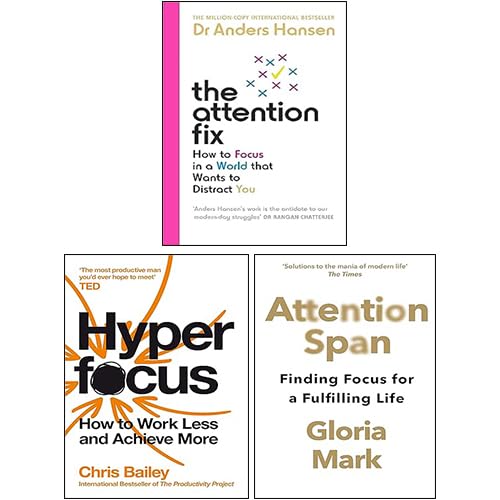
Why you need it: If you want the deep dive into the science we covered (like the 47-second stat), this is the book. Dr. Mark doesn’t just diagnose the problem; she offers a realistic framework for “kinetic attention”—learning to move with your focus rather than fighting it. It’s a validating read for anyone who feels “broken.”





We craft smart, actionable content about money, health, style, and travel that fits real life. No fluff, just practical wisdom delivered with charm and backed by data.