


The moment you drop your perfectly packed, expensive suitcase onto the conveyor belt at check-in? It’s a moment of deep, irrational faith. You’re handing over everything you own for the next week to a maze of machines and people you’ll never see. You just hope it shows up on the other side.
But what actually happens back there? Why do bags go missing when technology is supposed to track everything?
The truth, revealed by the people who work the ramp—the ground crew, the baggage handlers—is both simple and a little cold. Your luggage is not the star of the show; it’s a co-star, at best. It’s part of a massive, finely tuned industrial process where, quite frankly, other things matter more. We’ve got the insider playbook on what really goes on below the wing, and eight non-negotiable steps you need to take to protect your stuff.
The Cold, Hard Truth: You’re Fourth on the Priority List
Here’s the secret no traveler ever wants to hear. A ramp agent—the person responsible for getting your bag onto the plane—has a strict hierarchy of priorities, and your luggage comes in fourth.
First is safety, always. Second is the structural integrity of the aircraft. Third? On-time performance (OTP). That’s the non-negotiable goal. Only after those three are secured does your suitcase enter the picture.
Think about it this way: Delaying a fully loaded commercial flight costs the airline thousands of dollars—in gate fees, fuel adjustments, and massive cascading delays across their network. The cost of dealing with your single delayed bag? A relative pittance. So, if your inbound flight is late, that plane waiting at the gate will not wait for your connecting luggage, no matter how short the delay. The decision to leave a bag behind is a clear-cut financial calculation, and the plane pushes back on schedule.
The Post-Pandemic Mess
Maybe it’s just me, but the frustration of mishandled bags exploded a couple of years ago. Turns out, that’s not just your imagination—the statistics prove it. The global rate of mishandled baggage (delayed, lost, or damaged) nearly doubled in 2022 to 7.60 bags per 1,000 passengers. That surge—widely known as the “summer of lost luggage”—was caused by airlines struggling to cope with huge traveler volumes (3.42 billion passengers in 2022) while facing severe labor shortages.
The industry has stabilized a bit since then, thanks to heavy investment in tech, bringing the rate down to 6.3 bags per 1,000 passengers in 2024. But look, that still means millions of bags get messed up every year.
And where does it go wrong? That tricky transfer phase. Bags moving from one flight to another consistently account for the biggest chunk of delayed luggage—42% of all incidents. This risk is so concentrated that international flights, which almost always involve connections, have a mishandling rate eight times higher than domestic flights.
What Happens in the Automated Labyrinth
When you check your bag, it disappears into the Baggage Handling System (BHS), a complex maze of high-speed conveyors and sensors. This automated system is designed for throughput. If everything runs smoothly, your bag is scanned, sorted, and routed to the correct gate in as little as three-and-a-half minutes.
Hundreds of photo sensors track your bag as an Automated Tag Reader (ATR) scans its barcode, ensuring it passes through security screening (Checked Baggage Inspection System, or CBIS) and then diverts it toward the right aircraft.
But here’s the issue: automation is fragile.
If a loose bag strap, a dangling souvenir, or a pinched wheel causes a glitch, the conveyor belt grinds to a halt. An alarm sounds, and a human has to rush over to manually unjam the system. This stops the flow, creates a backlog, and forces agents to handle subsequent bags faster—and rougher—just to catch up.
This is why, as a traveler, you have a responsibility for “baggage hygiene.” The ramp agents are supposed to place loose items (like backpacks with long straps) into protective bins, but when the airport is short-staffed, that step often gets skipped. Your loose strap becomes their problem, and it causes the delay.
Damage is on the Rise (and The Futility of the ‘Fragile’ Sticker)
While delayed bags still dominate the statistics (74% of all mishaps), there’s a concerning trend: damaged and pilfered bags have jumped to 18% of all mishandled luggage in 2024. This suggests that even as automation is getting faster at routing, the physical stress on the bags is increasing.
It’s time to talk about materials.
Why That Cheap Suitcase is a Liability
Your luggage material really matters under this kind of high-speed, high-impact stress. You see those slick, plastic hard-shell suitcases? Ramp agents often express a preference for durable cases that are simply easier to grab and maneuver. More specifically, if your bag is made of ABS (Acrylonitrile Butadiene Styrene), you are at a much higher risk. ABS is stiff and less flexible compared to materials like polycarbonate, meaning it’s highly prone to cracking under the heavy impact and pressure of the BHS. Polycarbonate is better, though you might get a scratch or two.
The Fragile Fallacy
Look, I know you want to protect your breakables, but the “Fragile” sticker is a lie, and potentially a legal trap.
While a kind agent might handle it a little gentler during the manual loading , the sticker means absolutely nothing to the BHS. The automated system doesn’t care; it just moves all bags at the same rough, high-speed pace.
But here’s the real kicker: many major airlines will only accept a fragile item if you sign a Limited Liability Release form. By signing that, you essentially waive the airline’s responsibility if the item breaks. You lose the protection provided by the international Montreal Convention. You’re better off relying on bubble wrap and packing cubes than a sticker and a legal waiver.
The Traveler’s Defense: 8 Ways to Beat the System
You can’t control the BHS, and you can’t make the ramp agent slow down. But you can control how you prepare, and that makes all the difference. Here are the 8 crucial steps, incorporating the handler’s insights and the latest technology, to ensure your bag makes it safe and sound.
1. Track It Yourself

The Handler’s Insight: Airlines use fancy trackers, but they’re only as good as the system’s barcodes, which can fail or be ripped off.
The Defense: Place an Apple AirTag, Tile, or a dedicated GPS tracker (like Tracki, good for international travel) inside your bag. Real-time, passenger-driven tracking is so powerful that airport recovery systems now integrate your location data to recover lost bags faster. Knowing exactly where your bag is—even if it’s stuck in a warehouse in Chicago while you’re in Miami—gives you confidence and leverage.
2. Purge ALL Old Tags (Especially Bingo Stickers)

The Handler’s Insight: Too many tags confuse the automated scanners.
The Defense: Before every trip, strip your bag bare. Remove every old airline tag, destination sticker, and those little adhesive “bingo stickers”. If a sensor accidentally scans an old barcode, your bag gets misdirected, alarms go off, and a manual (and slow) investigation is required.
3. Pack Smart: The 24-Hour Rule

The Handler’s Insight: Delayed bags (74% of the problem) are inevitable.
The Defense: Assume your bag will be delayed. If you can’t function without it for 24 to 48 hours, it needs to be in your carry-on.1 Medications, keys, essential electronics, prescriptions, and at least one change of clothes—put them in your personal item.1 Don’t risk a catastrophe just because you ran out of carry-on space.
4. Choose Luggage the Handler Will Love

The Handler’s Insight: We need handles, not just the telescoping one.
The Defense: Select a suitcase with handles on all sides (top, side, and bottom). Ramp agents call four-roller suitcases a “Godsend” because they offer “far more control” when they have to quickly lift and load your bag, which drastically reduces the chance of a drop or rough toss.1 Also, check the condition of your existing bag. If seams are loose or zippers are broken, tell the check-in agent so they can tape and mark it, protecting both the bag and the ground crew.
5. Double-Identify (Inside and Out)

The Handler’s Insight: Tags get ripped off in the system.
The Defense: Use a sturdy, brightly colored luggage tag on the outside to prevent theft or mistaken identity on the carousel. More importantly, place a detailed secondary identification card inside a zipped pocket. Include your full name, current email, and phone number, but skip your home address for security. If the external tag fails—the primary cause of permanent loss—the internal label ensures the bag can be positively matched to you.
6. Give Your Bag a Time Buffer (Avoid Tight Connections)

The Handler’s Insight: We won’t delay the plane for your connection.
The Defense: Since transfer errors are the #1 cause of delays, do not book a tight layover. Travel experts recommend aiming for a minimum connection time of 1.5 hours for domestic travel, and ideally more for vast international hubs. This buffer is crucial for the bag, allowing it time to be offloaded, re-screened, and transferred across terminals.
7. Prioritize Early Check-In

The Handler’s Insight: TSA screening takes time, and we have a hard cutoff.
The Defense: Aim to check your luggage at least 1.5 hours early for domestic flights. This isn’t just for your peace of mind; it ensures your bag enters the complex sorting queue with enough lead time to pass through TSA and the BHS before the plane’s critical loading window closes.
8. Pack Like It’s Going to War

The Handler’s Insight: The damage rate is increasing (18%).
The Defense: Internal stability is your last line of defense. Place heavier items toward the bottom, near the wheels, to maintain stability. Use packing cubes—they stabilize your contents and drastically reduce internal shifting during impact. And for anything fragile, cushion it thoroughly and place it in the center of the suitcase, surrounded by soft materials.
If the Worst Happens: Know Your Rights and Deadlines
Even with all the preventative steps, things go wrong. If they do, international air travel is governed by the Montreal Convention (MC99), which sets hard rules on airline liability.
Maximum Compensation Limits
The limit for lost, damaged, or delayed checked baggage is set to increase on December 28, 2024. The maximum compensation required of the airline is 1,519 Special Drawing Rights (SDR) per passenger.
| Type of Loss | Liability Limit (Special Drawing Rights – SDR) | Approximate USD Equivalent (Effective Dec 2024) |
| Loss, Damage, or Delay of Checked Baggage | 1,519 SDR per passenger | ~$2,175 USD [20] |
Note: This is the maximum they must pay. If your bag is worth less, that’s what you get. If it’s worth more, you generally need separate travel insurance.
The Claims Clock is Ticking
Speed and documentation are everything. Don’t leave the airport without filing a report.
- Delayed Bags: File a report immediately at the airline’s Baggage Service Office (BSO) or use the QR code/online portal now available at many baggage claims. Get a file identification number (a 13-character ID).
- Reimbursement for Necessities: While waiting, you are entitled to compensation for essential items (meds, personal effects, clothing). You must submit your claim for these necessities in writing within 21 days after you receive the delayed bag.
- Damaged Bags: This is time-sensitive. You must file a report before leaving the airport, or, for international flights, within 7 days of receiving the damaged bag.
Look, the process of checking a bag doesn’t have to be a blind act of faith. Now that you know the handler’s secret—that speed and OTP rule the day—you can use technology and smart packing to create your own buffer. Be proactive, track your bag, and avoid those silly stickers. You’ve got this.
Need More Help For Secure and Worry-Free Travel? Look Into These Essential Products
1. Tile Pro Bluetooth Tracker

Recognized as a versatile, best-in-class overall luggage tracker, the Tile Pro offers superior range and the loudest alert tone among Bluetooth proximity finders. Its robust performance across both iOS and Android platforms makes it an ideal universal solution for travelers who require cross-compatibility and reliable network access in crowded airports.
2. Apple AirTag

For travelers primarily utilizing the iOS ecosystem, the AirTag offers an unmatched advantage. By leveraging the immense and densely populated global Apple Find My network, the AirTag provides the highest probability of location update reliability and precision tracking, especially when luggage passes through highly saturated international air travel hubs.
3. Samsonite Freeform Hardside Checked Spinner

This luggage represents a strategic investment in physical resilience. The Freeform line is constructed with a 100% polycarbonate shell, a material known for its high-impact resistance and flexibility, which is crucial for checked baggage. Its design often features a scratch-resistant micro-diamond hardshell exterior, balancing extreme durability with a professional appearance.
4. Samsung Galaxy SmartTag2
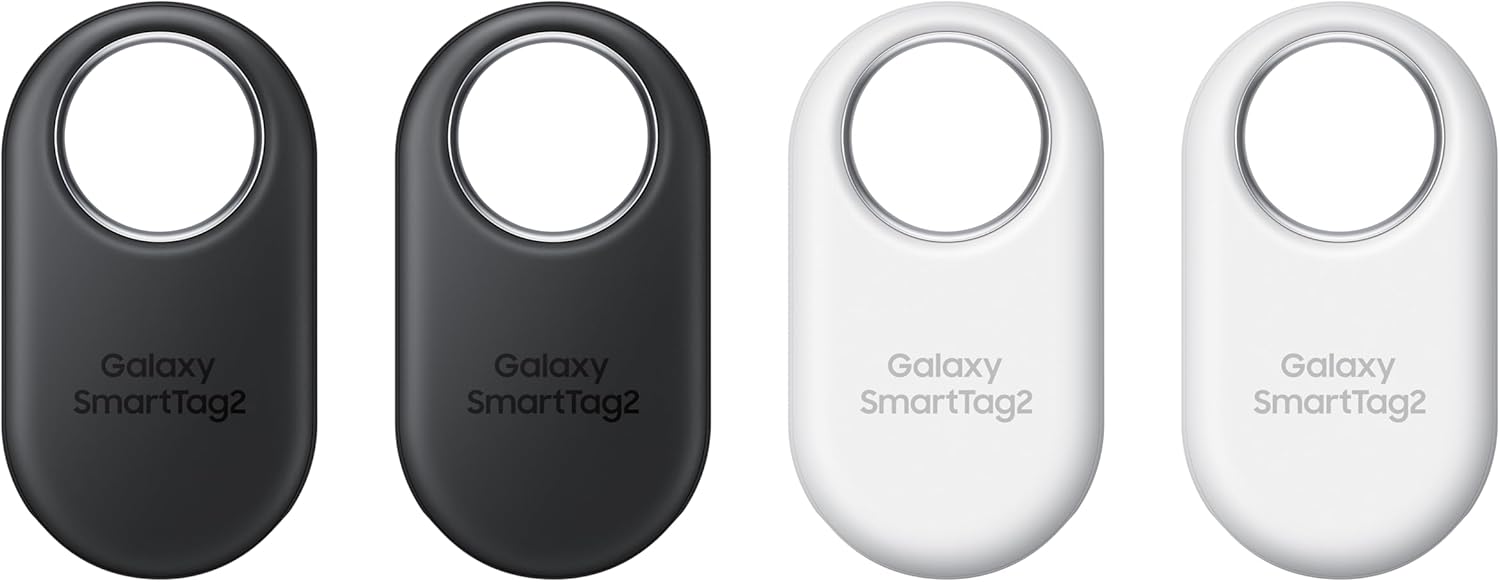
Specifically tailored for the large demographic of Samsung device users, the SmartTag2 provides optimized tracking and seamless integration within the Galaxy Find network. It offers an essential, high-quality tracking solution that maximizes efficiency and usability for those whose primary mobile device is within the Samsung ecosystem.
5. Invoxia Real Time GPS Tracker

For high-stakes transit, high-value cargo, or complex global movements where network dependency is unacceptable, the Invoxia provides dedicated real-time location. Operating independently of nearby smartphones by utilizing cellular networks, this tracker delivers true, continuous, global location data, ensuring visibility even when the bag is far outside the range of typical Bluetooth mesh networks.
