


First, we need to get real about what “sold-out” actually means in the aviation world. It usually means oversold. Airlines intentionally sell more tickets than there are seats because they know, statistically, a certain number of people—the “no-shows”—will miss their flight. It’s a calculated risk to maximize revenue. The problem is when those calculations are wrong and too many people show up. That’s when the chaos starts.
But here’s your opportunity: A “full” flight means the system is rigid, and the agent needs flexibility. The last available seats—like those exit rows or premium seats—are often intentionally blocked off until the very last minute for elite status members, passengers with special needs, or to ensure weight and balance is calculated properly. When that automatic process is done, the human agent gets a brief, intense window of power.
Look, automation handles a lot of the heavy lifting. The computer system automatically processes upgrades and clears standby lists right up until 30 minutes before a domestic flight (or 60 minutes for international).
You want to approach the gate after this automated sweep, when the agent has the authority to make manual, discretionary decisions.
Walk a Mile in Their Boarding Shoes: The Agent’s Stress Test
Before you say a single word, you have to remember one thing: Gate Agents (sometimes called Customer Service Representatives, or CSRs) are measured primarily on two things: safety compliance and on-time departure.
They’re dealing with archaic computer systems and coordinating everyone from the pilots to the cleaning crew. This creates insane stress, which, psychologically, leads to tunnel vision and cognitive rigidity. If you come at them with anger or demands, you are literally making their stress worse, and research shows that triggers them to become defensive and less helpful.
The goal of your communication, therefore, is to lower their cognitive load and help them get that plane out on time.
The 7 Strategic Communication Vectors (Your “Magic Words” Decoded)
These aren’t secret phrases you whisper. They are precise, polite questions that show you understand the operational mechanics and offer a solution, not just a problem.
1. The Upgrade Gambit: “Have revenue management released any first-class seats for miles upgrades yet?”

This is a master-level move. When you call reservations or approach the gate, a standard agent will likely tell you there are no upgrades. But the availability of unsold premium seats is often controlled by a centralized team called Revenue Management.
By dropping that term, you signal that you know the hidden mechanism. You’re asking the agent to check the higher-level status of the inventory, forcing them past the generic “no.” This tactic has worked for seasoned travelers, unlocking premium seats for miles upgrades.
2. The Exit Row Offer: “I am happy to take the exit row seat if there is one available, and I meet all the requirements.”

Airlines often hold back desirable seats, like exit rows, until the very last minute. Why? They need to assign them to elite members or ensure the passenger physically meets the safety requirements.
An agent with a complex seating chart loves it when you offer an immediate, low-friction solution. An agent confirmed that they often give these desirable seats to the first polite person who asks and confirms they can perform the duties.
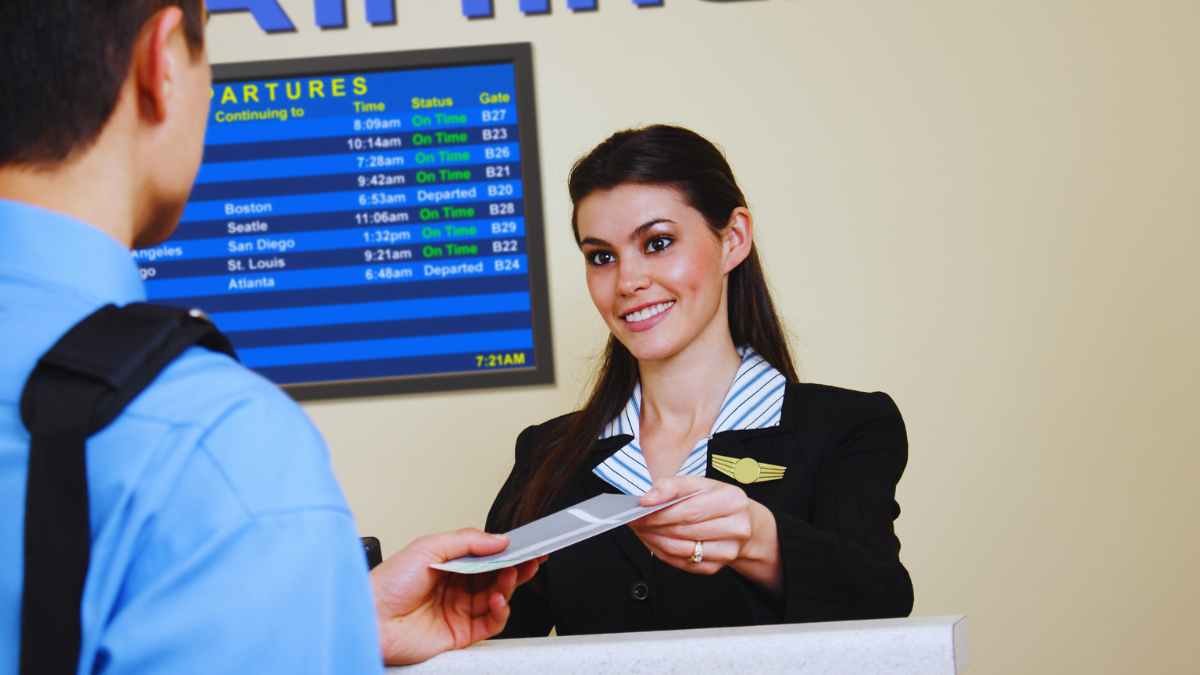
3. The Prepared Passenger: “My boarding pass and ID are ready. I’m only carrying this personal item.“

This isn’t a phrase as much as an action paired with a statement. Think about it: if every passenger on a 150-person flight wastes five seconds fumbling for their phone and ID, that’s nearly 15 minutes of delay.
Showing up organized, polite, and minimizing your carry-on hassle makes you the ideal, low-maintenance passenger. You become a small, positive data point in a very stressful environment.
4. The Crisis Strategy: “What alternative routes are available through partner airlines (or co-terminals)?”
When your flight cancels (Irregular Operations, or IROPS), the agent’s first instinct is to rebook you on their own airline.
But if their flights are full, they can often rebook you on a partner carrier (like AF, KL, or VS if you’re flying Delta) or into a nearby co-terminal (like flying into Philadelphia instead of Newark) .
Asking about these specific, authorized options shows proactive problem-solving and can unlock a confirmed seat on another network entirely.
5. The Negotiation Baseline: “I would be willing to volunteer, but I need cash compensation, $X, and a confirmed seat tomorrow.”

When a flight is truly oversold, the agent is desperately seeking volunteers to avoid involuntary denied boarding (IDB). They will start low, often with a low-value voucher. Your job is to negotiate up.
You must demand cash (which is always better than a voucher) and a confirmed seat on the next flight. Use the high end of consumer expectations—Americans, on average, expect $599, but California residents expect $832 —as your baseline.
Don’t be shy; they need you more than you need them in that moment.
6. The Collaborative Approach: “I understand this is difficult. How can I help you re-accommodate me quickly?“

This is the ultimate empathy play. You are validating the agent’s high-stress environment and immediately positioning yourself as a teammate, not an adversary.
You’re shifting the interaction from a confrontation (which guarantees resistance) to a collaboration (which elicits helpfulness).
7. The Status Check: “Can you confirm my Premier status priority on the standby list, just so I know where I stand?”

If you have airline status, don’t just assume the system registered it correctly. The standby list is purely based on objective metrics (status, fare class). This non-demanding question confirms procedural compliance and ensures you’re correctly positioned at the top of the priority queue before the automated clearance begins.
The 4 Fatal Errors: Phrases That Guarantee a “No”
Just as the right words open doors, the wrong words slam them shut. These four errors trigger the agent’s defenses and force them to rely solely on rigid policy, removing all discretionary help.
The Confrontation: Anything Perceived as Rude, Demanding, or Aggressively Confrontational
Honestly, this should be obvious, but it’s the number one cause of refusal. When an agent feels attacked, they stop trying to help. An agent once noted that “rude” often just means “I didn’t get what I wanted”. But if you’re yelling or demanding, you’re interfering with crew duties, which is grounds for refusal of transport entirely. Don’t be that person.
The Ultimatum: “You need to fix this right now! I want an upgrade, or I’ll call the DOT!“
Demanding an override consumes valuable time and requests the impossible. Gate Agents are bound by complex manuals that, for example, might prohibit rebooking passengers within two hours of departure. Threatening them with the Department of Transportation (DOT) forces them to rely exclusively on legal counsel and rigid protocol, removing any potential for human flexibility. You are essentially asking them to violate their job contract.
The Melodrama: Detailed personal emergencies (e.g., “I just have a few more things on my bucket list and a mother in law in heart failure”).
Gate Agents hear tragic stories every day. While you may be genuinely distressed, these emotional pleas are often viewed as manipulative attempts to jump the queue. The system is built on objective priority: elite status and fare class. Your personal crisis, however heartbreaking, rarely overrides the rules of who is next in line.
The Late Dash: Arriving after the gate has closed
This is administratively fatal. If boarding is complete, the agent has printed the mandatory paperwork listing all passengers, plus the critical weight and balance information used by the flight crew. Asking to board after that paperwork is filed means asking the agent to completely restart all administrative and safety tasks, which guarantees a massive delay. The operational mandate to maintain safety and schedule overrides your individual need to travel, 100% of the time.
Your Final Safety Net: Know Your Rights and Compensation Caps
What if you do everything right—you’re polite, you’re prepared—but you get involuntarily denied boarding (IDB) anyway? This is where your financial knowledge becomes your superpower.
If you are involuntarily bumped (not by choice), the US Department of Transportation (DOT) mandates specific compensation be paid in cash or check (Denied Boarding Compensation, or DBC). The amount is tied to the length of the delay in your arrival .
Key Takeaways on Your Rights:
- Cash is King: The compensation is required to be paid in cash or check, not just vouchers .
- The Caps are High: The maximum compensation is tied to the length of the delay, but the caps are substantial.
- Preventative Measure: The people at highest risk of IDB are those with Basic Economy fares or those who check in late. Avoid those if you can!
Here are the current compensation tiers for involuntary denied boarding:
| Involuntary Denied Boarding Compensation (DBC) Tiers (US DOT, Current Caps) |
| Delay in Arrival |
| 0 to 1 hour delay |
| 1 to 2 hour delay |
| Over 2 hour delay |
| 1 to 4 hour delay |
| Over 4 hour delay |
Need to Be the Low-Friction Traveler? Look at These Essentials
Okay, so communication is key, but strategy starts long before you open your mouth. You need the right tools to execute the “low-friction traveler” approach. Think of these five items as your secret handshake with the gate agent—they show you’re organized, you respect their time, and you’re ready to fly now. Get these sorted, and you eliminate the common problems that instantly trigger an agent’s “no.”
1. Travel Document Organizer/Passport Holder

Stop the fumbling! If every passenger wastes five seconds looking for their ID and phone pass, the flight gets delayed. Having your documents ready to scan immediately makes you a hero and saves valuable gate time.
2. Digital Luggage Scale

Nothing stops a quick boarding process faster than an agent needing to weigh a bag or having to call a crew member to lift a bag the passenger couldn’t. Eliminate the stress and fees by knowing your bag is compliant before you even leave for the airport.
3. Noise-Canceling Headphones

Airports are loud, chaotic pressure cookers. When you’re dealing with a delay or trying to figure out a rebooking strategy, you need to minimize stress. Tuning out the general noise keeps you calm and focused, ensuring you approach the agent with composure, not chaos.
4. Portable Phone Charger (Power Bank)

Your smartphone is your absolute lifeline during an Irregular Operation (IROPS) event. It holds your boarding pass, status updates, and is the tool you use to quickly search for alternative partner flights. Don’t let a dead battery force you to wait in a two-hour line when you could have solved the problem via the app.
5. Luggage Cup Holder Attachment

This is such a small, smart detail. We’ve all tried to juggle a coffee, a book, and a passport while trying to pull luggage. Gate Agents appreciate passengers who are hands-free and won’t cause a hold-up or spill. This keeps your personal item secure and your hands ready to present your documents instantly.
