

Look, I got it. Opening your investment app can feel a lot like peeking through your fingers at a horror movie. You see the red numbers, the doom-and-gloom headlines about “billions wiped out,” and your stomach drops. It doesn’t feel like “investing”; it feels like gambling. And if you’re anything like me, you work too hard for your money to watch it vanish because some CEO tweeted the wrong thing.
But here’s the truth that nobody on Wall Street wants to whisper too loudly: The “nervous investor” isn’t broken. Your fear is actually a survival mechanism. The problem isn’t that you’re scared; the problem is that the financial industry has convinced you that the only way to win is to be smarter, faster, and bolder than everyone else.
They’re wrong.
There is a strategy that doesn’t require you to watch CNBC, read balance sheets, or have nerves of steel. It’s called the Lazy Portfolio . And honestly? It’s arguably the smartest way to invest, precisely because it admits that we’re human.
Why Your Brain Hates the Stock Market (And That’s Okay)
First, let’s take a breath and acknowledge why this is so hard. You aren’t “bad with money” just because you panic when the market drops. You’re just biologically human.
Psychologists call it Loss Aversion . It turns out that the pain of losing $1,000 feels about twice as terrible as the joy of gaining $1,000 feels good. Our brains are wired for the savanna, where losing a day’s food meant starvation. So when your portfolio dips, your amygdala—the ancient alarm system in your brain—screams “DANGER!” and floods your body with cortisol.
This fight-or-flight response causes what we call the Behavior Gap . This is the difference between what the market returns and what actual people return.
Check this out: In 2024, the S&P 500 (the market) went up a massive 25.02% . But the average equity fund investor? They only made 16.54%.
That’s a gap of nearly 8.5%. Why? Because people panicked. They sold when things looked scary and bought when things looked safe (which usually means “expensive”). We try to outsmart the market, and we end up outsmarting ourselves. The Lazy Portfolio is designed to protect you from you .
The “Lazy” Philosophy: Why Being Average Makes You Elite

The core idea here is counter-intuitive. In almost every area of life—sports, career, cooking—if you want to be the best, you have to work harder than everyone else.
In investing, the opposite is true. The harder you try to beat the market, the more likely you are to fail.
1. The “Haystack” Principle

The legendary John Bogle, founder of Vanguard, puts it best: “Don’t look for the needle in the haystack. Just buy the haystack!”.
Trying to pick the next Apple or Amazon is looking for a needle. It’s exhausting, and the odds are terrible. “Lazy” investing means buying the entire haystack (the entire stock market). If you own the whole market, you automatically own the winners. You don’t have to guess.
2. The Math Don’t Lie

You might be thinking, “But I don’t want to be average.” Here’s the kicker: being “average” in the market actually makes you elite.
Every year, S&P Global releases a report called SPIVA. It tracks how many professional money managers—the “smart money”—actually beat the market. The results for 2024 were pretty damning: 65% of active large-cap fund managers underperformed the S&P 500. Over a 15-year period? It’s even worse. Zero categories of active managers had a majority that beat the market.
So, if you just buy a boring index fund and go take a nap, you are likely to outperform the professionals in their high-rise offices.
The Building Blocks
1. Stocks
(The Engine)
This is your growth. You aren’t betting on a ticker; you’re buying a slice of real companies. As long as people solve problems, this value tends to go up.
2. Bonds
(The Parachute)
Loans you make to governments. They pay interest to keep you sane. When stocks crash, bonds cushion the blow.
3. Asset Allocation
(The Sleep Test)
The most important decision: How much stock vs. bond?
Okay, let’s get practical. You don’t need complex derivatives or options. You just need three things. Think of this like baking bread—flour, water, yeast. Simple ingredients, great results.
1. Stocks (The Engine)

This is your growth. When you buy a stock fund, you aren’t betting on a ticker symbol; you are buying a tiny slice of ownership in real companies. You are betting on human ingenuity. As long as people are solving problems and making things, this value tends to go up over time.
2. Bonds (The Parachute)

Bonds are loans you make to governments or companies. They pay your interest. They aren’t there to make you rich fast; they are there to keep you sane. When stocks crash, high-quality bonds often hold their value or even go up, cushioning the blow.
3. Asset Allocation (The Sleep Test)

This is the most important decision you will make. How much stock vs. how much bond?
- The “I Want to Sleep Like a Baby” Mix: 40% Stocks / 60% Bonds. You won’t get rich quickly, but you won’t panic.
- The “Balanced” Mix: 60% Stocks / 40% Bonds. The classic pension approach.
- The “Iron Stomach” Mix: 80% Stocks / 20% Bonds. High growth, but prepare for a wild ride.
Rule of Thumb: JP Morgan once told a friend who was worried about the market to “sell down to the sleeping point”. If you’re checking your phone at 2 AM, you have too much in stocks.
The Strategy: The “Bogleheads” Three-Fund Portfolio

This is the gold standard of lazy investing. It’s simple, cheap, and effective. You buy three funds that cover the whole world.
- Total US Stock Market: Owns almost every public company in America.
- Total International Stock Market: Owns the rest of the world (Europe, Asia, Emerging Markets).
- Total Bond Market: Owns the safety net.
That’s it. You own over 10,000 companies globally. If the US economy slows down, your International stocks might pick up the slack. If stocks tank, bonds stabilize you.
“Okay, but what do I actually type into the search bar?”
I hate when guides are vague, so here are the actual ticker symbols for the big three brokerages. You can’t go wrong with any of these.
| Asset Class | Vanguard (ETF / Mutual Fund) | Fidelity (Mutual Fund / ZERO Fund) | Schwab (ETF / Mutual Fund) |
| Total US Stock | VTI / VTSAX | FSKAX / FZROX | SCHB / SWTSX |
| Total International Stock | VXUS / VTIAX | FTIHX / FZILX | SCHF / SWISX |
| Total Bond | BND / VBTLX | FXNAX | SCHZ / SWAGX |
Quick Tip: Fidelity’s “ZERO” funds (FZROX) literally have zero fees. It’s hard to beat free.
“But What If…” (Answering Your 3 AM Worries)

This is where the rubber meets the road. It’s easy to be a lazy investor when the sun is shining. It’s hard when it’s storming.
“What if the market goes to zero?”

I heard this a lot. “What if it all crashes to nothing?” Think about what that actually means. If the S&P 500 goes to zero, it means Apple, Microsoft, Walmart, and Google are all worth $0. It means the entire global economy has collapsed. If that happens, money won’t matter. We’ll be trading canned beans and ammo. As long as civilization exists, the broad market will have value.
“What if I buy at the top?”

This is the fear of Timing . “The market is at an all-time high, should I wait?” Here’s a secret: The market is usually at or near an all-time high. That’s what growing things do. Fidelity did a study on their best-performing accounts. The winners? People who had died or forgotten they had accounts. They didn’t touch it. They didn’t try to time it. If you’re nervous, use Dollar Cost Averaging . Don’t dump your life savings in today. Put in $500 a month. If the market drops next month, great! Your $500 buys more shares. You’re getting a discount.
“What if I lose everything like in 2008?”

You only lose if you sell. Imagine you bought a house for $300,000. Next year, the market dips and Zillow says it’s worth $250,000. Do you panic, run out into the yard, and put up a “For Sale” sign for $250,000 just to “stop the loss”? No! You live in the house. You wait for the price to recover. Stocks are the same. Volatility is the price of admission . It’s the fee you pay for high returns. If you don’t sell, the loss is just lines on a screen.
Advanced Laziness
Variations on a Theme 🍳The “Coffeehouse”
The Strategy: Slice the stock market into smaller chunks (Value, Small, REITs).
- 60% Stocks: Sliced into 10% chunks
- 40% Bonds: The safety net
The “Core-4”
Why? Real estate is a good inflation hedge and moves differently than stocks.
- 48% US Stocks
- 24% International
- 20% Bonds
- 8% REITs (Ticker: VNQ)
If the 3-Fund portfolio feels too vanilla, here are two other popular “lazy” recipes.
The “Coffeehouse” Portfolio

Created by Bill Schultheis, this is for the person who wants to feel a bit more diverse. It slices the market into smaller chunks (Value stocks, Small stocks, REITs) to try and catch different waves of growth.
- The Vibe: “I want to be safer than pure stocks, but I want to capture dividends and real estate.”
- The Mix: It’s strictly 60% Stocks / 40% Bonds, but the stock part is sliced into 10% chunks (Large Cap, Small Cap, International, REITs, etc.).
The “Core-4” Portfolio

Rick Ferri suggests one more ingredient to the 3-Fund mix: Real Estate (REITs) .
- Why? Real estate often moves differently than stocks. It’s a good inflation hedge.
- The Mix: 48% US Stocks, 24% International, 20% Bonds, 8% REITs (Ticker: VNQ).
1. The Psychology of Money by Morgan Housel:

If you only read one finance book in your life, make it this one. It’s not about charts or math; it’s about how your brain works. Housel explains why smart people do stupid things with money and how to behave your way to wealth. It’s the ultimate anxiety antidote.
2. The Simple Path to Wealth by JL Collins:

Written originally as letters to his daughter, this book is the “Lazy Portfolio” bible. It strips away all the Wall Street jargon and complexity, giving you a roadmap so simple you can read it in an afternoon and use it forever.
3. The Little Book of Common Sense Investing by John C. Bogle:
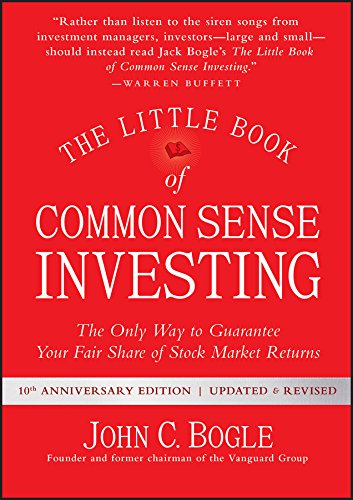
Want to hear it from the horse’s mouth? Jack Bogle, the founder of Vanguard and the inventor of the index fund, explains exactly why “don’t look for the needle, buy the haystack” is the only strategy that matters. It’s short, punchy, and irrefutable.
4. Clever Fox Budget Planner:

Sometimes anxiety comes from a lack of organization. This physical planner helps you track your savings rate and net worth manually. There is something psychologically soothing about writing down your progress with a pen rather than obsessively refreshing an app.
5. Fireproof Document Bag with Lock:

Peace of mind isn’t just about market returns; it’s about knowing your assets are secure. Use this to store your wills, trust documents, and—most importantly—the password to your brokerage account. Lock it up and put it away. If you can’t easily get to your password, you can’t panic-sell!
