

You know the feeling. I know you do.
It’s 2:55 PM. You’ve had a decent morning, you crushed a few emails, maybe sat through a meeting without zoning out. But then, almost like someone flipped a switch behind your eyes, the fog rolls in. Your eyelids feel like they’re made of lead. The spreadsheet in front of you might as well be written in hieroglyphics. You find yourself reading the same sentence three times, or worse, staring blankly at your screen while your brain quietly shuts down.
We call this the “3PM Energy Funeral.” And usually, this is the moment the guilt kicks in. You think, “I must be getting old,” or “I shouldn’t have eaten that sandwich,” or simply, “Why am I so lazy?”
Here’s the thing I need you to understand before we go any further: It is not your fault.
This isn’t a failure of willpower. It’s not because you hit 40 (or 30, or 60). It is a biological collision that has been happening inside human bodies for thousands of years. The only difference is that our ancestors took a nap, and we try to power through with another lukewarm coffee.
Let’s look at what is actually happening under the hood.
The “Perfect Storm” in Your Brain

If we want to fix this, we have to stop treating energy like a simple gas tank that we just need to refill. It’s more complicated than that. Your alertness is actually a tug-of-war between two massive physiological forces. Scientists call this the Two-Process Model, and understanding it changes everything.
The Sleep Pressure (Process S)

Imagine that from the second you opened your eyes this morning, you started carrying a backpack. Every hour you stay awake, you add a rock to that pack.
Biologically, those “rocks” are a chemical called adenosine. As your neurons fire and your brain burns energy (ATP), adenosine builds up as a byproduct. It floats around your brain, looking for receptors to latch onto. When it finds them, it slows down neural activity. It’s basically your brain’s way of saying, Hey, we’ve been running for a while. We need to stop.
By 3:00 PM, if you woke up at 7:00 AM, you’ve been hauling that backpack for eight hours. The pressure to sleep is high.
The Alerting Signal (Process C)
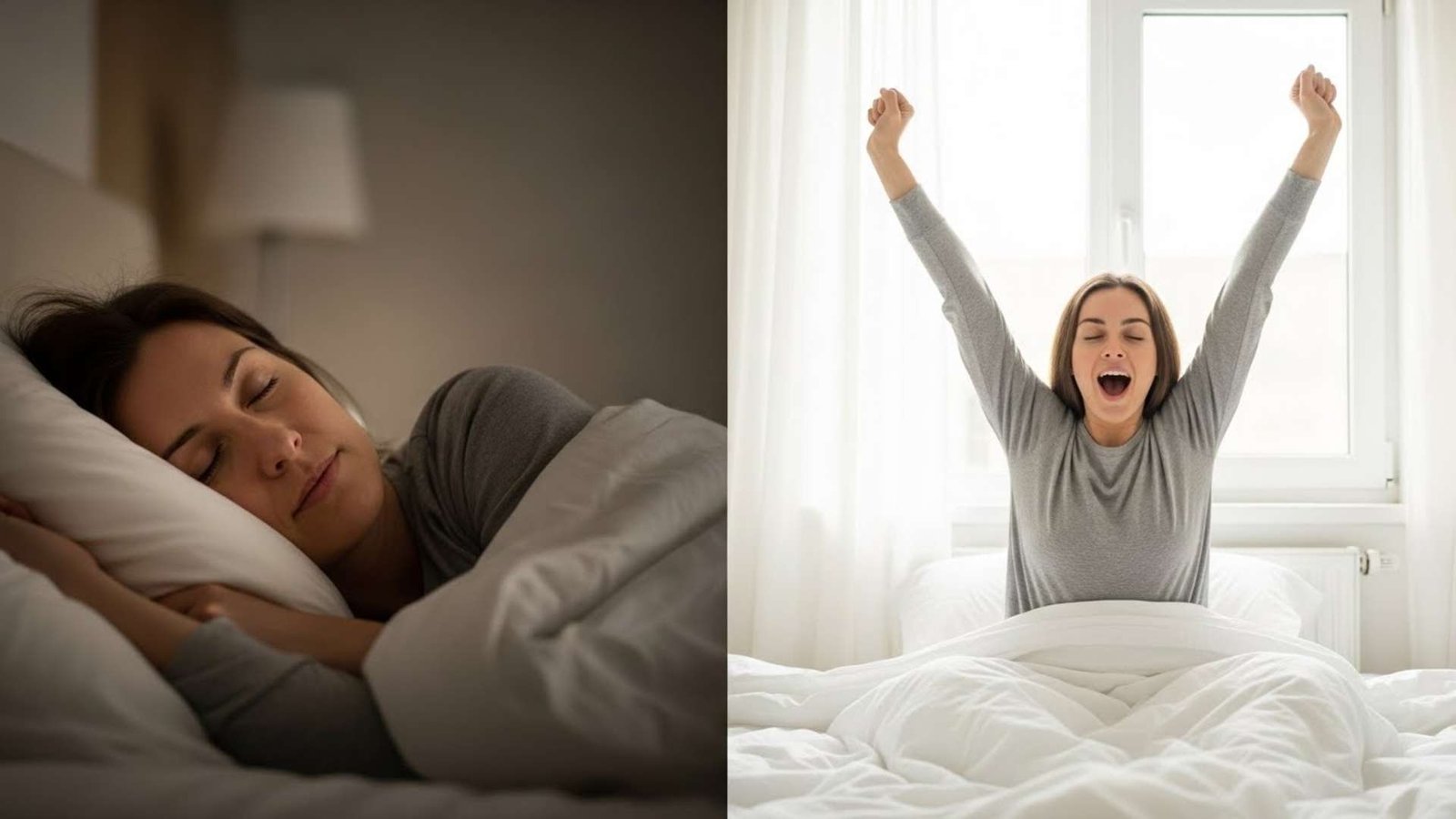
Now, normally, you have a counter-force. This is your Circadian Rhythm (Process C). Think of this like a cheerleader in your brain (specifically in the Suprachiasmatic Nucleus, if we’re being precise).
This cheerleader’s job is to scream “Stay awake!” loud enough to drown out the adenosine. It pumps out cortisol and adrenaline to keep you sharp. Usually, as the sleep pressure gets heavier throughout the day, the cheerleader yells louder to compensate.
The Collision
But here is the cosmic joke: Right around early afternoon (typically 1:00 PM to 4:00 PM), that cheerleader takes a break. Your circadian alerting signal naturally dips or plateaus.
So, you have High Sleep Pressure (heavy backpack) colliding with Low Circadian Drive (quiet cheerleader).
That gap you see in the chart? That is the “funeral.” Your brain is physically biased toward sleep during this window. In pre-industrial times, this was a feature, not a bug—it was the perfect time for the tribe to rest. Today, it’s just a 3PM meeting you’re struggling to survive.
“But I’m Not Old…” (The Age Myth)

I hear this all the time: “I never used to get this tired when I was 20.”
Well, yes and no. The mechanism I just described—that collision of Process S and Process C—happens to everyone. It happens to toddlers (why do you think they have nap time?), it happens to teenagers, and it happens to the elderly.
What changes isn’t the existence of the slump, but the timing of it.
- Teens: Their clocks are shifted late. Their “afternoon” slump might not hit until 5:00 PM because their circadian rhythm is delayed by puberty.
- Adults (You and Me): We are usually squarely in that 1:00 PM – 4:00 PM danger zone.
- Older Adults (60+): The clock shifts earlier. The slump might hit at noon or 1:00 PM, and because the circadian signal flattens out a bit with age, the sleep might feel more fragmented rather than one big crash.
So, don’t blame your age. You’re just human.
The Food Coma
Is Real
1. The Sugar Spike
You eat a High-GI lunch (white bread, pasta). Blood sugar rockets. You feel great… for 20 mins.
2. The Panic
Your pancreas freaks out. It dumps a massive load of insulin to clear the sugar flood.
3. The Crash
Insulin works too well. Reactive Hypoglycemia hits right when your circadian rhythm dips.
Swap pasta for Low-GI (Salad + Chicken). No spike = No crash. 🥗
Okay, biology loads the gun, but what you eat for lunch pulls the trigger.
We’ve all heard the myth that turkey makes you sleepy because of tryptophan. That’s mostly nonsense. The real villain in your 3PM tragedy is the Glycemic Index of your lunch.
Here is the scenario: You’re busy, so you grab a sandwich on white bread, maybe a side of chips, or a pasta dish. That’s a “High-GI” meal.
- The Spike: Your blood sugar rockets up. You feel great for about 20 minutes.
- The Panic: Your pancreas sees this sugar flood and panics. It dumps a massive load of insulin into your blood to clear it out.
- The Crash: The insulin works too well. It clears the sugar so fast that your blood glucose plummets below where it started. This is called reactive hypoglycemia.
Now, look at the timing. This sugar crash usually happens 90 to 120 minutes after you eat. If you eat at 12:30 PM, the crash hits right at… 2:30 PM.
You are effectively timing a metabolic crash to happen at the exact same moment your circadian rhythm is dipping. It’s a double whammy.
The Fix: You don’t have to starve. But if you swap that pasta for a salad with chicken or fish (Low-GI), the glucose release is steady. You don’t get the spike, so you don’t get the crash.
Your Office Is Sabotaging You

It’s not just inside your body; it’s the room you’re sitting in.
The “Biological Darkness”

Our eyes are designed to see sunlight, which ranges from 10,000 to 100,000 lux (a measure of light intensity). Most offices? They hover around 300 to 500 lux.
To your brain, 300 lux isn’t “daytime.” It’s what chronobiologists call “biological darkness.” It’s dim enough that your brain isn’t getting a strong “be alert” signal, but bright enough to be annoying. By sitting in dim light all day, you are starving your brain of the photon energy it needs to suppress melatonin.
The Water Problem

We also underestimate water. We drink coffee all morning (which is a diuretic), and then forget to drink water until lunch. By 3PM, you might be just 1% to 2% dehydrated.
That sounds like nothing, right? But research shows that at just 1% dehydration, cognitive function drops, anxiety increases, and—you guessed it—fatigue sets in. Your brain shrinks slightly (literally) and has to work harder to perform the same tasks.
We Used to Sleep Through This
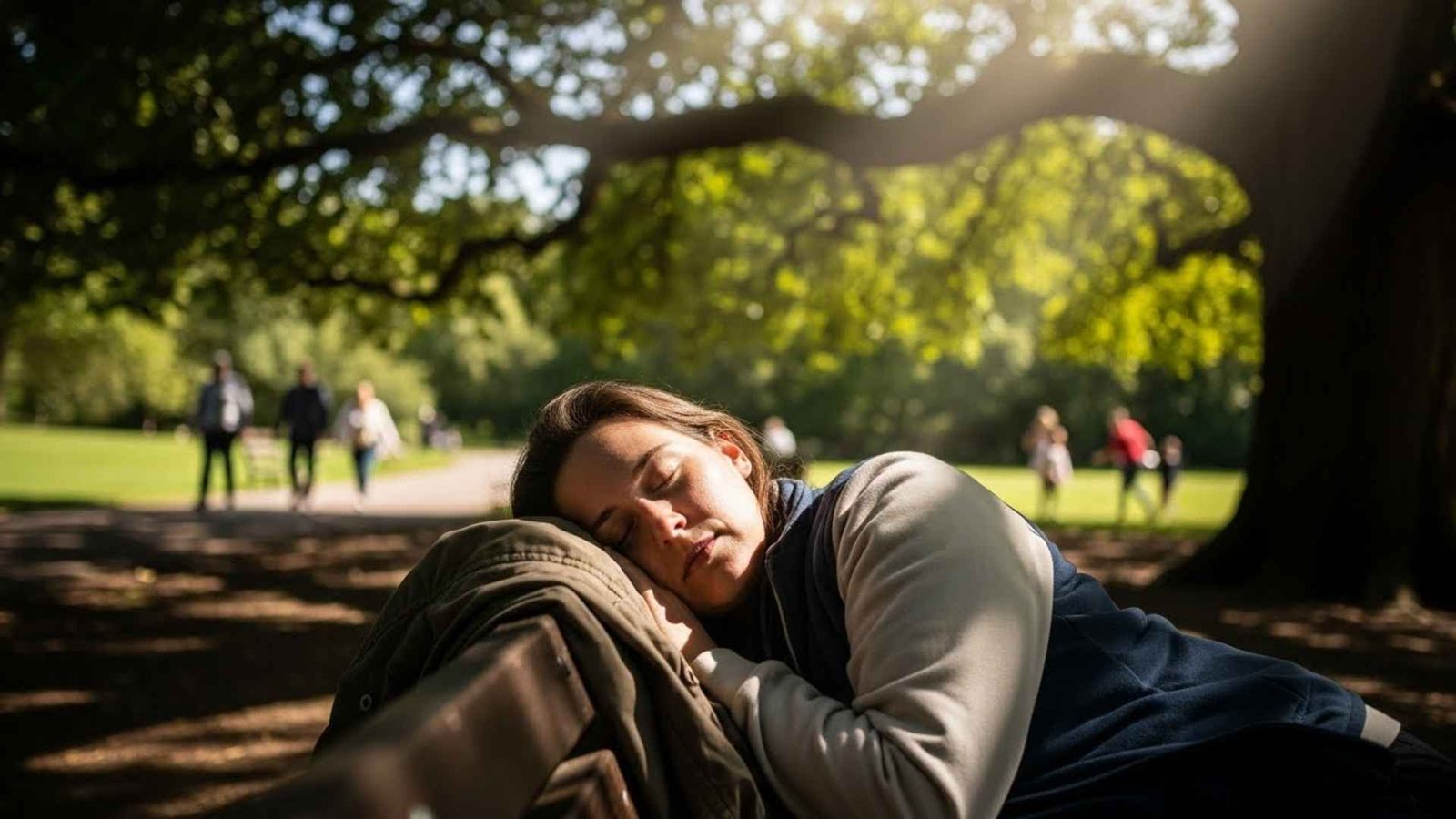
Here is a bit of history that makes me feel better about my afternoon naps. We weren’t designed to work for 8 to 10 hours straight.
Before the Industrial Revolution, sleep was much more fluid. In many parts of the world, the siesta wasn’t just a cultural quirk; it was an adaptation to biology. People worked, stopped when the sun was high (coinciding with that circadian dip), rested, and then worked again in the cool of the evening.
We killed the siesta because factories needed continuous shifts. We traded our biological rhythm for the rhythm of the assembly line. So when you feel that slump, you aren’t “lazy”—you’re just a Paleolithic human stuck in a 21st-century office.
Pushing Through
The Golden Hour
9:00 AM – 11:00 AM
Peak performance window. Use this time for big ideas and critical work.
The Dead Zone
3:00 PM – 5:00 PM
The least productive time. Scheduling brainstorms here burns money.
Decision Fatigue
Pushing too hard leads to burnout, “quiet quitting,” and eating donuts you didn’t even want.
We are obsessed with productivity, but we’re doing it wrong. The data is laughable.
Surveys from 2023 and 2024 consistently show that the 3:00 PM to 5:00 PM window is the least productive time of day for almost everyone. Conversely, 9:00 AM to 11:00 AM is the golden hour.
Yet, we schedule brainstorms at 3:00 PM. We try to write critical reports at 4:00 PM. We are burning money and mental energy fighting a battle we can’t win. It leads to burnout, “quiet quitting,” and decision fatigue. By the afternoon, your “decision fuel” is empty, which is why you’re more likely to snap at a colleague or eat a donut you didn’t even want.
How to Cheat the System (The Toolkit)
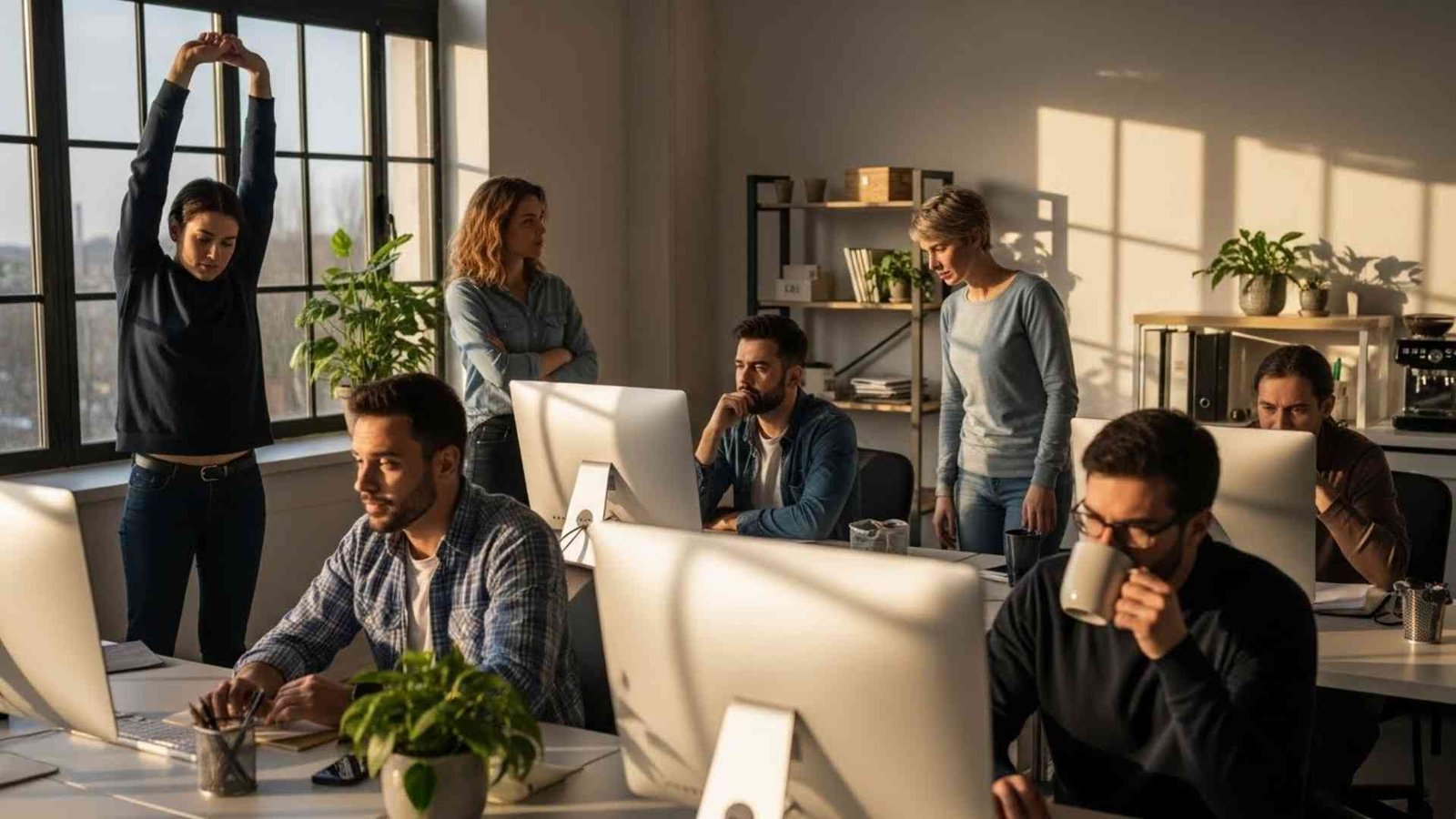
Okay, we know the science. We know the history. How do we actually survive the afternoon without quitting our jobs?
Here are the protocols I use, based on work from experts like Dr. Matthew Walker and Dr. Andrew Huberman.
1. The Caffeine Sniper Strategy

Most of us drink coffee wrong.
- The Mistake: Drinking it at 7:00 AM when you wake up. Your cortisol is naturally high then; you don’t need it.
- The Fix: Wait 90 minutes after waking up to have your first cup. This lets your body clear out the morning drowsiness naturally.
- The Hard Rule: Stop by 2:00 PM. Caffeine has a half-life of ~6 hours. If you drink it at 4:00 PM, half of it is still spinning in your brain at 10:00 PM, ruining your deep sleep and guaranteeing you’ll be tired tomorrow.
2. The “Nappuccino” (If you can nap)

This is for the brave souls working from home.
- Drink a cup of coffee quickly.
- Immediately set a timer for 20 minutes and close your eyes.
- Why? It takes 20 minutes for caffeine to kick in. You get a 20-minute restorative nap, and you wake up exactly as the caffeine hits your bloodstream. It’s a double boost.
3. Non-Sleep Deep Rest (NSDR)
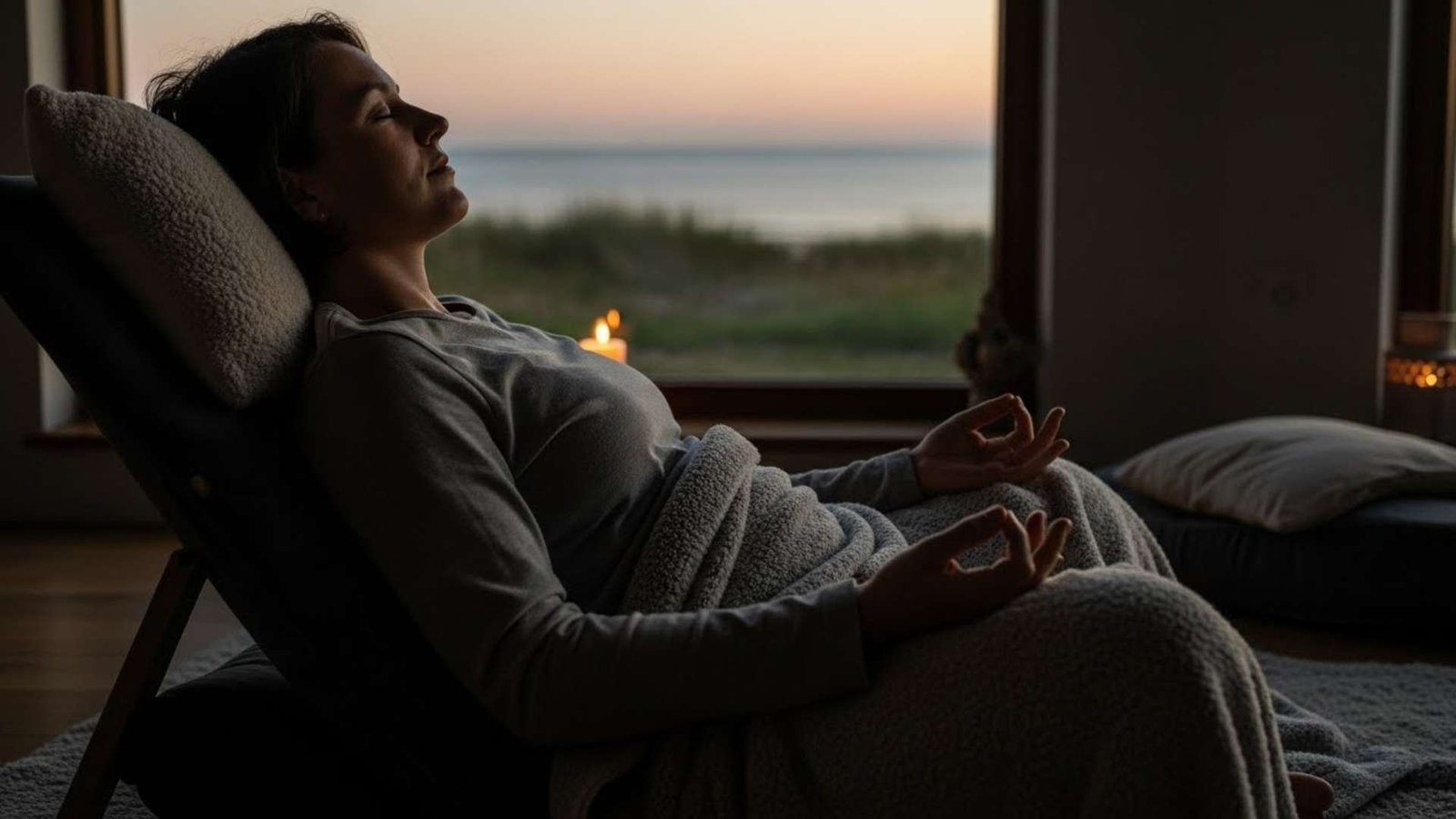
Can’t nap? Do this instead. It’s a guided relaxation technique (you can find scripts on YouTube/apps) that puts your brain in a “hover” state between awake and asleep. Just 10 minutes can reset your dopamine levels and clear mental fog without the grogginess of a nap.
4. Movement > Sugar

When you want a candy bar, what you really need is oxygen. A study from the University of Georgia found that 10 minutes of walking up and down stairs gave more energy than 50mg of caffeine. It forces oxygen into the brain and clears out the metabolic “trash.”
Use Some Useful Product That Can Optimize Your Biological Workflow
Implementing a bio-optimized workspace doesn’t require a complete renovation of your office; it often starts with selecting the right tools that interface directly with your biology. Whether you are battling the afternoon slump, trying to improve your sleep efficiency, or simply looking to stay active while tethered to a desk, the following curated list represents the “best-in-class” options identified in our research. These products have been selected not just for their popularity, but for their adherence to the physiological principles discussed in this report—prioritizing function, ingredient quality, and ergonomic integrity. Integrating even one or two of these into your daily routine can yield measurable improvements in energy and focus.
1. Verilux HappyLight Luxe

This is the gold standard for circadian regulation. Its large 53 sq. inch lens size minimizes glare while delivering the clinically required 10,000 lux intensity. The adjustable color temperature allows you to shift from a “wake up” blue-enriched mode in the morning to a softer “focus” mode in the afternoon, preventing over-stimulation.
2. LMNT Electrolyte Drink Mix

A potent tool for cognitive clarity. By removing sugar and increasing sodium (1000mg), magnesium, and potassium, LMNT supports the electrical firing of nerve cells without the insulin crash associated with traditional sports drinks. It is the ideal hydration strategy for those practicing fasting or low-carb protocols.
3. Manta Sleep Mask (Sound or Pro)

Sleep is the foundation of performance. The Manta mask’s modular eye cups offer true 100% blackout without putting pressure on your eyelids, preserving REM sleep patterns. The “Sound” version adds integrated audio for masking disruptive environmental noise, effectively creating a portable sensory deprivation tank.
4. Chomps Grass-Fed Beef Sticks

The ultimate desk snack for sustained energy. With zero sugar and high-quality protein from 100% grass-fed and finished beef, Chomps provide satiety and stabilize blood sugar levels. This prevents the “hangry” distraction and keeps you focused until your next proper meal without the guilt of processed junk food.
5. FluidStance Balance Board

Sitting is the new smoking, but static standing is hard on the joints. Fluid Stance boards introduce subtle, non-distracting micro-movements that keep your metabolism active and joints lubricated while you work. It offers the most premium, fluid experience in the balance board market, designed to look as good as it feels.
