
We often read to confirm what we already believe, nodding along when an author articulates thoughts we’ve secretly held for years. But the real magic happens when a book stops you cold, dismantles your worldview, and rebuilds it from the ground up.
After reading thousands of books, most blur into a vague memory of “good” or “bad,” but a select few remain vivid, continuing to shape how I interpret reality years later. Here are five of those heavy hitters that didn’t just inform me—they rewired me.
1. Poor Charlie’s Almanack by Charles T. Munger

This isn’t just an investment book; it is a masterclass in rationality that exposes how flawed our standard thinking really is. Charlie Munger, Warren Buffett’s longtime business partner, champions the concept of “mental models”—a framework where you borrow big ideas from multiple disciplines like physics, biology, and psychology to solve problems, rather than relying on a single, narrow perspective. Munger argues that most people are like a man with a hammer, to whom every problem looks like a nail. He introduces the “Lollapalooza Effect,” which explains how several psychological biases acting together can lead to massive, often irrational, behavioral outcomes. Reading this forces you to adopt a “multidisciplinary” approach to life, realizing that wisdom isn’t found in siloing knowledge, but in seeing how the systems of the world interlock.
If you want to stop fooling yourself—and Munger reminds us that “you are the easiest person to fool”—this book is your toolkit. It shifts your focus from trying to be brilliant to simply trying to be consistently not stupid, which, surprisingly, is a much harder and more profitable game to play.
2. The Case Against Reality by Donald Hoffman

Donald Hoffman drops a cognitive bomb that is nearly impossible to recover from: the world you see is not the real world. Through his “Fitness-Beats-Truth” theorem, Hoffman uses evolutionary game theory to prove that evolution does not favor those who see reality as it is; it favors those who see what they need to survive. He compares our perception to a computer desktop interface. When you look at a blue file icon on your screen, you aren’t seeing the “reality” of diodes, resistors, and software code; you are seeing a simplified symbol designed to help you use the machine without deleting your operating system by accident. In the same way, space and time are just a headset our species wears to navigate a complex universe without getting eaten.
It’s a terrifying yet liberating realization that our senses are an interface, not a window. Once you grasp this, you stop assuming your perceptions are objective truths and start treating them as useful, but limited, data points tailored strictly for your survival.
3. Slaughterhouse-Five by Kurt Vonnegut

On the surface, this is a war novel about the firebombing of Dresden, but dig a little deeper and you find a profound philosophical treatise on the illusion of time and free will. Billy Pilgrim, the protagonist, becomes “unstuck in time,” experiencing moments of his life in a nonlinear order. Through the alien Tralfamadorians, Vonnegut suggests that all moments—past, present, and future—exist simultaneously, like a mountain range viewed from a distance. They don’t mourn the dead because the person is just “doing badly” in that particular moment, while doing fine in plenty of others. This perspective strips away the agonizing “why me?” questions we ask during tragedies, replacing them with the stoic, albeit fatalistic, mantra: “So it goes.”
It changes your relationship with grief and control. You realize that fighting against the structure of time is futile, and there is a strange peace in accepting that we are all just “bugs in amber,” trapped in the moments we are living, yet eternal in the timeline of our existence.
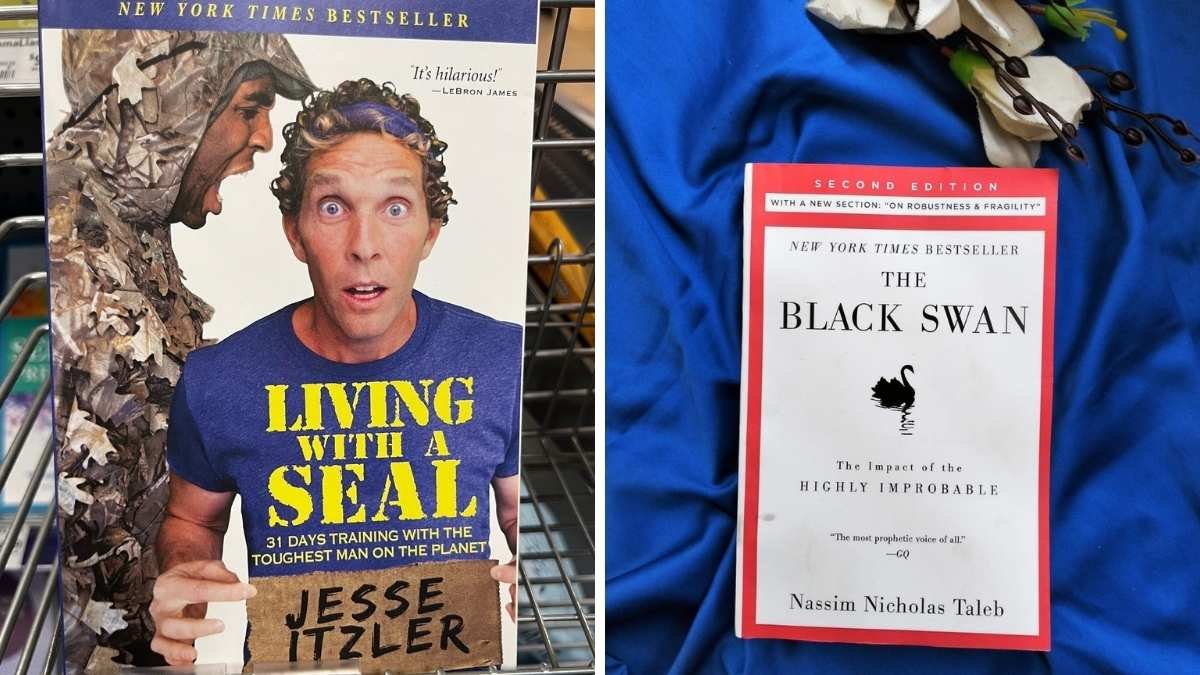
4. Living with a SEAL by Jesse Itzler

Most of us think we know our limits, but Jesse Itzler’s month-long experiment with Navy SEAL David Goggins proves we barely scratch the surface. Itzler invited Goggins to live in his house and train him, leading to the discovery of the “40% Rule.” The rule states that when your mind tells you you’re done, you’re only 40% done. It’s a brutal lesson in how our brains are designed to protect us from discomfort, governing us with a “governor” that kicks in way before our physical tank is empty. The book is hilarious, but the undertone is deadly serious: comfort is a slow death. By doing things that suck every single day, you callus your mind just like you callus your hands.
The takeaway is instant and practical: the barrier between you and your potential isn’t physical ability, it’s your mental tolerance for suffering. After reading this, your internal monologue changes; the voice saying “I can’t” starts sounding a lot less like a fact and more like a suggestion you can ignore.
5. Civilized to Death by Christopher Ryan

We are raised on the “narrative of perpetual progress”—the idea that history is a steady march from dark, brutal barbarism to a bright, technological utopia. Christopher Ryan dismantles this entirely, arguing that civilization is not an upgrade, but a trade-off. He presents compelling evidence that our hunter-gatherer ancestors were not only healthier and stronger but arguably happier and more socially connected than the average modern human. The book highlights how the “pathologies of civilization”—chronic stress, isolation, and metabolic diseases—are the result of living in a zoo of our own making, disconnected from the environment our bodies evolved to inhabit.
It doesn’t make you want to run off and live in a cave, but it makes you look at your iPhone and office chair with deep suspicion. You start to see that what we call “success” often comes at the price of our biology, forcing you to be much more intentional about how you live within the modern world.
6. The Black Swan by Nassim Nicholas Taleb

If you think you can predict the future based on the past, Nassim Taleb is here to tell you that you are driving a car while looking only in the rearview mirror. Taleb introduces the concept of “Black Swans”—rare, unpredictable events that carry massive, history-changing consequences (like the internet, 9/11, or a financial crash). Humans are biologically wired to learn from what is “normal” and “average,” but Taleb argues that the most important parts of our lives are governed by the extreme and the unknown. He mercilessly attacks our reliance on “bell curves” and experts who claim to forecast the future, showing that we build fragile systems because we convince ourselves that the world is safer and more predictable than it actually is.
Reading this shifts your worldview from trying to predict what will happen to simply positioning yourself so you can survive—and even benefit—when chaos inevitably strikes. You stop trusting the narrative of “steady progress” and start respecting the power of the highly improbable, realizing that what you don’t know is far more dangerous than what you do.
7. Sapiens: A Brief History of Humankind by Yuval Noah Harari

Yuval Noah Harari poses a question that seems simple but unravels everything: How did a physically weak ape come to dominate the planet? His answer isn’t tools or intelligence, but our unique ability to believe in things that don’t exist. Harari explains that money, corporations, nations, and human rights are all “shared fictions”—they have no physical reality outside of our collective imagination. A dollar bill is just paper; it only has value because we all agree to pretend it does. This book makes you realize that the “solid” structures governing your life are actually fragile myths sustained only by mass cooperation.
It’s a dizzying perspective shift that makes you look at a courtroom, a bank, or a border map and see them for what they truly are: stories we tell one another. Once you see the matrix of these imagined orders, you can never quite take the rules of society as seriously as you did before.
