


We need to talk about the guy on the treadmill.
You know the one. Maybe you are the one. He’s there every Tuesday and Thursday, running the same five-mile loop at the same 6.0 mph pace he’s held since 2015. He’s sweating. He’s trying. He’s consistent as hell. But if you really look at him—and I mean really look—he hasn’t changed in a decade. His waistline is creeping out, his knees are taped up, and he looks exhausted, not energized.
It’s the quiet tragedy of the fitness world: You can work incredibly hard and get absolutely nowhere.
We’re taught that consistency is the key to everything. Just show up, right? But nobody tells you the dark side of consistency: If you do the same thing forever, you stop moving forward. In fact, you start sliding backward.
The routine that made you lean at 25 can actually break you at 45. The HIIT class that shredded you for your wedding might be the reason you’re dealing with chronic insomnia and belly fat today. This is the “Zombie Routine”—it’s dead, but it keeps walking, eating away at your joints and your recovery reserves.
The numbers back this up, and they aren’t pretty. About 50% of people who join a gym quit within six months . They don’t quit because they’re lazy; they quit because they’re bored and broken. Even worse, sports injuries jumped 17% in 2024 alone . We are working harder than ever, yet we are breaking faster.
So, let’s stop guessing. Let’s look under the hood at your biology, figure out why your “old reliable” workout turned on you, and build something that actually works for the body you have today.
Why Your Body Stopped Caring
Survival Mode
Here’s the harsh truth: Your body doesn’t care about your six-pack. It cares about Survival. It is an adaptation machine designed to save energy, not look good in a mirror.
The Shock Factor
When you first started, your body freaked out. Heart racing, muscles tearing. It said: “This is stressful. I need to adapt so next time it won’t be so hard.”
The Efficiency Paradox
But here is the catch: Your body is too good at adapting. That 5-mile run isn’t a workout anymore; it’s just a commute. You burn 20-30% fewer calories because you became efficient.
Here’s the thing about your body: It doesn’t care about your six-pack. It doesn’t care about your PRs. It cares about one thing: Survival.
Your body is an adaptation machine designed to save energy. When you first started working out, everything was a shock. You ran a mile, and your body freaked out. It burned a ton of calories, your heart raced, and your muscles tore. In response, your body said, “Okay, that was stressful. I need to build bigger muscles and more mitochondria so that if we do this again, it won’t be so hard.”
That’s called adaptation. It’s the magic we’re chasing.
But here’s the catch: Your body is too good at it. If you keep running that same mile, your body eventually masters it. It learns to fire fewer muscle fibers. It becomes hyper-efficient at cooling you down. You stop burning as much fat. You stop building muscle. You’re just sweating.
This cycle is governed by a law called General Adaptation Syndrome (GAS). It’s not just a theory; it’s how all biology works. Take a look at this chart—it explains exactly where most of us go wrong.
The Trap: See that red dotted line? That’s where many of us live. We keep hammering the “Alarm” phase (the stress of the workout) without giving ourselves enough time in the “Resistance” phase (where the growth happens). If you hammer a nail that’s already flush with the wood, you’re just damaging the wood.
The “Efficiency Paradox”
I hear this all the time: “I’m doing the same workout, eating the same food, but I’m gaining weight.”
It feels like you’re defying the laws of physics, but you’re not. You’ve just become efficient. A conditioned runner might burn 20-30% fewer calories running a 10-minute mile than a beginner does. Your “old routine” is literally worth less today than it was a year ago. To your body, that 5-mile run isn’t a workout anymore; it’s just a commute.
The “Danger Gap” (Or, Why You Keep Getting Hurt)

There is a specific window of time where you are most likely to snap something. It happens right when you start feeling “fit.”
I call it the Danger Gap.
Let’s say you decide to get off the couch and train for a marathon. Your cardiovascular system (heart and lungs) adapts super fast. Within a few weeks, you aren’t wheezing anymore. You feel like you can run forever.
But your structural system—your tendons, ligaments, and bones—is slow. Painfully slow. It takes months for collagen to remodel and strengthen. So, you have a Ferrari engine inside a beat-up Honda Civic chassis. You have the energy to push hard, but your frame can’t handle the force yet.
This is why “RunTok” challenges and things like “75 Hard” often end in orthopedic clinics. You feel great… right up until your stress fracture shows up.
The Takeaway: If you’re jumping back into a routine after a break, or ramping up intensity, you have to respect the red line in that chart. Your lungs are lying to you. Your tendons are the real speed limit.
The “Used to Work” Archetypes

Do you recognize yourself in any of these? Be honest.
1. The “Cardio Bunny”

The Vibe: You live on the elliptical or treadmill. You’re terrified that lifting weights will make you “bulky,” so you just try to sweat as much as possible to “burn off” lunch. Why It’s Backfiring: Chronic, medium-intensity cardio spikes cortisol (stress hormone). If you don’t lift weights to signal your body to keep muscle, your body will actually burn muscle for fuel because muscle is “expensive” to keep around. You end up “skinny fat”—smaller, but with a slower metabolism and higher body fat percentage.
2. The “HIIT” Addict

The Vibe: If you aren’t on the floor gasping for air, it wasn’t a workout. You go to Orangetheory or F45 six days a week. Why It’s Backfiring: You’re frying your central nervous system. You can’t go “high intensity” every day. Eventually, you end up in the “Grey Zone”—you’re too tired to go truly hard, but you’re working too hard to recover. You’re just tired and inflamed.
3. The “Bro Split” Lifer

The Vibe: Monday is Chest. Tuesday is Back. Wednesday is Legs (maybe). You annihilate one muscle group once a week. Why It’s Backfiring: This works great if you’re 21 and full of testosterone (or on steroids). For a natural, aging lifter, muscle protein synthesis only lasts about 24-48 hours. If you hit chest on Monday and wait until next Monday to hit it again, you missed two other growth windows that week. You’re doing “junk volume”—doing more reps just to feel the burn, without actually stimulating growth.
The Hard Truth
You cannot train at 45 the way you trained at 25.
Young = Look good naked.
Old = Don’t Die.
The Villain: Sarcopenia
The biggest threat isn’t fat; it’s being frail. Sarcopenia is the thief in the night—the involuntary loss of muscle that accelerates in your 50s.
Buying Freedom
An Active 70-year-old has the same functional capacity as a sedentary 40-year-old. This is the difference between a nursing home and a cruise ship.
Here’s the hard truth we need to accept: You cannot train at 45 the way you trained at 25.
When you’re young, you exercise to look good naked. When you’re older, you exercise to not die. That sounds dramatic, but it’s the “Centenarian Decathlon” concept from longevity expert Dr. Peter Attia. You are training now for the ability to pick up your grandkids, carry your own groceries, and get off the toilet unassisted when you’re 80.
The biggest threat to your future isn’t being fat; it’s being frail.
Sarcopenia is the thief in the night. It’s the involuntary loss of muscle mass that starts in your 30s and accelerates like a runaway train in your 50s. If you aren’t actively lifting heavy things to stop it, you are losing strength every single year.
Look at the difference a few gym sessions make over a lifetime. This chart isn’t just data; it’s the difference between a nursing home and a cruise ship.
The critical insight: Notice how the “Active” 70-year-old has the same functional capacity as a “Sedentary” 40-year-old? That’s what we are fighting for. You are buying yourself 30 years of freedom.
The Fix (What Actually Works)
Okay, so the old routine is dead. What do we replace it with? We don’t need a “hack.” We need principles.
1. Progressive Overload (The Golden Rule)
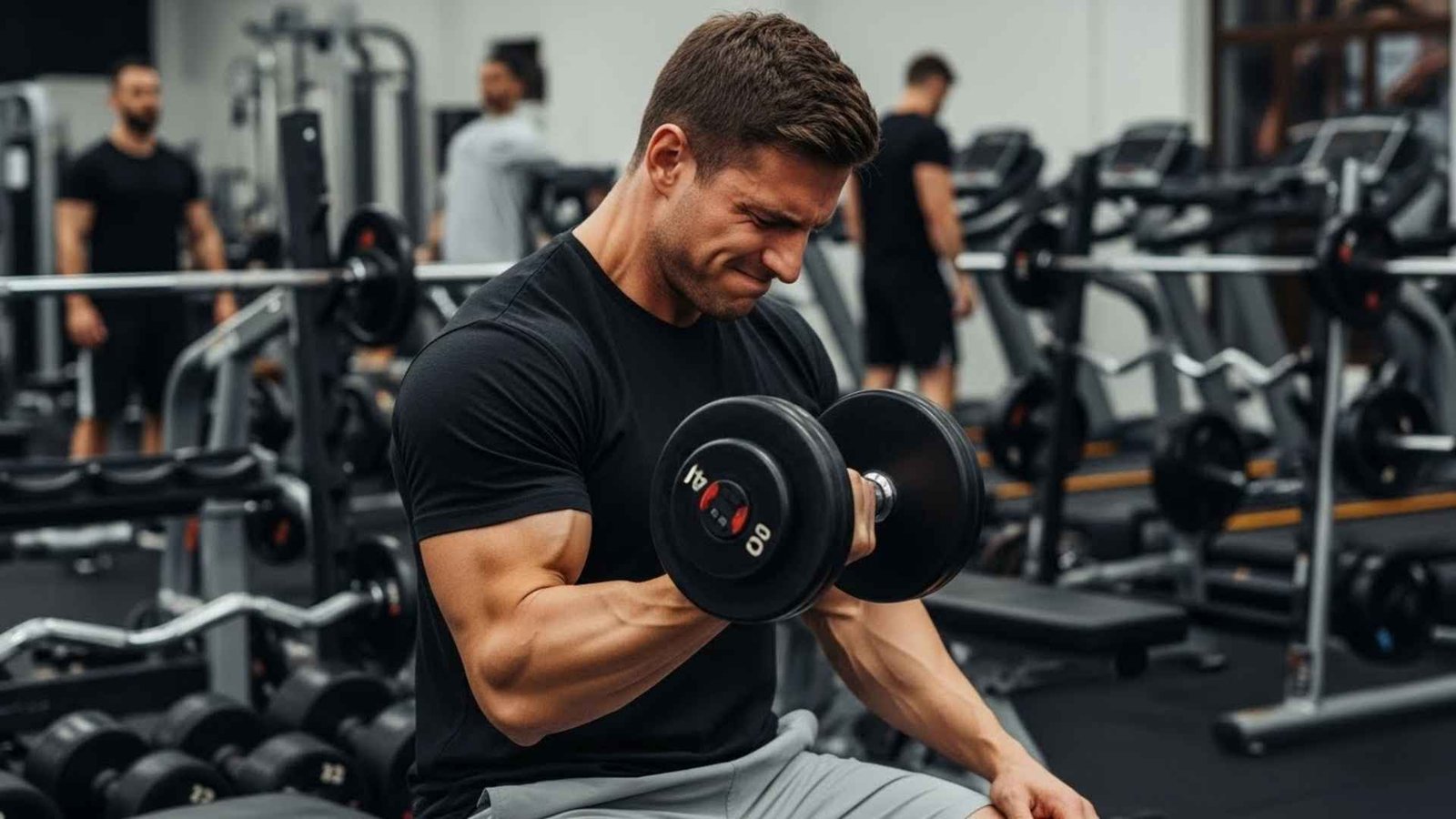
This is non-negotiable. If you lift the same pink dumbbells for the same 12 reps for five years, you aren’t training; you’re just moving. Simple Rule: You need to do more over time. That means adding 2 lbs to the bar, doing one more rep, or resting less. If the workout doesn’t get harder, your body won’t change.
2. Zone 2 Cardio (The Base)

Stop killing yourself with sprints every day. You need to build your engine. Zone 2 is that boring, steady pace where you can hold a conversation, but you’d rather not. It builds mitochondria—the power plants of your cells—without stressing your body out. Aim for 3 hours a week. It’s the foundation that lets you survive the hard stuff.
3. Movement over Muscles

Stop training “biceps.” Start training “pulling.” Your body moves in patterns, not isolated parts. Your week should cover the big six: Squat, Hinge (Deadlift), Lunge, Push, Pull, Carry. If you hit those, the biceps will take care of themselves.
4. Recovery is the Workout

You don’t grow in the gym. You break tissue in the gym. You grow in bed. If you’re sleeping 5 hours a night, you are wasting your workout. Period.
Your New Blueprint
I’m not going to leave you hanging. Here is a framework you can actually use. It’s based on the best current science (Huberman, Galpin, Attia) but simplified for people who have jobs and kids.
The “Longevity Protocol” (3-4 Days/Week)
- Monday (Strength – Lower Focus): Squats or Lunges (3 sets of 5-8 reps). Go heavy. Then some stability work.
- Tuesday (Strength – Upper Focus): Pushing (Bench/Overhead Press) and Pulling (Rows/Pull-ups).
- Wednesday (Zone 2 Cardio): 45-min jog or incline walk. Listen to a podcast. Keep it easy.
- Thursday (Rest or Mobility): Stretch. Walk the dog.
- Friday (Full Body / Fun): A mix of everything. Maybe a HIIT class if you enjoy it, or a hike, or a “pump” session for the mirror muscles.
- Weekend: Just be active. Go for a hike, play a sport, chase your kids.
The “Audit” Checklist Before you start, use this decision tree to figure out exactly why you’re stuck right now.
Tools to Build Your New Routine (That Actually Work)
You don’t need a garage full of expensive equipment to fix your routine. In fact, keeping it simple usually leads to better consistency. However, there are a few tools that can mean the difference between guessing and actually progressing. Based on the science we’ve discussed—tracking Zone 2, prioritizing recovery, and rucking—here are five things worth looking into.
1. Polar H10 Heart Rate Monitor

If you’re going to do Zone 2 training, you need to know you’re actually in Zone 2. Wrist watches are okay, but they often lag during movement. The Polar H10 is the gold standard for chest straps. It connects to your phone or gym equipment and tells you exactly when you’re pushing too hard (or not hard enough).
2. ProsourceFit Weighted Vest

We talked about “Rucking” (walking with weight) as a top-tier longevity exercise. You can use a backpack, but a weighted vest distributes the load better and saves your lower back. Throw this on for a neighborhood walk, and you’ve instantly turned a stroll into a bone-density-building workout.
3. TriggerPoint GRID Foam Roller

Recovery isn’t just sitting on the couch. It’s active maintenance. A high-density foam roller helps mobilize stiff fascia and improve blood flow to those “old man” or “old lady” trouble spots like the thoracic spine and hip flexors. It’s cheaper than a physical therapist and available 24/7.
4. Bodylastics Resistance Bands

If heavy iron hurts your joints, bands are the answer. They provide “variable resistance,” meaning the exercise gets harder as you stretch the band, matching your muscles’ natural strength curve. They are perfect for hitting those high-rep sets to build connective tissue without the grinding compression of gravity.
5. Outlive by Dr. Peter Attia

I mentioned Dr. Attia’s “Centenarian Decathlon” concept earlier. If you want the deep dive—the full operational manual for transitioning from “exercising for looks” to “training for life”—this book is non-negotiable reading. It will completely change how you view your health.
