

You know that feeling. The one where you wake up, swing your legs out of bed, and for those first few steps, your body feels less like a well-oiled machine and more like a rusty gate. It’s that tightness in the knees, the resistance in the hips—the sensation that your joints have somehow “set” like concrete overnight.
If you’re nodding along, you aren’t alone. And honestly, it’s not just “getting old,” despite what everyone jokes about at dinner parties. We are looking at a quiet epidemic of stagnation. The CDC tells us that over 53 million adults in the U.S. alone are living with arthritis or joint stiffness. Globally, the numbers are even wilder—the WHO reported a 113% increase in osteoarthritis cases since 1990. That is a staggering amount of discomfort.
For years, we’ve been told the solution is in a pill bottle—NSAIDs, painkillers, anti-inflammatories. And look, they have their place. But they often act like a mute button for the symptoms without actually fixing the broadcast. They don’t address the environment inside your body that allows stiffness to thrive: the stagnant fluids, the stress chemicals, the inflammation.
But what if I told you that a solution—a really powerful, science-backed one—was happening right under your nose? Literally.
There’s been a lot of buzz recently about a “discovery” by yoga instructors and movement therapists regarding specific breathing patterns that can mobilize joints. It sounds mystical, I know. But when you dig into the physiology (which I’ve done, so you don’t have to), it’s not magic. It’s mechanics. It’s biochemistry.
This isn’t about lighting incense and chanting (unless you want to). This is about using your breath to physically pump fluid, chemically lower inflammation, and neurologically turn off pain. Let’s break down how 10 minutes of breathing can do what hours of stretching sometimes can’t.
The Real Reason You Feel “Stiff” (It’s Not Just Bone-on-Bone)

Before we get to the “how,” we have to talk about the “why.” There’s a huge misconception that stiffness is just your cartilage wearing away, like brake pads on a car. While structural changes happen, that “morning stiffness” or the “gelling” you feel after sitting too long is usually a fluid problem.
Think of the fluid inside your joints (synovial fluid) like ketchup. When it sits still, it gets thick and stuck (a property called thixotropy). When you shake the bottle—or in this case, move the joint—it thins out and flows.
But here’s the kicker: your joints rely on your lymphatic system to drain away the waste products and swelling that make them feel puffy and tight. If your lymph system is sluggish—which happens when we sit all day and breathe shallowly into our chests—that fluid backs up. It creates a micro-swamp around your joints.
Add to that the chemical soup of stress. When you’re in pain, your body goes into “fight or flight” mode (sympathetic overdrive). Your muscles tighten up to “guard” the joint, compressing it further, and your blood vessels constrict, cutting off the fresh blood supply it needs to heal.
So, to fix it, we need a protocol that does three things:
- Pumps the fluid.
- Changes the chemistry.
- Resets the nerves.
Here are the four patterns that do exactly that.
1. The Mechanical Pump: Diaphragmatic Breathing
Let’s start with the heavy lifting. Most of us breathe vertically—our shoulders go up and down. This is actually a stress signal to the body. To move fluid, we need to breathe horizontally, using the diaphragm.
Here is why this matters: Your lymphatic system doesn’t have a heart to pump it. It relies on movement. The diaphragm acts as the “lymphatic heart”. When you take a deep belly breath, your diaphragm drops down like a piston. This creates a massive pressure vacuum in your chest that literally sucks lymph fluid up from your legs and hips, flushing out that stagnant swamp.
It also boosts venous return—getting the blood out of your legs and back to your heart—which helps reduce that heavy, throbbing feeling in the lower body.
How to Do “The Belly Balloon”
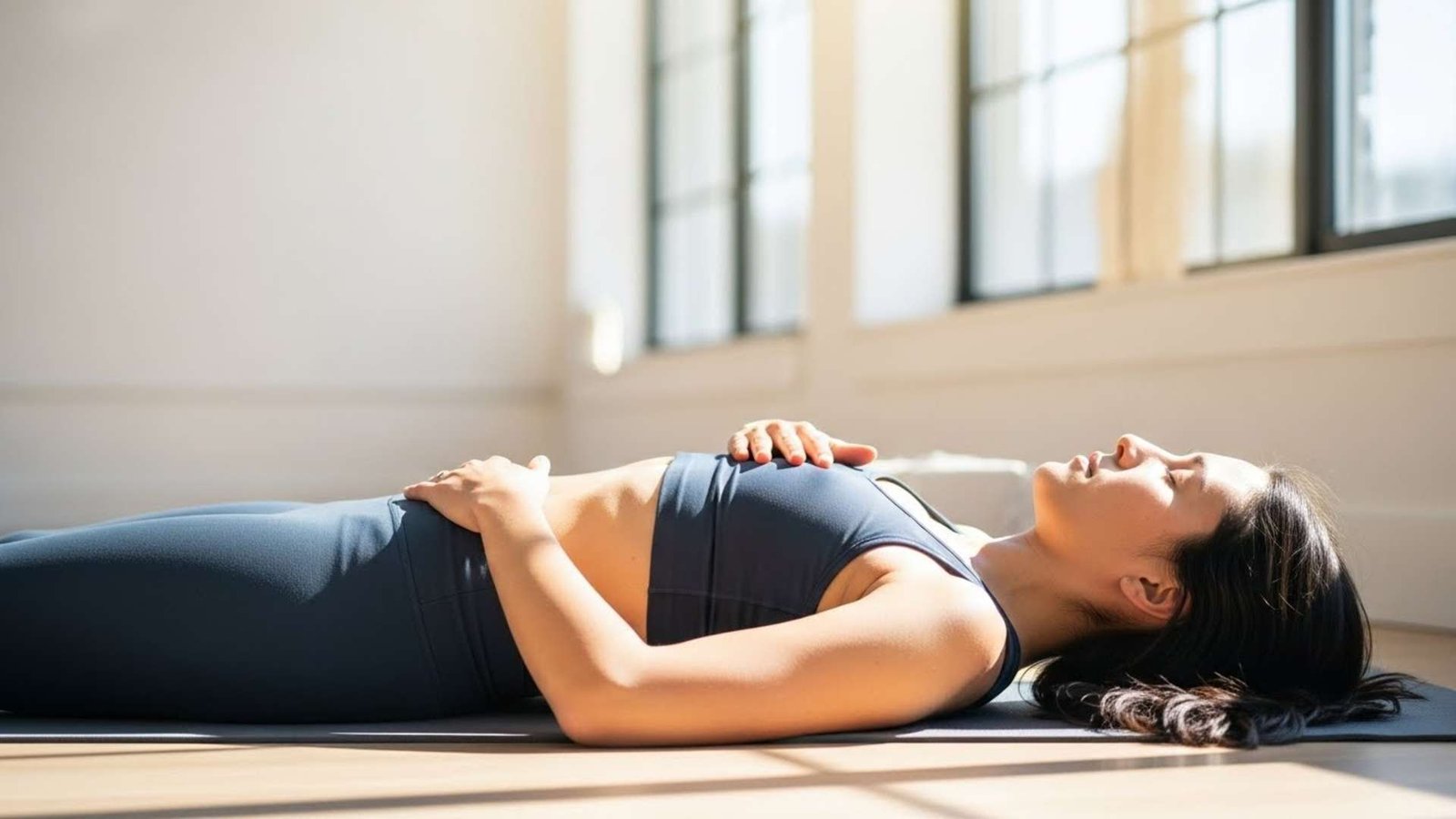
You can do this lying down or sitting.
- The Setup: Put one hand on your chest and one on your belly button.
- The Action: Inhale slowly through your nose for a count of 4. Imagine there is a balloon in your stomach. Make the bottom hand rise, while keeping the top hand still.
- The Release: Exhale through pursed lips (like you’re cooling soup) for a count of 6. Feel your belly button sink back toward your spine.
- Why it works: You are manually operating the pump that clears your joints.
2. The Internal Pharmacy: Bhramari (Humming)

Okay, this one might feel a little silly at first, but stick with me because the science is incredible. Bhramari Pranayama basically just means “Humming Bee Breath.”
Why hum? It turns out your paranasal sinuses are a reservoir for a gas called Nitric Oxide (NO). This isn’t laughing gas; it’s a miracle molecule for blood flow. It’s a potent vasodilator (it opens up blood vessels) and it’s anti-inflammatory.
When you breathe silently, most of that NO stays trapped in your sinuses. But researchers found that the vibration of humming shakes the NO loose, mixing it into the air you breathe. In fact, humming increases nasal Nitric Oxide output by 15-fold compared to silent breathing.
When you inhale that NO-rich air into your lungs, it enters your bloodstream and travels to your joints, opening up the tiny capillaries that have been squeezed shut by swelling. It’s like a natural dose of nitroglycerin, delivering oxygen exactly where your stiff tissues need it most.
How to Do “The Humming Bee”
- The Setup: Sit comfortably. Close your mouth but keep your teeth slightly apart.
- The Action: Inhale deeply through your nose.
- The Sound: On the exhale, make a low, long humming sound—Mmmmmm. Feel the vibration buzzing in your nose and lips.
- Pro Tip: If you gently plug your ears with your thumbs, it intensifies the vibration and helps calm the nervous system even faster.
Neural Brake Pedal
Stress is the gas pedal.
The Vagus Nerve is your brake.
The Math: Exhaling for twice as long as you inhale slows the heart and signals safety.
The Setup:
Tongue against ridge behind upper teeth.
If you’re in pain, your nervous system is likely stuck on the gas pedal (stress). We need to slam on the brakes. That’s where the Vagus Nerve comes in. It’s the main line for your “rest and digest” system.
Dr. Kevin Tracey and his team discovered something called the “Inflammatory Reflex.” They found that stimulating the Vagus nerve essentially tells your spleen to stop pumping out inflammatory chemicals (cytokines). You can hack this reflex with the 4-7-8 technique popularized by Dr. Andrew Weil.
It works because of the math. By exhaling (8 counts) for twice as long as you inhale (4 counts), you force your heart rate to slow down and signal safety to your brain.
How to Do “The System Reset”
- The Setup: Place the tip of your tongue against the ridge of tissue just behind your upper front teeth. Keep it there.
- The Breath:
- Inhale quietly through the nose for 4 seconds.
- Hold the breath for 7 seconds (this lets oxygen saturate).
- Exhale forcefully through the mouth (making a whoosh sound) for 8 seconds.
- The Dose: Start with just 4 cycles. It’s potent. You might feel a little lightheaded—that’s normal, just the oxygen hitting your brain.
4. The Balancer: Nadi Shodhana

Finally, we need to balance the system so the stiffness doesn’t just come creeping back the moment you stand up. Nadi Shodhana, or Alternate Nostril Breathing, is about balancing the two sides of your autonomic nervous system.
Our bodies operate on rhythms. One nostril is usually more open than the other, switching every 90 minutes or so. This cycle is linked to brain hemisphere activity. By manually switching the airflow, you are essentially “cross-training” your nervous system, improving Heart Rate Variability (HRV) and reducing the background tension that keeps muscles tight around your joints.
How to Do It
- The Action: Use your right thumb to close your right nostril. Inhale through the left.
- The Switch: Close the left nostril with your ring finger, release the thumb, and exhale through the right.
- The Return: Inhale through the right, switch fingers, and exhale through the left.
- The Vibe: Keep it smooth and silent. No forcing.
Need More Help? Look Into These Tools
You definitely don’t need gear to breathe—your lungs are free. But I’ve found that when you’re dealing with stiffness or pain, getting comfortable enough to actually relax can be a challenge. Sometimes, having a dedicated tool turns a “chore” into a ritual you actually look forward to. These are a few specific items I’ve found helpful for deepening the practice.
1. Mindsight ‘Breathing Buddha’ Visual Guide

If you find it distracting to count “4-7-8” in your head while trying to relax, this little device is a game-changer. It sits on your desk or nightstand and uses gentle, fading lights to guide your inhale, hold, and exhale. You just follow the colors, and your brain can finally turn off.
2. Manduka Enlight Yoga Bolster

Lying flat on your back for Diaphragmatic Breathing can sometimes pinch the lower back, which defeats the purpose of relaxing. Sliding this high-quality bolster under your knees takes the pressure off your lumbar spine and allows your diaphragm to move freely. It’s also firm enough to sit on for meditation.
3. Florensi Meditation Cushion

For the “Humming Bee” breath, you need a straight spine to let the vibrations resonate. If you’re doing this on a soft couch, you’ll likely slump, which compresses your lungs. This buckwheat cushion lifts your hips just enough to stack your spine effortlessly, preventing leg numbness.
4. “Breath: The New Science of a Lost Art” by James Nestor

If you want to geek out on why we’ve all forgotten how to breathe, this book is the modern bible of breathwork. It reads like an adventure story but is packed with hard science that will convince you to never mouth-breathe again. It provides the perfect context for why these exercises matter.
5. Mindful Breathing Necklace

This is a simple, wearable tool (essentially a tuned hollow tube) that you exhale through. It physically forces you to slow down your exhale, which is the fastest way to hack that vagus nerve response we talked about. It looks like jewelry, so it’s great for sneaking in a few “calm down” breaths at work.
