


Let’s be honest for a second. You know that moment? You bend down to pick up a sock, or maybe you just twist slightly to grab your coffee mug, and suddenly—snap. A sharp, breath-stealing pain shoots through your lower back.
You freeze. You carefully straighten up, thinking, “What did I even do? I didn’t lift a fridge. I didn’t run a marathon. I did… nothing.”
That’s the frustrating reality for millions of us. We call it “non-specific back pain,” which is just doctor-speak for “we can’t find a single big event that caused this.” It feels random. It feels unfair.
But here’s the thing I’ve learned from digging into the research: It is almost never “no reason.”
The truth is actually a little more insidious. Your back isn’t failing because of that one sock you picked up today. It’s failing because of the thousands of tiny, invisible choices you made over the last five years. It’s the way you sit, the way you scroll on your phone, even the way you sleep.
That chart isn’t just data; it represents 619 million people right now who are in pain, a number that’s skyrocketing. But we don’t have to be part of that statistic.
I want to walk you through the eight specific habits that are secretly chipping away at your spine’s resilience. We’re going to look at the science, sure, but we’re going to talk about it in plain English so you can actually do something about it.
The “Sedentary Siege” (Or, Why Your Butt is Asleep)

We need to talk about sitting. I know, you’ve heard “sitting is the new smoking” a million times. But let’s actually look at why it destroys your back, because it’s not just about being lazy.
When you stand, your spine has this beautiful, natural “S” curve that distributes weight perfectly. But the second you sit down? That curve flattens out. The pressure on your lower discs doesn’t just increase—it can nearly double.
But the real silent killer here is something called “Gluteal Amnesia.” Yes, that’s a real medical concept, though you might hear it called “Dead Butt Syndrome.”
Think of your body like a pulley system. When you sit for eight hours, your hip flexors (the muscles in the front of your hip) are shortened and tight. They are screaming at your brain, “We are tight!” Your brain, trying to be helpful, tells the opposing muscles—your glutes—to relax.
Eventually, your glutes get so used to being “off” that they forget how to turn “on.”
Why this matters to you:
Your glutes are supposed to be the powerhouse of your body. When they go on strike, your lower back muscles have to take over their job. Your lower back was never designed to be a powerhouse; it’s a stabilizer. So, you stand up, your back muscles spasm from doing work they shouldn’t be doing, and you’re in pain.
The Digital Descent
Your head weighs 10-12 lbs (like a bowling ball). Your neck handles this fine in neutral.
But when you tilt down to scroll, the leverage changes drastically:
Imagine this:
Carrying an 8-year-old child around on your neck for 4 hours a day.
That is exactly what texting does to your cervical spine.
Constant pressure squeezes discs and stretches ligaments until they become loose.
Think of it like an overstretched rubber band.
The Consequence: Loose ligaments can’t stabilize your neck, forcing muscles to work overtime just to keep your head from falling forward.
I’m guilty of this one, and I bet you are too. You’re waiting in line, or maybe you’re reading this right now, and your head is tilted down.
Your head is heavy. In a neutral position, it weighs about 10 to 12 pounds—roughly the weight of a bowling ball. Your neck handles that just fine.
But physics is a cruel mistress. As soon as you tilt that bowling ball forward, the leverage changes.
- At 15 degrees? That 12 lb head exerts 27 lbs of force.
- At 60 degrees (the standard texting pose)? It’s 60 lbs.
Imagine carrying an 8-year-old kid around on your neck for four hours a day. That is what you are doing to your cervical spine when you scroll through Instagram.
It’s not just about muscle soreness. This constant pressure squeezes the discs in your neck and stretches the ligaments until they become loose and floppy, like an overstretched rubber band. Once those ligaments are loose, they can’t stabilize your neck, and your muscles have to work overtime to keep your head from literally falling forward.
The Asymmetrical Burden (Purses & Wallets)

We tend to be creatures of habit. You probably carry your bag on the same shoulder every day.
When you do that, your body has to compensate. You hike up one shoulder and curve your spine sideways just to walk in a straight line. Do that for a decade, and you’re essentially training your body into a functional scoliosis.
And guys, we need to talk about your wallet.
If you carry a thick wallet in your back pocket and then sit on it, you are asking for trouble. Doctors call it “Wallet Neuritis.”
Imagine putting a rock under one leg of a chair. The chair is going to be tippy and unstable, right? When you sit on a wallet, you are un-leveling your pelvis. Your spine has to curve to compensate. Even worse, that “rock” is pressing directly into your glute muscles, right where the sciatic nerve lives. You could be chasing “back pain” cures for years, when all you actually needed to do was take your wallet out of your pocket.
The Foundation Failure (Footwear)

Ladies, I know you love the heels. They look great. But biomechanically? They are a nightmare.
Think of your body like a tower of blocks. If you tilt the bottom block (your feet), every block above it has to tilt to keep the tower from falling over.
- Heels up = weight shifts forward.
- Pelvis tilts forward to catch the weight.
- Lower back arches excessively (swayback) to balance the pelvis.
That deep arch crunches the joints in your lower back together. If your lower back hurts after a night out, it’s not just fatigue—it’s compression.
The “Micro-Trauma” of Chores

We all know we should “lift with our legs” when moving a couch. But do you do it when you pick up the laundry basket?
Probably not. You probably bend at the waist, maybe twist a little to reach the machine.
That motion—bending plus twisting—is the single most dangerous movement for a spinal disc. You don’t need a heavy weight to cause damage; you just need repetition.
This is the “death by a thousand cuts” concept, or what experts call micro-trauma. You aren’t hurting your back today. You are creating tiny tears in the disc wall every time you vacuum with a rounded back or twist to grab a grocery bag from the back seat. Eventually, the “straw that breaks the camel’s back” lands—and that’s when you bend over to tie your shoe and can’t get up.
The Chemical Assault
The Hydration Connection
Think of your spinal discs as hydraulic shock absorbers. They are filled with a gel that is mostly water.
Gravity squeezes this water out daily! If you don’t drink enough, discs stay flat and brittle—like a dried-out sponge.
The Smoking Gun
Smoking essentially suffocates your spine.
Discs have no blood supply; they soak up nutrients from nearby vessels. Nicotine constricts these vessels, cutting off the supply line.
This is the one that surprises most people. We think of the spine as bones and wires, but it’s living tissue.
The Hydration Connection:
Your spinal discs are basically hydraulic shock absorbers. They are filled with a gel that is mostly water. Throughout the day, gravity squeezes that water out (you are literally shorter when you go to bed than when you woke up!).
If you don’t drink enough water, those discs can’t re-inflate while you sleep. They stay flat and brittle. A dehydrated disc is like a dried-out sponge—it doesn’t absorb shock; it just crumbles.
The Smoking Gun:
If you smoke, you are suffocating your spine. Your discs don’t have their own blood supply; they get nutrients by soaking them up from nearby blood vessels. Nicotine constricts those vessels.
As you can see, smoking essentially cuts off the supply line. It starves the disc of oxygen and nutrients, making it impossible for it to repair those daily micro-traumas.
The Nocturnal Neglect (Sleep)

You spend a third of your life in bed. If your sleeping position is twisting your spine, you are spending 8 hours a night injuring yourself.
The Stomach Sleeper Problem:
If you sleep on your stomach, you have to turn your head 90 degrees just to breathe. Try walking around all day with your head turned all the way to the right. It would be agony. Yet, we do it for 8 hours at night and wonder why our necks are stiff.
The Fix:
- Back sleepers: Put a pillow under your knees. It takes the tension off your hamstrings and lets your lower back relax.
- Side sleepers: Put a pillow between your knees. Without it, your top leg slides forward, twisting your pelvis and lower back all night long.
The Stress Factor

Finally, we can’t ignore the brain. When you are stressed, you release cortisol.
This is an ancient survival mechanism. Your body thinks a tiger is chasing you, so it tightens your muscles to prepare for a fight—specifically the psoas muscle, which connects your legs to your lower spine.
Chronic stress means chronic tension. You are literally walking around with your back muscles in a vice grip because your brain thinks you’re in danger. Sometimes, the most effective back pain relief isn’t a stretch—it’s a few minutes of deep breathing to convince your nervous system that you are safe.
So, What Can We Actually Do?
I don’t want you to finish reading this and feel paranoid about moving. The body is resilient. It wants to heal. We just need to stop getting in the way.
You don’t need a gym membership to fix this. You need Micro-Breaks.
Try the 30-30 Rule:
For every 30 minutes you sit, take 30 seconds to move.
That’s it. Stand up, reach for the ceiling, shake out your legs. Just reset the timer on your biology.
And let’s clear up some myths before we go:
| Myth | The Real Deal |
| “Bed rest is best.” | False. Lying in bed makes you stiffer and weaker. Motion is lotion. Gentle movement heals. |
| “Pain = Damage.” | Not always. Sometimes pain is just a sensitive alarm system. Hurt doesn’t always mean harm. |
| “I need an MRI.” | Rarely. Most “abnormal” MRI findings (like bulging discs) are found in people with zero pain. Treat the person, not the picture. |
Need a Little Help? Tools to Support Your Spine
Look, I’ll be the first to tell you that you can’t buy your way out of back pain—habits always beat gear. But let’s be realistic: sometimes our environment fights against us. If you’re sitting in a terrible chair or staring at a laptop screen that’s two feet too low, willpower alone won’t save your neck. I’ve rounded up five simple, practical tools that directly address the habits we just talked about. Think of these as your “spine survival kit” to help nudge your body into the right alignment when you aren’t paying attention.
1. Everlasting Comfort Lumbar Support Pillow
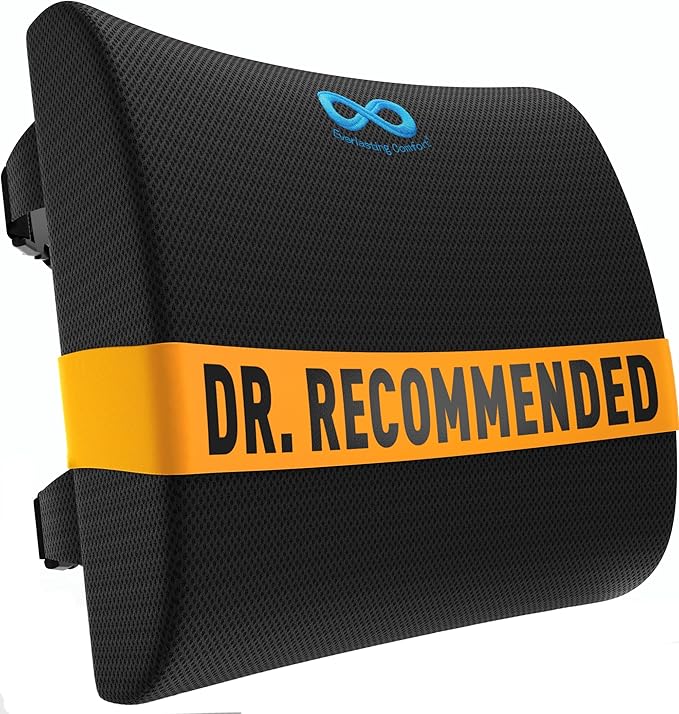
If your office chair feels like a medieval torture device (or if it just lacks support), this memory foam cushion is a game changer. It fills that gap between your lower back and the chair, forcing your spine into that healthy “S” curve we talked about in Habit 1. It helps prevent slouching without you having to constantly think about it.
2. Roost V3 Laptop Stand

Remember the “bowling ball” analogy for your head? This stand solves the Tech Neck problem by raising your laptop screen to eye level. It’s incredibly lightweight and portable, so you can save your neck whether you’re at the office or a coffee shop. Pair it with an external keyboard, and your cervical spine will thank you.
3. TriggerPoint GRID Foam Roller

For those days when you feel like a stiff board, this is your best friend. It’s perfect for rolling out tight quads and glutes (fixing Habit 1) or gently mobilizing a stiff upper back (fixing Habit 2). It’s like having a deep tissue massage available in your living room 24/7.
4. Fit Simplify Resistance Loop Bands

We talked about “Gluteal Amnesia”—well, this is the alarm clock. These simple bands are perfect for doing “monster walks” or glute bridges while you watch TV. They help wake up those sleepy butt muscles so they can start supporting your back again.
5. Motivational Water Bottle with Time Marker

Since dehydration literally deflates your spinal discs (Habit 6), drinking water is non-negotiable. This bottle takes the guesswork out of it with time markers on the side. It’s a simple visual cue that reminds you to keep sipping throughout the day, ensuring your discs stay hydrated and spongy.
