They Had Zero Building Experience and Turned a $21K School Bus Into a Treehouse on Wheels

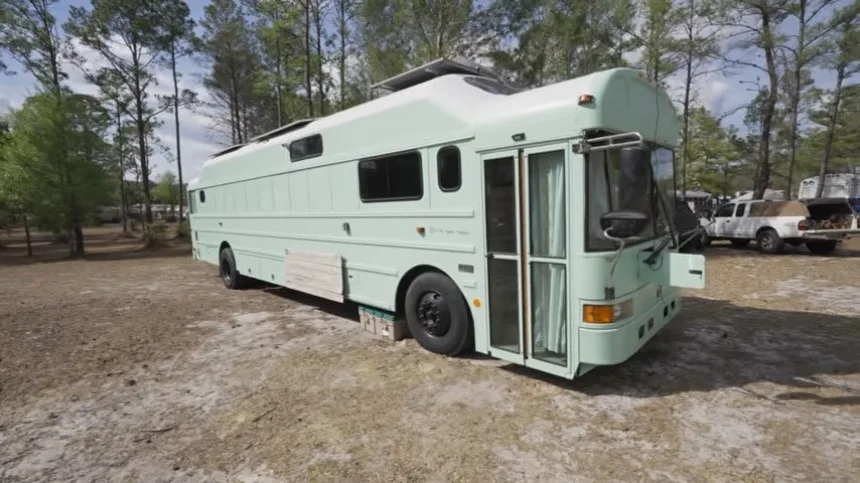
Kevin and Emma did not set out to become builders. They were a young couple living in a small 500-square-foot apartment, wondering where life would take them next.
Then Emma’s family moved to Florida, and the question got sharper. Instead of picking one place to settle, they picked the road.
They bought a 2006 International RE300 school bus on Facebook Marketplace for $21,000, named it Thyme, and turned it into a treehouse on wheels. Three years later, they are still traveling up and down the US East Coast between Florida, Pennsylvania, and New Jersey, staying close to family and to their roots in New Jersey.
At a glance
- Who: Kevin and Emma, a young couple traveling with their cats
- The bus: A 2006 International RE300, named Thyme
- Bought for: $21,000 on Facebook Marketplace, already gutted with a 20-inch roof raise done
- Total spend: Around $65,000 to $70,000
- Time on the road: Three years at the time of the story
- Power: Four 450W solar panels (1,820 watts total) plus a 50-amp shore power hookup
- Where they travel: The US East Coast, between Florida, Pennsylvania, and New Jersey
1. Why a Bus Beat an RV
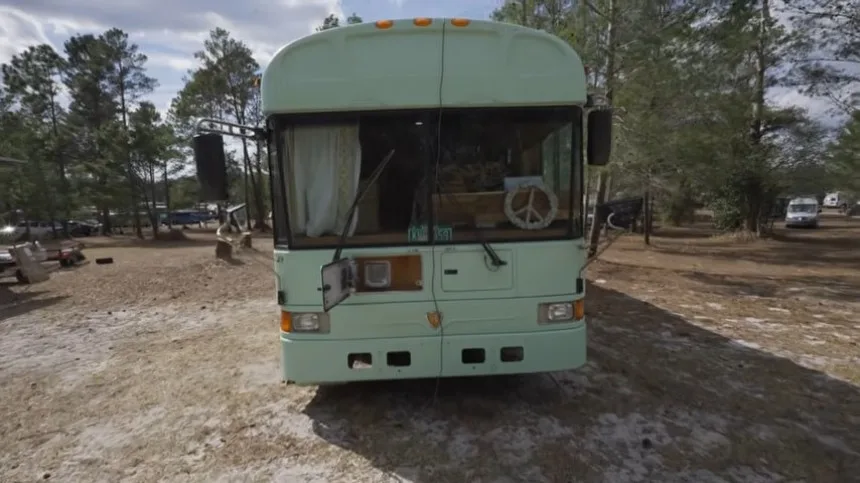
Photo: Tiny House Giant Journey via My Positive Outlooks
Kevin and Emma were no strangers to small living. Before bus life, they had already explored the US in a minivan, so they knew what life on the road felt like.
Emma worked as a full-time potter. Kevin was a mechanic. When they went looking for a home on wheels, they deliberately skipped the RV lot.
“We bought a bus instead of an RV because RVs are inherently flimsy… buses, they’re very hardy. They’re steel. They’re made to last,” Kevin said.
Their bus backed that up. It runs on a DT466 diesel engine with an Allison transmission, a pairing built for years of hard school district service. A school bus is a steel box on a truck frame. An RV is a light box on a light frame. For full-time living, that difference matters every single mile.
They also wanted a home that could keep up with their lives, not a holiday vehicle dressed up as one. The bus gave them a shell they could rebuild from scratch, exactly the way they wanted it.
2. Starting From Zero
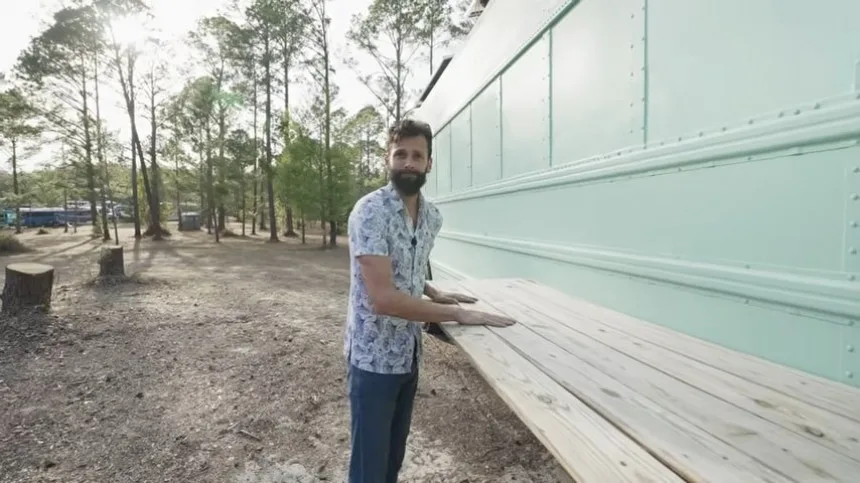
Photo: Tiny House Giant Journey via My Positive Outlooks
Here is the part that stops most people cold. Kevin and Emma had zero building experience when they started.
“We both had zero woodworking experience… we just use a circular saw… there’s charm. Lot of charm,” Kevin said.
A circular saw is a handheld power saw with a spinning round blade. It is one of the simplest woodworking tools you can own. With little more than that, they learned plumbing, electrical work, woodworking, and other crafts as they went.
The bus helped. It arrived already gutted, and the 20-inch roof raise was already complete. A roof raise means the roof was cut and lifted higher to add headroom inside, and having it done saved them time and money.
They also kept improving the bus while living in it, instead of trying to guess everything in advance. “I think if we just had it parked the whole time and tried to work on it and imagine what we needed, it would have turned out so different,” Kevin said. Real life on the road taught them what actually worked.
Cost breakdown
- The bus: $21,000 (Facebook Marketplace, already gutted, 20-inch roof raise complete)
- The conversion: $45,000 to $50,000
- Total spend: Around $65,000 to $70,000
- Clever saves: A bench seat from a salvaged minivan cost just $24
- Still to come: More solar panels, as they plan to expand the system to go fully off-grid
The big lesson is in the gap between the bus price and the total. The conversion cost more than twice what the bus cost, and that is normal for a finished skoolie.
3. A Living Room That Feels Like a Forest
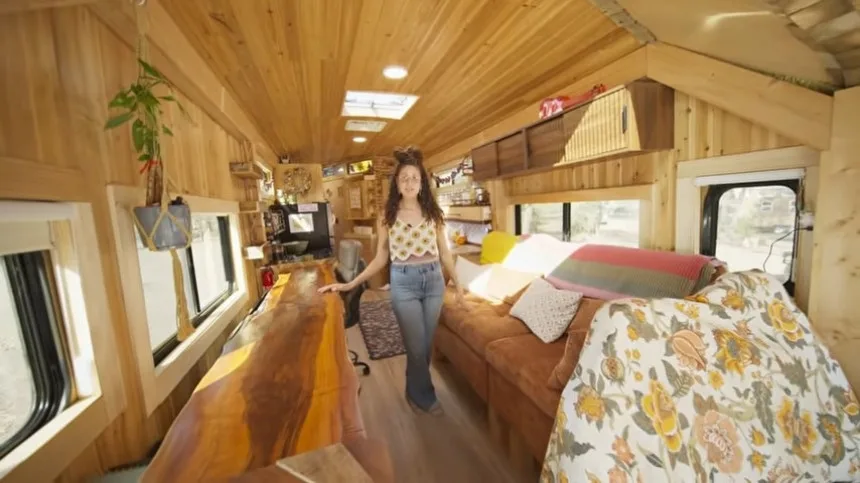
Photo: Tiny House Giant Journey via My Positive Outlooks
Step inside and the school bus disappears. Wood lines the walls and ceiling, and the whole space feels warm, calm, and a little bit wild.
“I wanted it to feel like home… kind of like you’re in a forest, but it’s a treehouse on wheels or something like that.” That was Emma’s vision, and it shows everywhere.
The living room centers on a live-edge table. Live edge means the wood keeps its natural, uneven outer edge instead of being cut straight, so every table looks one of a kind. Kevin uses it for calls and meetings, and it doubles as a dining space.
The couch extends into a small bed for relaxing or hosting. The stools double as storage. Above the couch, extra storage keeps daily items within reach.
The best trick is the hidden motorized TV. It rises when they want a movie night and disappears when they do not, so the room stays open and calm the rest of the time.
4. A Kitchen With More Counter Space Than Their Apartment
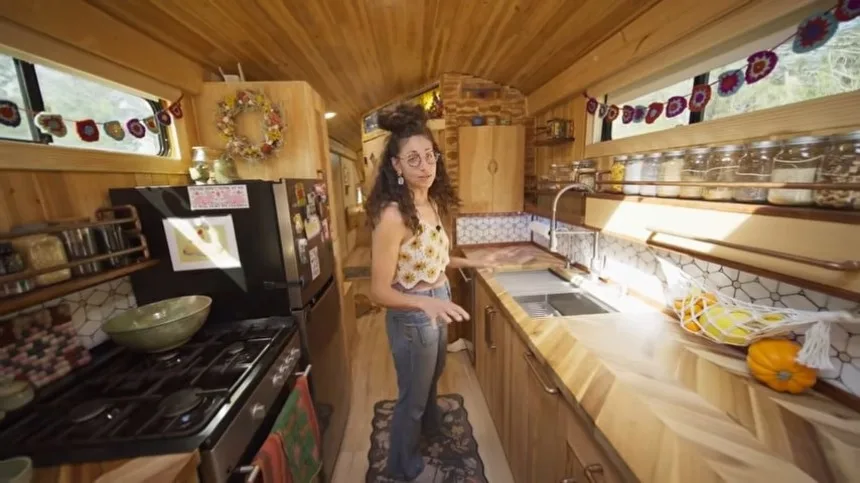
Photo: Tiny House Giant Journey via My Positive Outlooks
The kitchen is the biggest surprise in the bus. It offers more counter space than their old 500-square-foot apartment did.
Butcher block countertops run along the wall. A butcher block counter is made from strips of wood glued together into a thick, warm work surface. The sink is large and repurposed, and the stove is a 24-inch gas model with four burners.
An apartment-size refrigerator keeps food cold without eating the whole room. A 24-inch dishwasher uses only 2 to 3 gallons per load, which matters a lot when your water tank is not endless.
Copper pipe rails and custom cabinets add the rustic detail. Then there is the personal touch. “I told Kev, I was like, I need to display my mugs somehow,” Emma said. So she got her mug display, right where she can see it every day.
One small road trick is worth stealing. They use rubber bands on jars to cut down noise while driving. Simple, cheap, and it works.
5. A Bathroom With a Real Bathtub
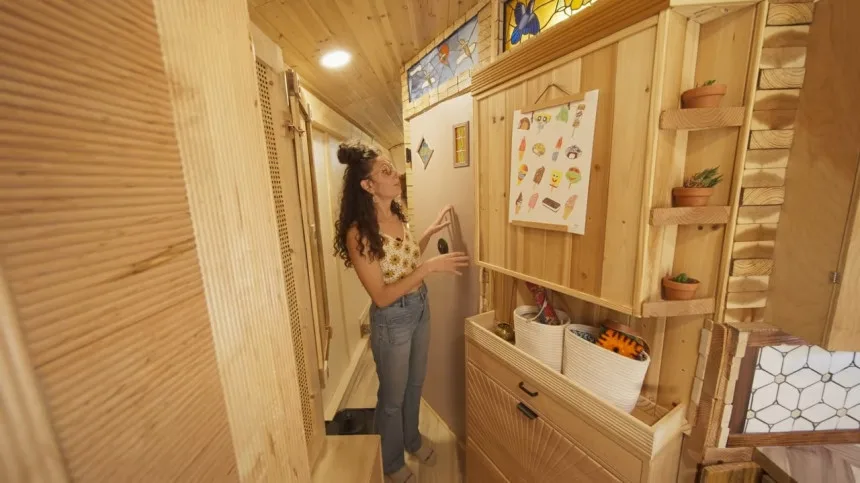
Photo: Tiny House Giant Journey via My Positive Outlooks
Most tiny homes ask you to give up the bath. This one does not.
The bathroom holds a full-size bathtub and shower, bought online and fitted to the space. When it is not bath time, it can double as storage. That is the kind of double duty a small home demands.
The toilet is a Nature’s Head composting toilet. A composting toilet uses no water and separates liquid and solid waste, so it suits a home that is not always hooked up to sewer lines.
A Nebia water-saving shower head stretches every gallon further. The sink is handmade. A built-in medicine cabinet keeps toiletries tidy.
The most meaningful detail hangs above the doors. Stained-glass panels made by Emma’s grandfather add color and family history to a room most people would treat as purely practical. It is the kind of touch no showroom build can buy.
6. A Calm Bedroom at the Back
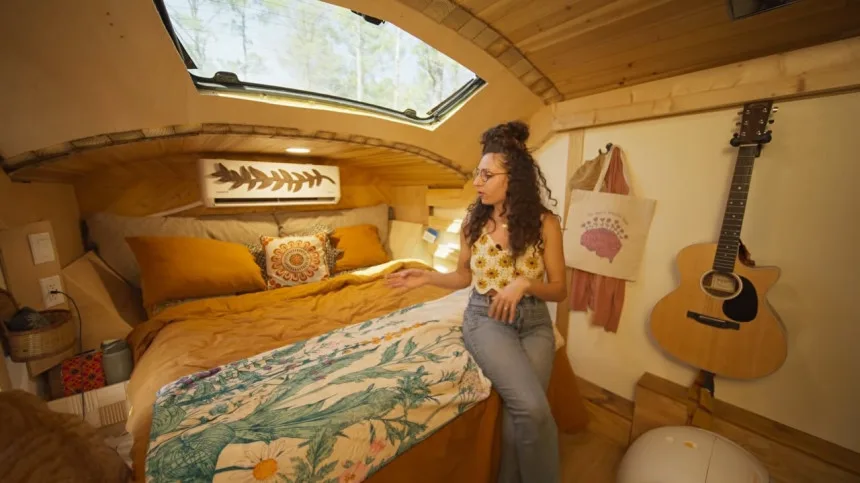
Photo: Tiny House Giant Journey via My Positive Outlooks
At the back of the bus sits a peaceful bedroom built for rest and creativity.
The queen-size bed anchors the room. Built-in cabinets with custom driftwood handles keep clothes and gear organized, and the driftwood keeps the forest feeling going right to the last room in the bus.
Charging stations and bedside storage handle phones and daily essentials. A motorized drop-down TV folds away when it is not wanted, so the bedroom stays a place for sleep, not screens.
A foldable desk gives them an extra workspace. That matters because both of them work from the bus, and two people working in one small space need two real spots to sit. The bedroom desk means they are not fighting over the live-edge table all day.
7. Power, Cats, and Everyday Life on the Road
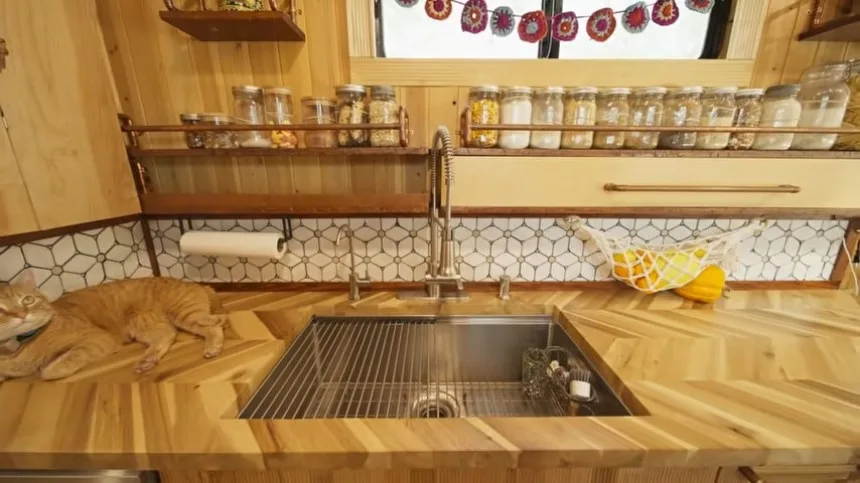
Photo: Tiny House Giant Journey via My Positive Outlooks
Daily life in Thyme runs on a mix of sun and plug-in power. Four 450W solar panels on the roof add up to 1,820 watts. A 50-amp shore power hookup lets them plug into campground electricity.
A propane hot water heater handles showers and dishes. A mini-split air conditioning unit keeps the bus comfortable. A mini-split is a compact heating and cooling system with a quiet indoor unit and a small outdoor unit.
Rear and side cameras help with driving safety, since a bus has big blind spots. They plan to expand the solar system to go fully off-grid in the future.
Outside, the mint green paint makes the bus easy to spot and hard to forget. A flip-up picnic table and outlet turn the side of the bus into an outdoor dining spot. Underbay storage holds tools and gear.
The cats travel with them, of course. Entryway stairs rebuilt with hidden shoe storage keep the entrance tidy. A bench seat from a salvaged minivan cost just $24. And a microchip-activated cat door at the front only opens for their cats, so strays stay out.
8. What They Would Tell You Before You Buy a Bus
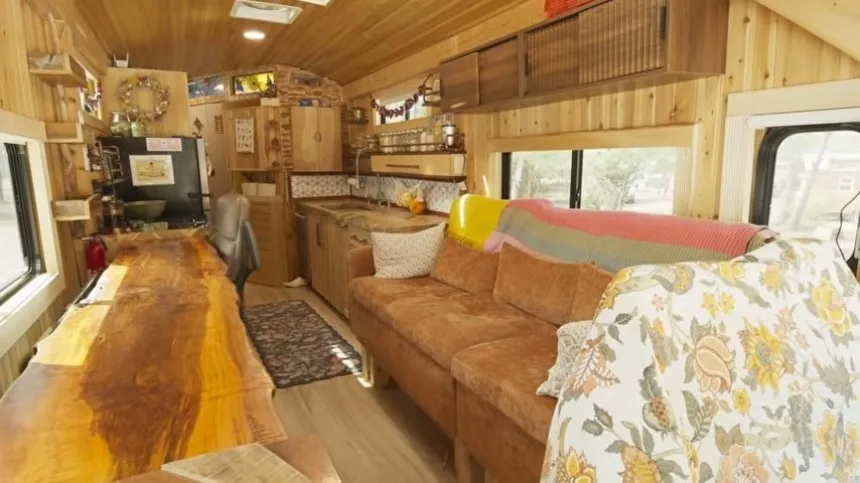
Photo: Tiny House Giant Journey via My Positive Outlooks
“Make sure you know what you’re getting into… It’s going to cost more than you think. It’s going to take longer than you think,” Kevin said.
Take that warning literally, and budget extra money and extra months.
“It’ll test your relationship… you’re either going to come closer or further apart… I think it brought us closer together,” Kevin said. Living and working together in a small space leaves nowhere to hide.
If you are thinking of copying the idea, start with the paperwork. A converted bus often needs retitling as a motorhome, and insurance and registration rules vary by state, so check yours before you buy. Check rust, the engine, and the roof carefully.
Plan utilities early. Solar, shore power, water, and propane all need space and weight planned in advance. You can learn skills as you go, just like they did, but learning takes time, and time is part of the budget too.
Then comes the encouragement. “You can do it… you’re not too old… you’re not, you know, incapable,” Emma said. Zero experience did not stop them.
Honest pros and cons
Pros:
- A steel bus shell is far tougher and longer lasting than a typical RV
- Buying already gutted with a roof raise done saved time and money
- Full-size comforts: a real bathtub, a dishwasher, a queen bed, and a real kitchen
- Freedom to travel the East Coast and stay close to family
- You can learn every skill as you go, no experience required
Cons:
- Total cost ran to $65,000 to $70,000, far more than the $21,000 bus
- The build takes longer than you think, and surprises keep coming
- Small-space living tests a relationship, with no room to escape a bad day
- Solar is not yet enough to go fully off-grid, so shore power is still needed
- Insurance, registration, and retitling rules vary and need checking before you buy
Sources: My Positive Outlooks: Inside a Custom School Bus Conversion Home and autoevolution: Thyme Is a Stunning DIY Skoolie With Impressive Woodwork, Modern Amenities, and a Treehouse Vibe.