They Refused to Pay 0K for a Van — So They Built This Shuttle Bus Home Instead

Amy and Mike wanted a home on wheels. They priced a van conversion first, and the quote stopped them cold.
The builder wanted $80,000. Just for the van. So they walked away and bought something much bigger for much less: a 25-foot shuttle bus they named Rhonda.
More than a year later, they still live in it full time with their rescue dog Gibson. They spend winters in Baja, then come home for six months to work, still sleeping in the bus. This is how they built it, what it runs on, and what daily life inside really looks like.
At a glance
- Owners: Amy and Mike, plus rescue dog Gibson
- Home: 25-foot shuttle bus named Rhonda, a 2002 E450 with a 7.3-liter engine
- Van quote they refused: $80,000 for a van conversion
- Total build cost: Not disclosed in the source
- Power: 1,200 watts of solar, 560 amp-hours of battery, 3,000W inverter, Victron setup, DC charging, plus shore power hookups
- Water: 65-gallon freshwater tank, blackwater system, outdoor shower, on-demand water heater
- Lived there: Full time for over a year
- Routine: Winters in Baja, then six months back home working, still living in the bus
The $80,000 Quote That Changed Everything

Photo: Tiny House Giant Journey via My Positive Outlooks
Amy and Mike started where a lot of people start. They looked at a van.
Then the price came back. Mike put it plainly: “First, we went for a van, and they wanted $80,000 to get one, and that’s just way overpriced”
Eighty thousand dollars, before a single night on the road. That number ended the van idea on the spot. It also opened the door to something better. A shuttle bus gave them far more room to stand up, cook, and live in, and it cost a fraction of the van quote.
Amy was honest about the leap. “When I was trying to convince Mike to do this um I was a little bit apprehensive about how we would actually make it work”
That worry is worth hearing if you are on the fence yourself. They did not start certain. They started with a price they refused to pay and a bus they believed they could make into a home.
Meet Rhonda, the 25-Foot Shuttle Bus

Photo: Tiny House Giant Journey via My Positive Outlooks
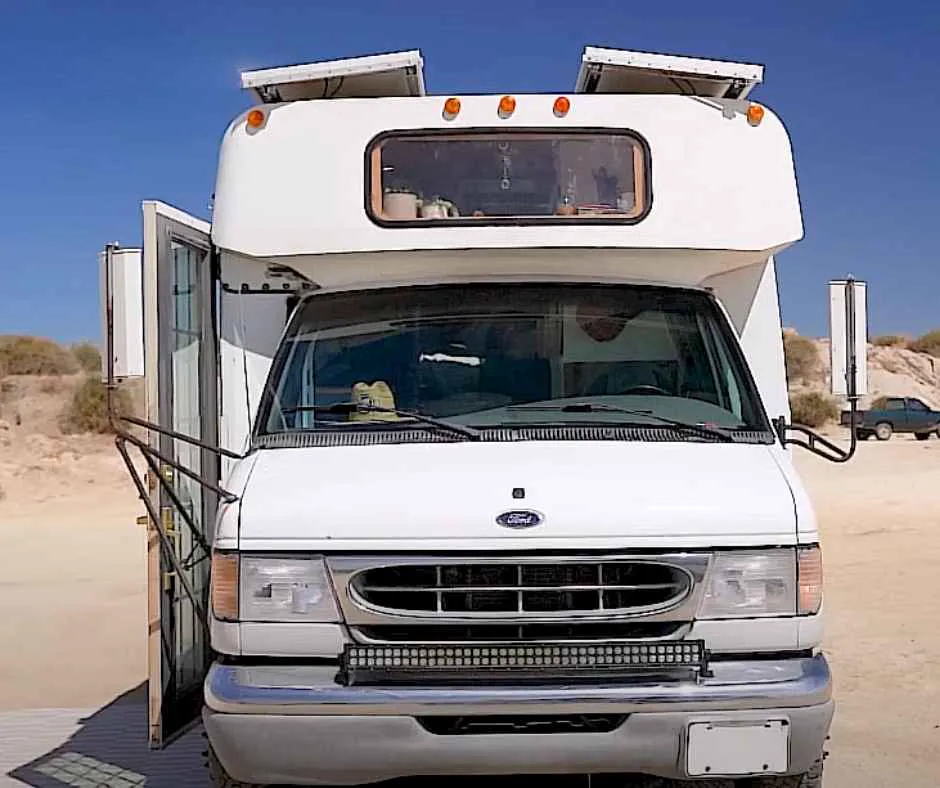
Rhonda started life as a 2002 E450 shuttle bus. Under the hood sits a 7.3-liter engine, a motor Mike calls a “million-mile motor” for its reputation for lasting.
That matters more than it sounds. A home on wheels is only a home if it moves when you need it to. An old bus with a tired engine is a driveway ornament. A strong, simple diesel gives them the confidence to point south each winter.
The outside got thoughtful upgrades. Floodlights light up camp after dark. A rear camera helps with parking a 25-foot rig. A fold-down bar table turns the outside wall into a place to sit with a drink.
The front door is custom built, home style, with a large glass panel. It makes the bus feel like a house the moment you step in, not a vehicle you happen to sleep in.
What the money picture actually looks like
- Van conversion quote: $80,000, refused
- Total bus build cost: Not disclosed in the source, so we are not guessing a number here
- Composting toilet: Built DIY instead of buying a $1,200 Canadian unit
- What they saved by skipping the van: The freedom to start sooner, with no car payment and no loan on the home
- Biggest money result: Amy says they saved more in their first year in the bus than ever before while living in a house and working full-time jobs
Solar on Top, a Deck on the Roof

Photo: Tiny House Giant Journey via My Positive Outlooks
Look down at Rhonda from above and the roof tells the story. Six solar panels cover most of it, with a wooden rooftop deck built into the rear section.
The power setup is serious. A Victron system manages 1,200 watts of solar feeding 560 amp-hours of battery storage, with a 3,000W inverter turning it into household power. DC charging tops the batteries up while driving. When a hookup is available, shore power plugs the bus straight into the grid.
That is a lot of capacity for 25 feet. It runs the fridge, the lights, the water heater, and Amy’s espresso machine without asking the couple to ration every watt.
The rooftop deck is the fun half of the same roof. It is custom built, a place to sit above the desert or the beach and watch the light change. The solar and the deck share the roof without fighting for space, which is the kind of planning that only happens when you design the whole roof at once.
Stepping Inside Feels Like a Real Home

Photo: Tiny House Giant Journey via My Positive Outlooks
The entrance sets the tone. Mexican tiles line the steps, bright and patterned, with a small woven mat showing a desert scene with cacti and a pink adobe house.
It is a small detail with a big effect. Most conversions feel like a vehicle with furniture in it. Rhonda feels like a tiny house that happens to have wheels, and the front steps are the first clue.
Inside, the ceiling is lined with cedar, warm and honey colored. Puck lights with dimmers let them set the mood instead of living under harsh white glare. A live edge cedar shelf adds one more natural touch.
The walls are insulated with foam boards and sealed aluminum panels. That layer is invisible in the photos, but it is what keeps the desert heat out in Baja and the warmth in on cold nights.
The handmade couch folds out into a guest bed. A swiveling table moves where it is needed, for meals or for work. Nothing in here is single purpose if it can help it.
A Kitchen Built Around an Espresso Machine

Photo: Tiny House Giant Journey via My Positive Outlooks
This is Amy’s favorite room, and it was designed around one appliance. The espresso machine came first. Everything else was arranged to fit around it.
That is a good rule for any small kitchen. Pick the one thing you will use every single morning, give it the best spot, and build outward from there. For Amy, mornings start with real coffee, so the machine earned the prime counter space.
The rest of the kitchen is full size where it counts. A regular-sized fridge holds real groceries, not a weekend’s worth. The pantry doubles as coat storage, which sounds odd until you live in 25 feet and realize every cabinet must earn its keep twice.
The sink has a built-in cutting board, so the counter grows when they cook. An oven and a three-burner propane stove handle real meals. A hidden drawer keeps valuables and the drone out of sight. Even the dog food has its own dedicated space, because Gibson lives here too.
A Full-Size Shower and a DIY Composting Toilet
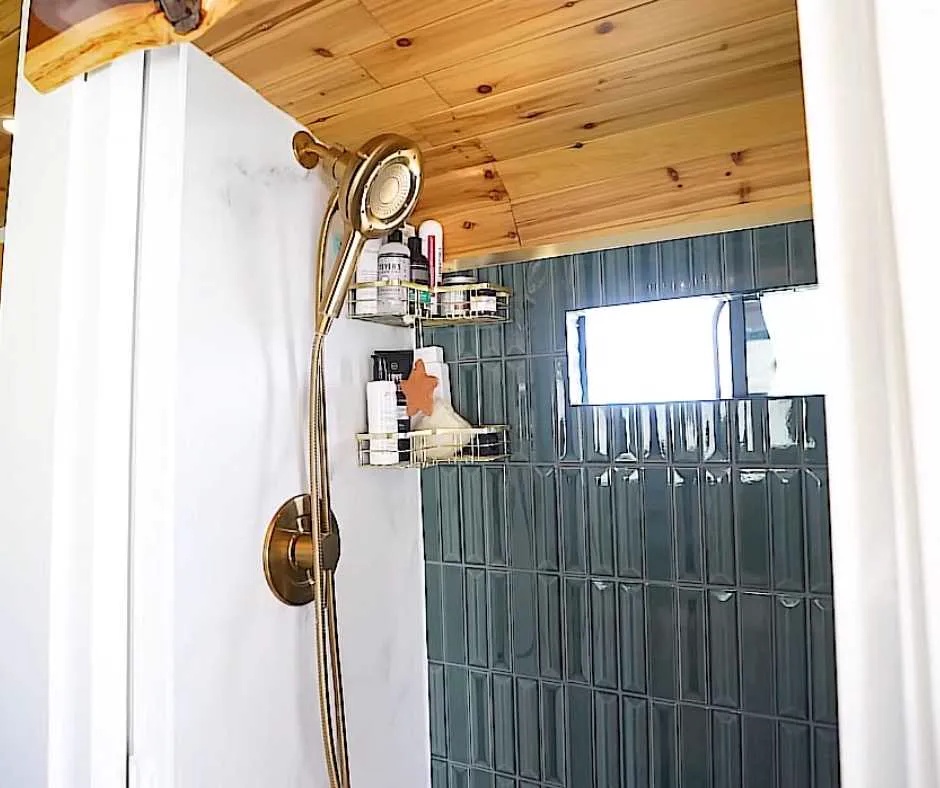
Photo: Tiny House Giant Journey via My Positive Outlooks
The bathroom refuses to feel like a compromise. The shower is a full-size 36×36-inch stall, big enough to turn around in without elbows hitting tile.
Cedar lines the bathroom ceiling, and a small window brings in daylight. Handmade Italian tiles, found on Facebook Marketplace, cover the walls. A Nebia by Moen shower head and a Nautilus shower door finish a space that looks more boutique hotel than bus conversion.
Then there is the toilet. Amy built their composting toilet herself, using a urine diverter bought from Etsy. She explained the math simply: “I really didn’t want to pay 1,200 Canadian for something that I felt like we could do ourselves, and it’s so far it’s worked out great”
That is the whole build in one sentence. If they could do it themselves for less, they did. The rebuilt medicine cabinet follows the same logic. Buy the skill, not the markup, whenever you can.
Water comes from a 65-gallon freshwater tank with an on-demand water heater, plus an outdoor shower and a blackwater system for waste. Sixty-five gallons sounds like a lot until three people, dishes, and showers share it. They watch it, and they plan fills.
Sleeping Under Cedar, Movies on the Ceiling

Photo: Tiny House Giant Journey via My Positive Outlooks
The bedroom sits at the back of the bus, where the original back doors were kept on purpose. From the bed, Amy and Mike look straight out through those doors at wherever they parked.
That view is the payoff for keeping the doors instead of walling them off. Some mornings it is desert. Some mornings it is the sea. The bed faces the scenery by design.
The bed itself is a queen mattress, trimmed down to fit the width of the bus. Fluffy pillows and soft throws make it feel less like a bunk and more like a bedroom.
The space behind the bed works as a gear garage, with storage tucked where the bus used to carry luggage. Magnets set into the ceiling hold up a projector screen, so movie night happens right there in bed.
It is a small room that does four jobs: sleeping, storing, viewing, and watching films. In a 25-foot home, every square foot has to pull that kind of weight.
The honest pros and cons
- Pro: They own their home outright, with no car payment and no mortgage hanging over it
- Pro: A full-size shower, a real fridge, and a proper kitchen make daily life feel normal, not camped out
- Pro: Solar plus shore power gives them real independence, and winters in Baja beat winters at home
- Pro: They saved more money in their first year in the bus than ever before in a house with full-time jobs
- Con: They do not work remotely, so the road life stops for six months of work back home each year
- Con: 65 gallons of water runs out, and an old bus needs a reliable engine and regular care
- Con: A shuttle bus is 25 feet of home to park, insure, and register, which is a bigger job than a van
Six Months on the Road, Six Months at Work

Photo: Tiny House Giant Journey via My Positive Outlooks
Amy and Mike do not work remotely. Their life runs in two halves: winters in Baja, then six months back home working, still living in Rhonda.
That rhythm is honest and repeatable. You do not need a laptop job to live in a bus.
The money result surprised even them. Amy said: “And this past year that we did that while living in the bus, we’ve managed to save more money than we were ever able to save while living full-time in a home and working full-time jobs”
Amy put it this way: “Well, it allowed us to do this sooner than I think if we had just uh gone with a car payment and the insurance and all of the other things that come along with that. Now we own our home outright”
Daily life is ordinary in the best way. Coffee in the morning, Gibson on the bed, dinner on the stove, a movie on the ceiling at night.
To copy this, start where they started. Price the easy option first. Check insurance and registration as an RV before you buy, size solar for the fridge and water heater, and plan water around 65 gallons.
Sources: Couple Transforms Shuttle Bus Tiny Home Into Dream Space, My Positive Outlooks and the Tiny House Giant Journey video tour. All photos by Tiny House Giant Journey via My Positive Outlooks.