Just 2 Days a Week: The 90-Minute Strength Habit Linked to Living Longer

Most of us picture strength training as a gym full of heavy weights and people grunting through workouts they dread. That picture keeps a lot of people away, and it is a shame, because the version that actually helps most adults looks nothing like that.
It looks like two short sessions a week, at home, with a chair, a mat, and maybe light dumbbells. It looks like standing up from a chair without using your hands and climbing stairs without a rest halfway up.
New long term research has made the case stronger than ever. A Harvard led study published in June 2026 followed 147,374 adults for up to 30 years. People who did 90 to 119 minutes of resistance training a week were 13 percent less likely to die during the study period than people who did none. Their risk of dying from cardiovascular disease was 19 percent lower, and from neurological diseases such as dementia it was 27 percent lower.
Those numbers describe a link, not a promise. The people in the study were not all gym regulars, and the benefit did not require hours of training. The sweet spot in that study was roughly 90 minutes a week, split across a few sessions. Two 45 minute sessions would do it. So would two shorter sessions plus a little extra movement on another day.
This article shows how to build that habit from scratch, what the newest evidence actually says, and how to progress without hurting yourself. No gym membership required, and no need to be strong before you start.
The 2 Day Week at a Glance
Start light, move slowly, and stop each set with a couple of good repetitions still in you. That is enough to begin.
1. Why Muscle Is Your Everyday Engine

Muscle is easy to ignore until it starts to fade. You notice it when a suitcase feels heavier than it used to, when getting off the floor takes a plan, or when a jar lid wins a fight it used to lose.
That fade has a name. After about age 30, adults tend to lose muscle gradually if they do not use it. The loss is slow at first, then faster later in life. Muscle helps you balance, catch yourself if you trip, and keep doing ordinary things that make a day feel normal.
Think of muscle as your everyday engine. It powers every stand, lift, reach, and step. When it weakens, everything costs more effort: stairs feel longer, shopping feels heavier, and gardening leaves you sore for days.
Strength training simply keeps that engine in working order. You ask a muscle to push or pull against resistance, then rest and let it recover a little stronger. The resistance can be your body weight, a band, or a dumbbell.
That is why the habit matters more than the equipment. A short session done twice a week, week after week, beats a heroic month followed by six months of nothing.
2. What 30 Years of Tracking Actually Found

The June 2026 study is worth a closer look because of its size and its length. Researchers analyzed three major long running studies involving 147,374 adults who were middle aged or older at the start, and tracked them for up to 30 years. That is a long time to watch a habit play out.
Participants reported how often and how hard they exercised, including resistance training and aerobic activity such as brisk walking and cycling. Deaths from all causes were also recorded, so researchers could compare habits over decades, not just weeks.
The clearest result was the 90 to 119 minute group. Those adults were 13 percent less likely to die during the study period than adults who did no strength training at all. Their risk of dying from cardiovascular disease was 19 percent lower, and from neurological diseases such as dementia it was 27 percent lower, according to Harvard Health.
Aerobic exercise still mattered on its own. The greatest benefit showed up when people did both. Adults who regularly did resistance training and aerobic activity had up to a 45 percent lower risk of dying during the study period than people who did little aerobic activity and no resistance training.
That combination is the real message. Walking stays wonderful, and strength training keeps the muscles walking relies on strong enough to keep walking easy.
Read the numbers with care. These studies observe people over time, so they show a link, not proof that one workout caused a longer life. Still, a link across 147,374 people and 30 years is worth paying attention to.
3. The 2026 Update That Changed the Advice

Two updates in 2026 changed how experts talk about strength training. The first was the long term study above. The second was a major review from the American College of Sports Medicine, which pulled together 137 systematic reviews involving more than 30,000 participants.
The review’s message was refreshingly simple. Progressive resistance training improved strength, muscle size, balance, and walking speed. For healthy adults, its central advice was to train all major muscle groups with enough effort at least twice a week.
That lines up with World Health Organization guidance, which has long recommended muscle strengthening on 2 or more days a week. The 2026 evidence did not invent a new rule. It gave the old rule a stronger foundation.
There was also a practical update. A 2026 paper in Frontiers in Public Health looked at why so few people meet the strength guideline: only about 10 to 30 percent do, the authors estimated, and lack of time is a common reason. Their answer was shorter sessions, exercise snacks spread through the day, and supersets, where you alternate two moves with little rest between them.
In plain terms, the science moved from “do more” to “do this, and here is how to fit it in.” A 20 minute session you actually do beats a 60 minute session you keep postponing.
4. Your First 2 Day Routine, Move by Move

Here is a simple routine that covers the whole body in about 30 to 45 minutes. Do it twice a week, with at least one rest day between sessions. Monday and Thursday works well. So does Tuesday and Saturday. Pick the days you are most likely to keep.
Warm up for five minutes first. Walk around the house, march in place, and roll your shoulders. Warm muscles move better and complain less.
Then do these six moves, in order, for 2 sets of 8 to 12 repetitions each, resting about 60 seconds between sets. If a move feels too easy, slow it down. If it feels too hard, use less weight or a lighter band.
One, sit to stand. Sit on a sturdy chair, feet flat, arms crossed. Stand up slowly, then sit back down with control. This is a squat in disguise, and it trains exactly the movement daily life demands.
Two, wall push up. Stand facing a wall, hands at shoulder height, and step back until your arms are almost straight. Bend your elbows, bring your chest toward the wall, and push back.
Three, band row or dumbbell row. Hold a band anchored to a sturdy point, or hold a dumbbell in each hand with a slight bend forward from the hips. Pull your elbows back, squeeze your shoulder blades together, and lower slowly.
Four, step up. Use a low, stable step. Step up with one foot, bring the other up, then step down in reverse. Hold a chair or rail at first for balance. Alternate the leading foot.
Five, overhead press. Hold light dumbbells or a band at shoulder height and press upward until your arms are almost straight, then lower slowly. Keep your ribs down and do not arch your back.
Six, dead bug. Lie on your back, arms up, knees bent at a right angle. Slowly extend one arm and the opposite leg, then return and switch sides. This trains your core without sit ups.
One Session, Six Moves, 30 Minutes
Finish with a five minute cool down: gentle stretches for your legs, chest, and shoulders, and slow breathing. Then write down what you did. A short note beats a perfect memory.
5. No Gym? No Problem: Bands, Bodyweight and a Chair

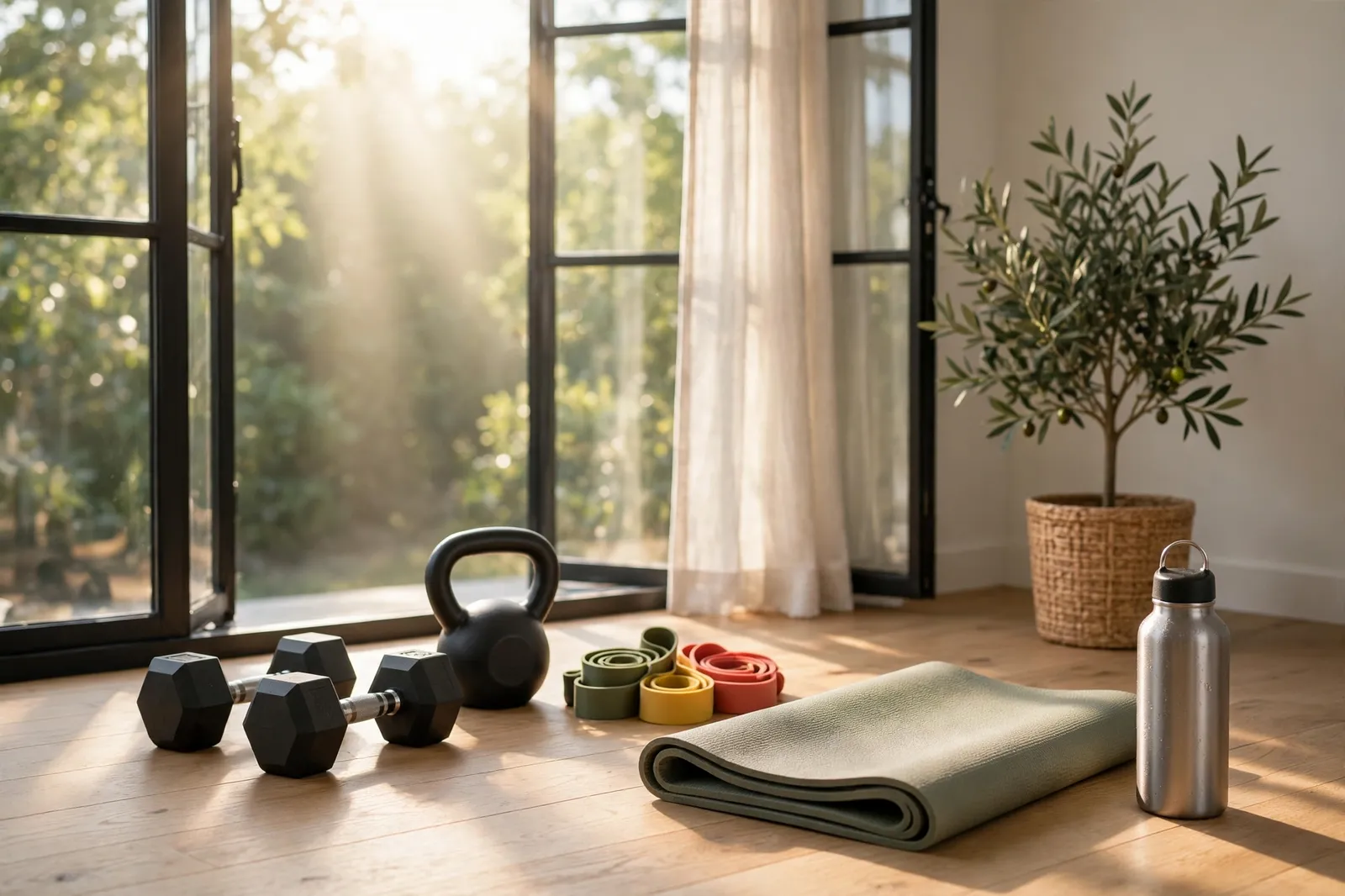
You do not need a gym to get stronger. You need resistance, and resistance is easy to find at home. Your body weight is resistance. A band is resistance. A water bottle, a bag of books, or a pair of light dumbbells all count.
Bands are the best starting kit for most beginners: cheap, light, quiet, and easy to store. A set with three strengths covers months of progress. Start with the lightest band, and only move up when you can finish all repetitions with good form.
A sturdy chair is your second best tool. It gives you sit to stands, step ups, and a balance aid for single leg work. Use a chair that does not slide or wobble, and place it on a rug or against a wall if the floor is slippery.
Bodyweight moves fill the rest. Wall push ups, sit to stands, step ups, and dead bugs need no equipment at all, so you can do them at home, in a hotel room, or in a park.
Keep your kit visible. Bands in a drawer get forgotten, while bands on a hook by the mat get used. Attach your session to something you already do, like after your morning coffee.
6. How to Progress Without Getting Hurt

Progress in strength training is wonderfully boring. You do a little more, a little at a time, and your body adapts. The trick is to make the “little more” small enough that you never have to stop.
Use the two repetition rule. When you can finish all your sets and still feel you could have done two more good repetitions on the last set, it is time to make the move slightly harder: a little more weight, the next band up, or a slower lowering phase.
Change only one thing at a time. Do not add weight, sets, and a new move all in the same week. Pick one change and live with it for two weeks. Slow progress that continues beats fast progress that ends in a sore back.
Form comes before weight, every time. A squat done well with no weight beats a squat done badly with a heavy dumbbell. Check yourself in a mirror for a straight back, knees tracking over your toes, and a controlled lowering phase.
Soreness is normal at the start. Muscles that have not worked this way will complain for a day or two. Sharp joint pain is different. So is pain that changes how you walk, pain that lingers for several days, dizziness, or chest discomfort. Those are signals to stop, rest, and talk to a clinician before continuing. This article is general information, not medical advice for your situation.
Rest is part of the program, not a break from it. Muscles get stronger while you recover, not while you train. That is why two sessions a week work so well. Sleep, water, and ordinary food with enough protein across the day support that recovery.
7. The 4 Week Starter Plan That Sticks

Week one is about learning, not effort. Do the six move routine twice, with the lightest option for every move, and 1 set of each if you are new to exercise. The goal is to finish both sessions feeling like you could have done a bit more.
Week two adds the second set: same moves, same light resistance, now 2 sets of 8 to 10 repetitions. Sit to stands and wall push ups usually improve fastest, because the body learns the pattern quickly.
Week three is your first small progression. Pick two moves that feel easy and make them slightly harder: a step further back for wall push ups, or the next band up for rows. Keep everything else the same. This is the week many people feel the habit click, because the work starts to feel like training rather than practice.
Week four is about making it yours. Keep the same six moves, but adjust the days and the time to fit your life. Habits survive when they fit your life, not when they fight it. If mornings are chaotic, train at lunch.
After four weeks, do a simple check. Can you stand from a chair more easily? Can you do more repetitions with the same weight? Those everyday wins are the real progress, and they usually show up before any visible change.
Then repeat the cycle: same structure, slightly more challenge, same two days a week. After three months, you can add a seventh move or try a third session. Or simply keep doing what works. Two good sessions a week, sustained for years, is a result most fitness plans never reach.
Your First 4 Weeks, Week by Week
Miss a session? Do the next one. The plan is built for real weeks, not perfect ones.
Two days a week is a small ask with a large return. It will not transform your life in a month. What it can do, quietly and steadily, is keep you able to do the things you care about, for longer, with less effort.
Start this week. Pick your two days, lay out your mat, and do the six moves with the lightest option. That first session is the hardest one you will ever do, because after it, you are no longer someone planning to start. You are someone who trains.
One last note: this article shares general wellness information based on published research, not personal medical advice. If you have a health condition or an injury, check with your doctor or a qualified physical therapist before starting.