Best Places in the World to Watch the Sunset

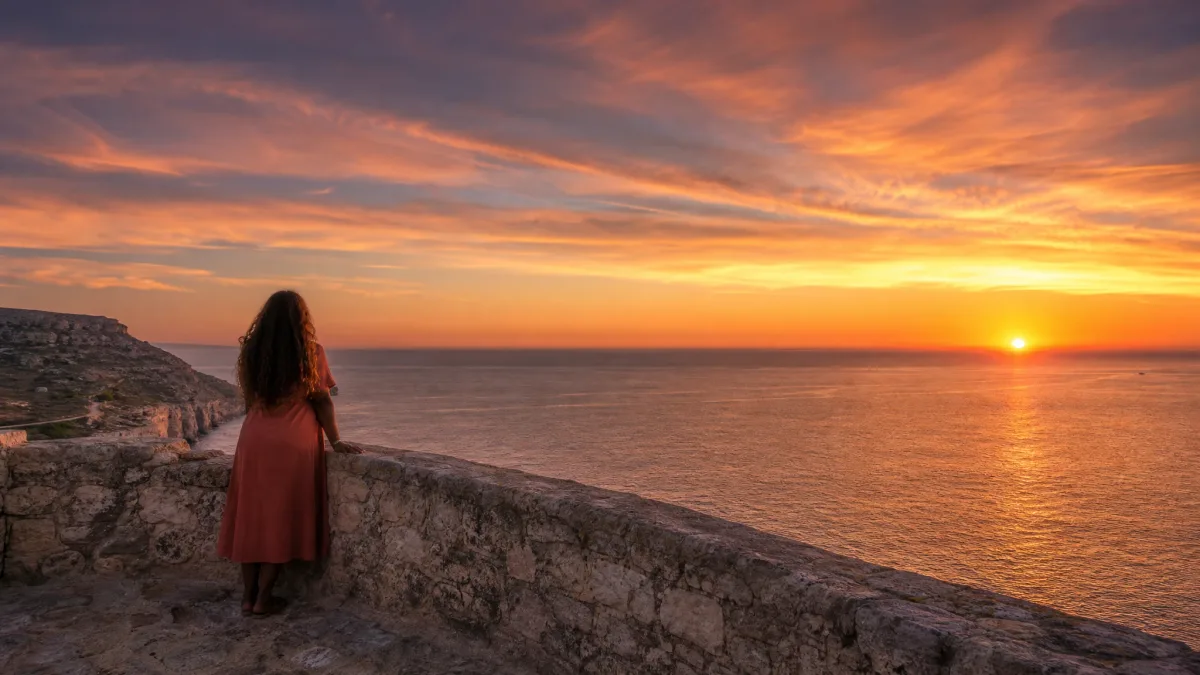
The most common mistake is booking the accommodation first and checking which direction it faces second – by which point the sunset is already behind the wrong hill.
Every traveler has stood on a beach and felt quietly cheated: the sky went pink for ninety seconds, then grey, and the whole thing was over before it started. That is not bad luck. It is the result of choosing a location for every reason except the light.
The fourteen places on this list are not pink-for-ninety-seconds locations. Each one produces its sunset through a specific geological, atmospheric, or architectural condition – a caldera that bounces golden light back into itself, a salt flat that dissolves the horizon, a volcano that puts you above the cloud layer entirely. Ordinary beaches cannot replicate any of them.
Watch a 40-minute rock color-shift in the Australian outback, float above 3,000 temples at golden hour, or sit on a Bolivian flat while the sky and the ground become the same surface. Fourteen places where the sunset alone justifies the flight – if you know where to stand and when to arrive.
You do not have to do all fourteen. By the end you will know which two belong on your shortlist.
Quick Tips Before You Start
Check the Facing Direction
Book any room or viewpoint facing west — east-facing accommodation misses the sunset entirely, and this cannot be fixed on arrival.
Arrive 45 Minutes Early
At any popular viewpoint, arriving fewer than 30 minutes before sunset means fighting for a position or watching from behind a tripod.
Pack a Warm Layer
Summit and desert locations drop 20–30 degrees after dark. A light down jacket makes staying for the afterglow possible.
Use a Sun Position App
PhotoPills or The Photographer's Ephemeris shows exact sunset direction and azimuth for any location and date — essential for positioning correctly.
Stay for the Afterglow
The 15–20 minutes after the disc disappears often outperform the sunset itself. Most crowds leave at the wrong moment.
1. Santorini, Greece: Caldera Rim at Dusk
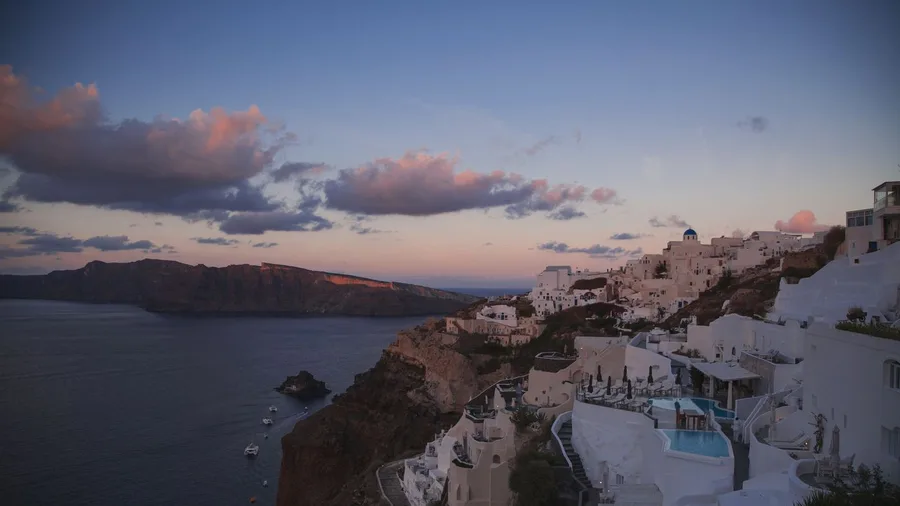
Every photo of the Oia sunset is accurate – and most people still leave disappointed, because they stand in the wrong spot and walk away too early. The castle ruin viewpoint packs out an hour before the sun moves, and the jostling kills the calm the light deserves. Walk instead to the path between the Ammoudi steps and the blue-domed church east of the village: unobstructed sightline, a fraction of the crowd, the same sky.
What makes the light here extreme is geometry. The caldera curves like a shallow bowl; the white-plastered walls facing west catch amber and gold and throw it back into the air, so the scene is lit from two directions at once as the disc drops into open Aegean water. Come in April, May, June, September, or October – midsummer, the sun slides behind the island of Thirasia and the full water-horizon effect vanishes. And when the sun disappears, stay. The sky runs from deep orange through violet to a brief crimson line along the water over roughly 20 minutes – that afterglow is what the photo cannot prepare you for, and it is what most visitors are already on a bus to miss.
💡 Tip: April through June and September through October place the sun's path over open Aegean water rather than behind the island's own landmass — these are the months the full effect actually works.
The Fourteen Sunsets — By the Numbers
2. Uluru, Australia: Sacred Rock at Golden Hour
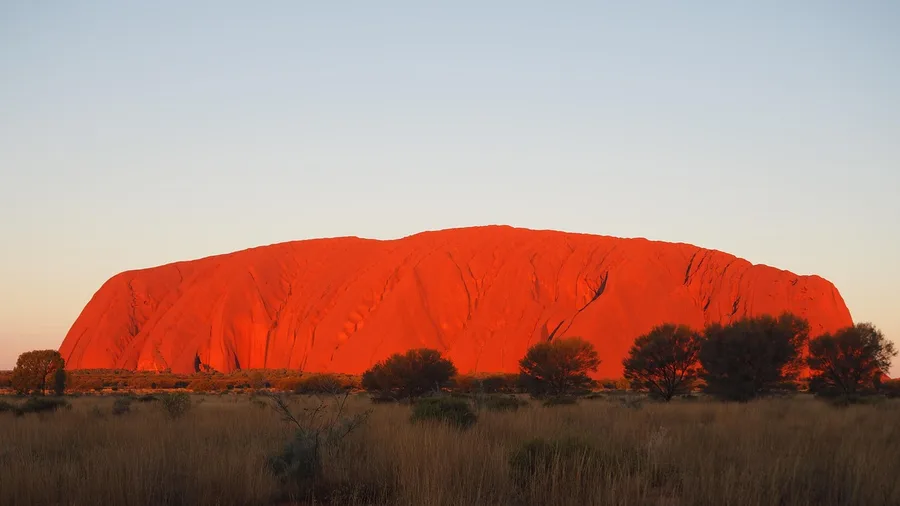
Uluru is not a red rock. It is a rock that changes color in real time.
The sequence takes roughly 40 minutes and runs in a precise order: ochre first, then burnt orange, then a deep arterial red, then violet-purple as the last light pulls away. That range does not happen at a coastal or mountain sunset. The reason is the rock’s own chemistry – the arkose sandstone is saturated with iron oxide, and the haematite in the stone does not simply bounce low-angle light back like a mirror. It absorbs specific wavelengths and re-emits them, so color saturation actually increases as the sun drops rather than fading with it. The rock glows brightest in the final ten minutes before full dark.
The designated viewing area on the western side has a platform and car parking – serviceable, and it does the job. The better position is the sand dune 500 meters south along the signed trail, elevated enough to change the angle and consistently less crowded. It is a ten-minute walk from the platform. If you are staying two nights, go back for sunrise from the same dune: the lighting comes from the opposite direction, and surface textures that are invisible at dusk – the ridges, the caves, the water-carved channels – become the whole story.
Getting to Uluru costs money, and there is no point understating it. Flights to Ayers Rock Airport (or a multi-day drive from Alice Springs, roughly 460km north) plus accommodation inside or near the park means this is not a budget detour. The Ayers Rock Resort properties near Yulara are the main accommodation options; rates vary significantly by season and room type, so checking current pricing directly is necessary – expect resort-level costs in a location with no competition. The entry fee to Uluru-Kata Tjuta National Park runs around $38 AUD per adult for a three-day pass; confirm current rates with the park authority before arrival.
Uluru is sacred to the Anangu people, and that is not background information – it changes how you visit. Certain rock faces carry explicit requests not to photograph them, marked on-site. Staying within the designated viewing corridors is the baseline of respectful conduct, not a technicality. The climbing ban, which took effect in 2019, is permanent. The experience the Anangu ask visitors to have is the one described above: standing at a distance, watching the light work on the stone. That is, by any measure, the better experience anyway.
Uluru Sunset — Key Details
🕐 Color Cycle Duration
~40 minutes
🚶 Alternative Viewpoint
South dune, 500m walk
✈️ Nearest Airport
Connellan (Ayers Rock)
💰 Budget Stay From
~$200/night
🌡️ Best Season
April–October (cooler)
Splurge Option
Longitude 131 positions decks directly toward the rock and includes a guided cultural interpretation of the full light sequence.
3. Key West, Florida: Mallory Square at Dusk
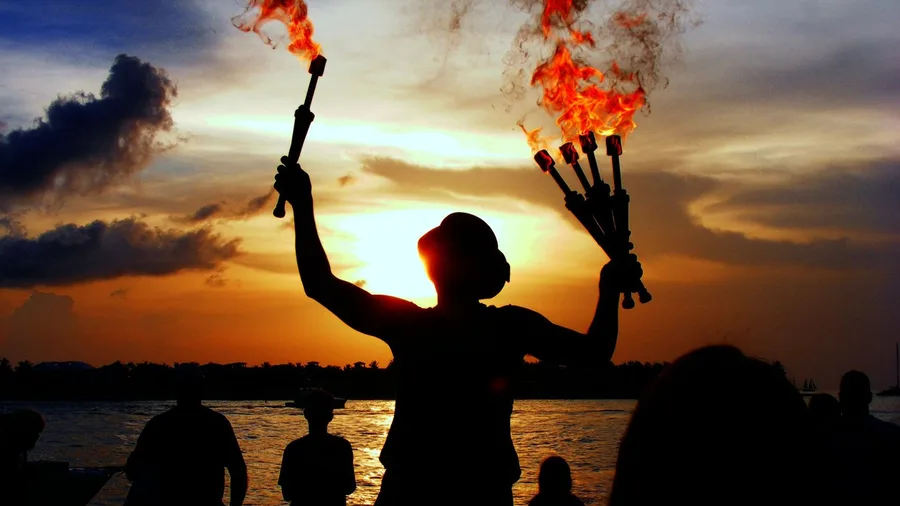
Some sunsets are private experiences. This one is deliberately communal – and that is the whole point. Mallory Square has been staging a nightly waterfront gathering since the 1960s, when local artists and street performers staked out the pier as their stage, and the tradition has never stopped. Fire jugglers, acrobats, a man who coaxes cats through hoops, food vendors running flat out – all of it operating continuously in the hour before dark, every single evening, every month of the year. When the sun makes contact with the water, the crowd applauds. Not because anyone organized it, but because it keeps happening anyway.
The pier faces due west over the Gulf of Mexico – the Atlantic side of the island faces east and catches only sunrise, so if your hotel is on that side, build in the ten-minute walk. The northwest corner of the square gives the widest open horizon; in peak season, December through March, that position fills 45 minutes before sunset and does not open up again. High summer humidity is the reason the light turns the color it does – the atmospheric moisture scatters the low-angle wavelengths into dense orange and red that reads cleanly on a phone camera, no editing required. The same air that makes August feel like a wet towel is doing the work.
💡 Tip: The communal applause at the exact moment the sun touches the Gulf water is a genuine spontaneous ritual, not a staged one. It happens every single evening.
💡 PRO TIP
The Humidity Works in Your Favor
Key West's high atmospheric humidity scatters low-angle light into richer orange and deep red tones than dry-air locations ever produce. The muggy summer evenings photograph cleanest — no filter required.
4. Serengeti, Tanzania: Plains at Sundowner Hour
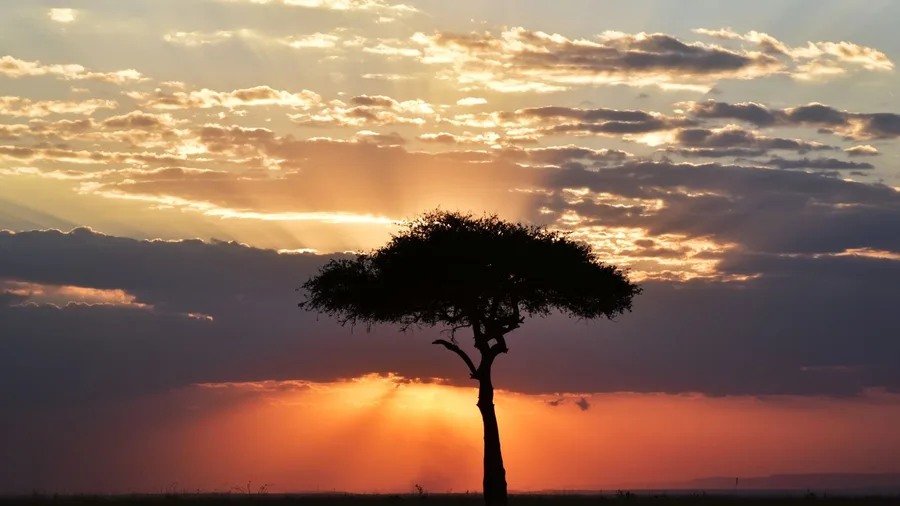
The vehicle stops, the engine cuts, and the silence arrives before the color does. Your guide sets out drinks on a folding table while the acacia trees ahead go dark against a sky that is already moving from yellow into something closer to copper – and you realize there is nothing to do but watch.
Whether this happens depends entirely on how the trip is booked. Most permanent camps in the Serengeti offer a dedicated late-afternoon drive that stays out until full dark; ask for it by name when you confirm your itinerary, because the standard game drive often turns back before the light peaks. Plan for June through October: the great migration concentrates wildlife on the plains, and the same months bring dry-season dust – fine particulate that hangs low in the atmosphere and scatters the red end of the spectrum so aggressively that the sky looks oversaturated, like someone has pushed the slider too far in post-production. It is not post-production.
The foreground is what makes the Serengeti version specific. Zebra graze slowly and hold position long enough to photograph cleanly against the last light – their black-and-white pattern against an orange sky reads almost graphically. Wildebeest move in loose columns toward water, silhouetted against the flat horizon. Forty minutes pass while the sky sequences through orange, deep red, and finally a brief violet band above the treeline – and then it is dark, the drinks are finished, and the drive back to camp covers ground that looks entirely different by headlight.
🌱 GROWING TIP
Build the Dates Around the Season, Not the Flight Price
Every location here has a specific 2–4 month window where its defining effect — the mirror flat, the four-phase color cycle, the midnight sun — is actually achievable. A cheap airfare in the wrong month means the thing you came for simply does not happen.
5. Haleakala, Hawaii: Above the Clouds at Dusk
The reservation system is the first thing to sort, not an afterthought. Summit area access at Haleakala now requires advance booking through the national park system, and during June through August slots disappear weeks out – walk-up access is not guaranteed, and arriving at the gate without a reservation is a real risk.
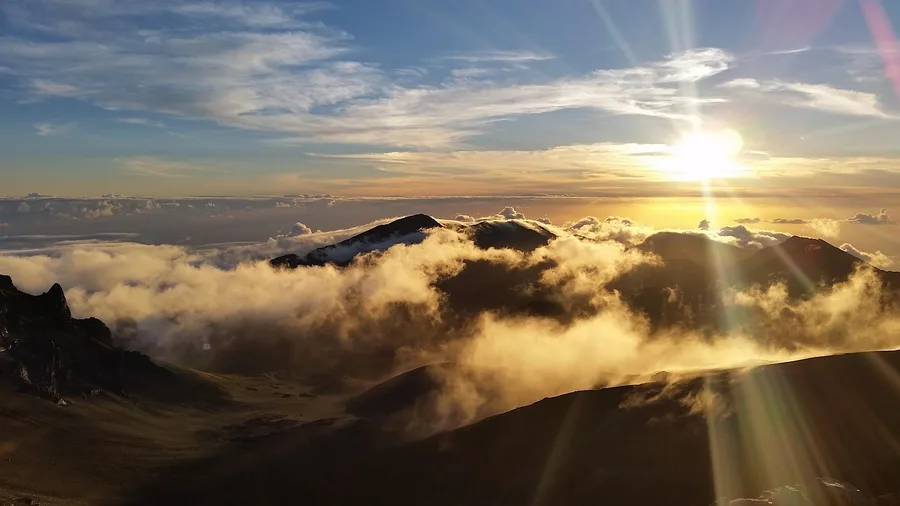
At 10,023 feet, the summit sits above the trade-wind cloud layer on most days of the year. What that means in practice: the sun does not drop toward a horizon but toward a solid white carpet of cloud, and as the disc descends, the cloud tops turn pink and orange while the sky directly overhead fades through blue to deep indigo – both sequences happening simultaneously, pulling the eye in two directions at once. The inversion effect only exists when the summit is clear and the cloud ceiling holds below roughly 8,000 feet, which is the typical pattern, but on overcast days the summit is inside cloud and visibility is zero. There is no middle version.
The drive from the south Maui coast takes around 1.5 hours; plan for 25 to 30 degrees colder at the top than at sea level, with constant wind – a warm layer, hat, and gloves belong in the car before you leave, not on a mental list. Sunrise draws the larger crowd and requires even earlier reservations; the sunset visit runs smaller, the light holds longer into the evening, and the drive back down in the dark is manageable with care. If the choice is between the two, sunset is the easier entry point and still delivers the full above-cloud effect.
Haleakala Sunset: The Sequence to Follow
6. Amalfi Coast, Italy: Clifftop Terrace at Dusk
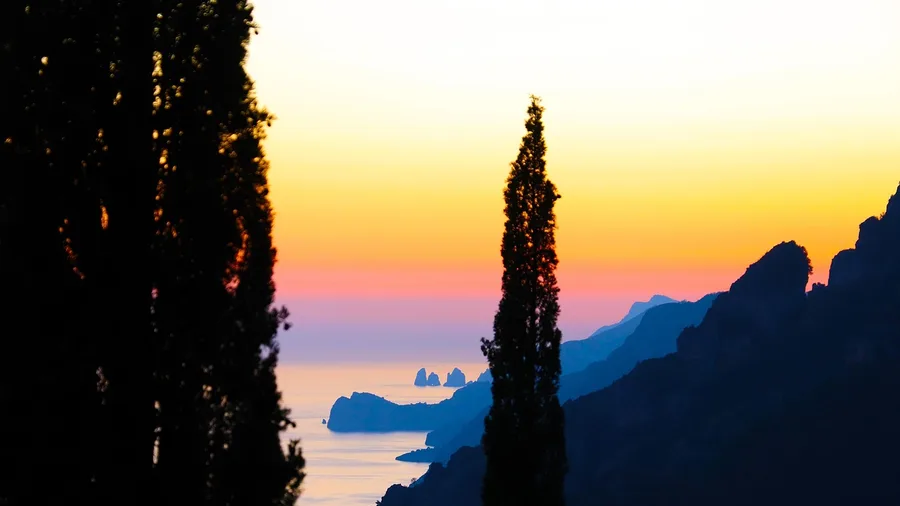
About 350 meters of altitude separates the best sunset on the Amalfi Coast from the most famous one – and that gap is the whole argument for going to Ravello instead of Positano. Most visitors head straight for Positano’s main beach, where the sun drops into the Tyrrhenian Sea between stacked pastel buildings. It is genuinely layered and immersive, and it is genuinely packed from June through August. Amalfi town, for what it is worth, faces south and misses the sunset entirely – a fact worth knowing before you book accommodation there.
Ravello sits above the cloud of beach-level tourism. Inside the Villa Cimbrone gardens, the Terrace of Infinity extends over the cliff edge on a series of stone balustrades, with open sea running to the horizon and no town, no beach, no boat traffic cluttering the view. Because the terrace is higher, the sun stays visible for several minutes longer than it does at sea level – the geometry works in your favor. In July and August the sun sets at its northernmost point, which means a longer, lower arc across the western sky and a sustained afterglow that lights the terraced coastline below at a raking angle for 20 to 30 minutes after the disc disappears.
Villa Cimbrone charges an entry fee and, critically, closes before dark in the shoulder months – confirm the current closing time before you build an evening around it, because the posted hours have been known to shift. The practical move is to book dinner at a west-facing terrace restaurant in Ravello for 30 minutes before sunset, let the meal run through the afterglow, and treat the gardens as the pre-dinner stop rather than the main event. That way a closed gate does not cost you the light.
Amalfi Sunset: What the Prose Did Not Cover
7. Atacama Desert, Chile: Valle de la Luna at Dusk
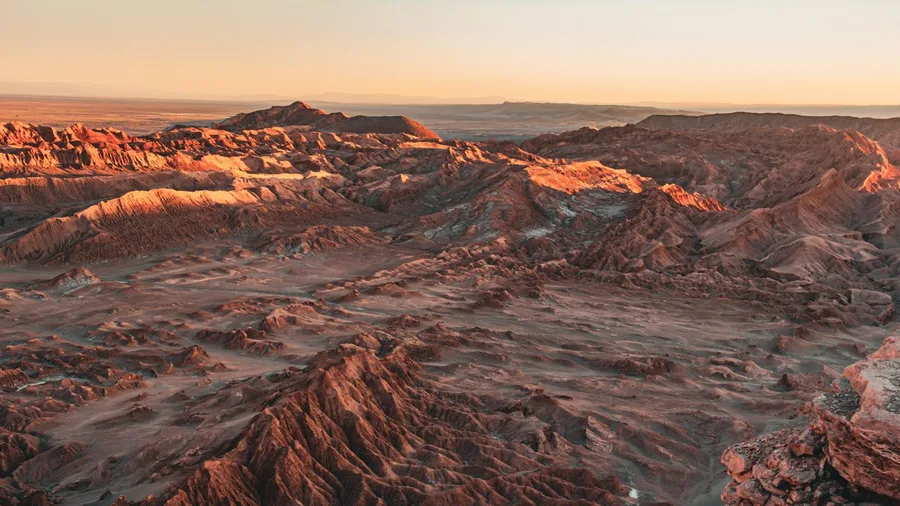
The air in the Atacama has almost no weight to it – at 2,400 meters above sea level, with humidity so low your lips crack within a day, the atmosphere strips away every filter between the sun and your eye. Most places dilute color before it arrives: moisture, haze, industrial particles. Here, none of that exists, which is why photographers who have worked every continent tend to say the Atacama light is in a category of its own.
Valle de la Luna earns its name at dusk. The salt ridges and eroded rock faces start the sequence around ochre and burnt orange, then deepen fast – within 20 minutes they have moved through blood-red into a crimson that looks too saturated to be natural. What makes it stranger is the shadows: the angular formations cast hard-edged lines that visibly rotate as the sun drops, so the whole landscape appears to slowly rearrange itself. San Pedro de Atacama, about 15km from the valley entrance, is the base for guided sunset tours that run in the range of $15-30 USD per person – check rates locally when you arrive, as prices shift by season and operator.
Stay past the sun disappearing. At this altitude and latitude the sky goes from dusk to full dark in under 30 minutes, and within that same window the Milky Way emerges overhead – not faintly, but fully, in a band wide enough to cast a shadow. Many tours extend into a short stargazing session at the same location, so the evening runs as one continuous arc from color to cosmos. Rain here is essentially theoretical – parts of the Atacama average under 1mm annually – so you are not planning around weather. You are just planning around the date you arrive.
Atacama Desert — By the Numbers
8. Angkor Wat, Cambodia: Temple Spires in Silhouette
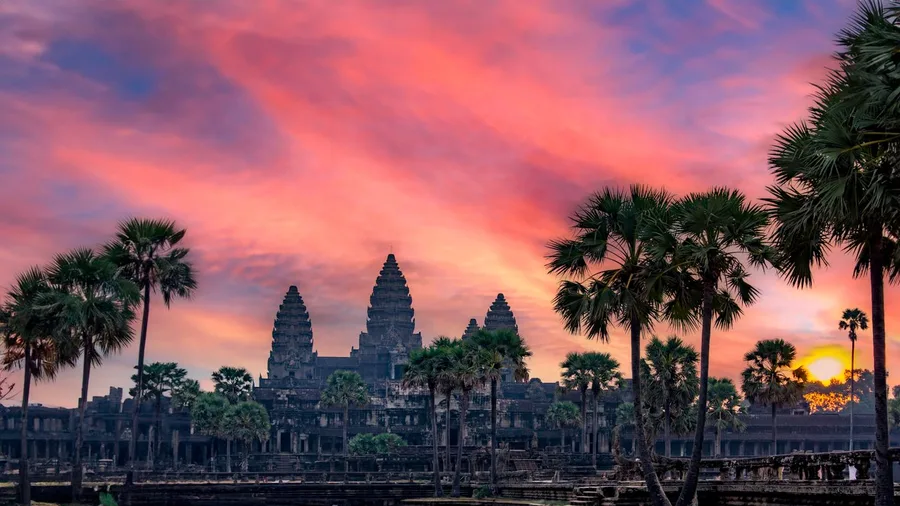
The Angkor Wat sunset is worth it – but the experience divides sharply by position and timing, and the wrong choice produces a crowd rather than a composition. The main entrance faces due west by deliberate 12th-century astronomical design: the five central towers align with the setting sun exactly as the architects intended, and the rectangular reflecting pool at the entrance doubles the silhouette in still water, spires above and mirror image below. That composition is every bit as striking in person as it looks in a century of photographs. Arrive at least 45 minutes before sunset to hold a front-row position at the pool; it fills fast. For a less-crowded alternative, Phnom Bakheng – a hilltop temple 1.5km north – gives an elevated view over the jungle canopy with Angkor Wat visible in the middle distance, but access is capped at 300 visitors and requires arriving well before the crowd does.
Dry season, November through March, delivers the sharpest silhouette and the clearest sky; the wet season produces dramatic cloud formations that can be striking but also carries haze that softens the towers considerably. A standard Angkor Archaeological Park pass covers the visit, and the main temple permits viewing until dark even though the park officially closes at 5:30pm – access rules have shifted in recent years, so confirm current policy directly with Angkor Enterprise before you build the evening around it. No altitude, no significant walking, no specialist gear: this is one of the few locations on this list that suits travelers of any age or fitness level. The only real barrier is planning ahead.
💡 Tip: The park officially closes at 5:30pm but sunset viewing at the main temple is permitted until dark. Confirm current rules directly with the Angkor Enterprise ticket authority before arrival — access policies have changed in recent years.
9. Lofoten Islands, Norway: Midnight Sun Over the Fjords
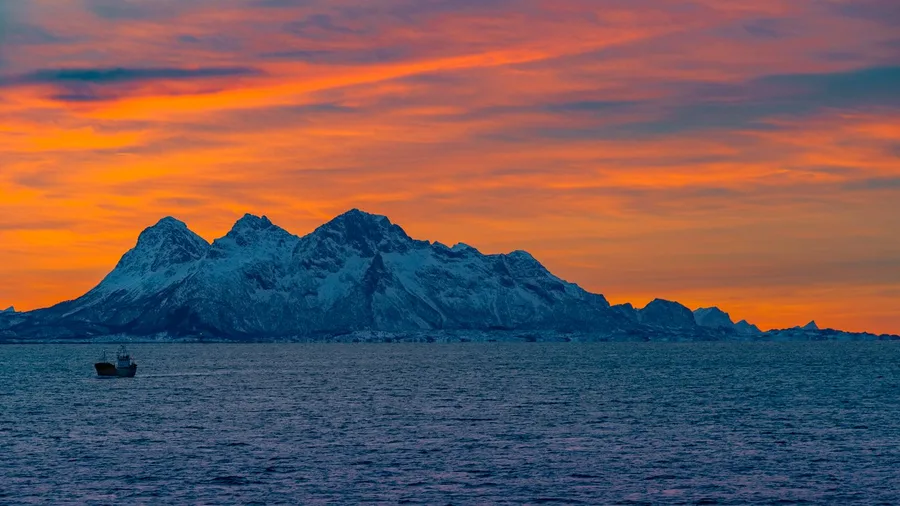
You are standing on a dock in Reine at 11pm and the sky is still amber. The sun is not setting – it is grazing the tops of the mountain walls to the northwest, moving sideways along the skyline, and the water below you is lit the same warm gold it was two hours ago. Nothing about your body clock or your understanding of evening prepares you for this.
From late May through mid-July, the sun above the Arctic Circle never fully drops below the horizon. It descends toward it after 10pm, skims along for two to three hours in what is essentially a sustained golden hour, then begins climbing again. The light quality during that window is unlike anything produced by a conventional sunset: the angle is so low that mountain peaks are illuminated from below, long shadows run across the fjord surface, and the amber tone that elsewhere lasts ten minutes here holds for the better part of the night. It does not look like daylight, and it does not look like dusk – it is its own thing entirely.
Where you watch it matters. Reine, at the southern end of the Lofoten chain, frames the light between steep mountain walls with open fjord to the west – the sun moves across your field of view rather than away from it. Henningsvær, further north, sits on a loose cluster of small islands with nearly 270 degrees of open water visibility, which gives the clearest sense of the sun’s lateral movement along the horizon. If you have four nights in the islands, split them between both.
Cloud is the real variable. The Norwegian Sea delivers overcast evenings regularly, even in June, and a single clear night is not guaranteed on a short stay. Four nights in the islands puts the odds in your favor for at least one clear midnight-sun window – fewer than that and you are relying on luck. Check the forecast obsessively once you arrive; the conditions can shift within a few hours.
Book accommodation well ahead. Reine and Henningsvær are small, and both fill completely for June and July – three months out is the minimum lead time, and for the last two weeks of June, which deliver the longest light, rooms at any reasonable price go earlier than that. The logistics are real, but the Lofoten midnight sun is one of the few experiences on this list that cannot be approximated anywhere else on earth.
10. Grand Canyon South Rim, Arizona: Canyon in Fading Light
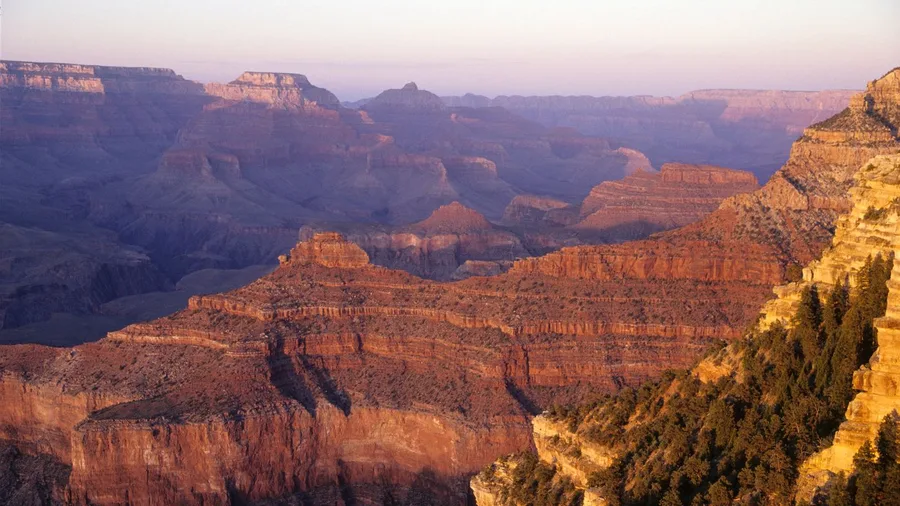
The Grand Canyon at sunset is not a view – it is a 40-minute light sequence, and standing in the wrong place means watching only the first act. As the sun drops, shadow climbs the western walls from the canyon floor upward while the east-facing inner walls stay lit and keep shifting color – amber to copper to a brief deep red – in visible bands roughly every two minutes. Mather Point, directly north of the visitor center, gives you the full width of that sequence across the canyon. Yavapai Point, about a kilometer east, extends on a promontory into the canyon itself and adds one element Mather cannot: the Colorado River far below, catching the last horizontal light. Worth the extra walk.
Both viewpoints are free, open without reservation, and about 10 to 20 minutes on foot from the village. The one logistical catch is that the South Rim shuttle stops at dusk – know your walking route back before the light goes. July and August bring afternoon thunderstorms that clear by late afternoon and leave cloud formations sitting above the canyon, lit from below by the low sun; a monsoon-season sunset here regularly beats the clear-sky version. Arrive 45 minutes early on any evening that is not a holiday weekend and a good position is yours.
💡 Tip: The South Rim shuttle stops running at dusk. Plan your walk back to the village — roughly 10–20 minutes from either viewpoint — before the light goes completely.
11. Bagan, Myanmar: Hot-Air Balloon Above Temple Plains
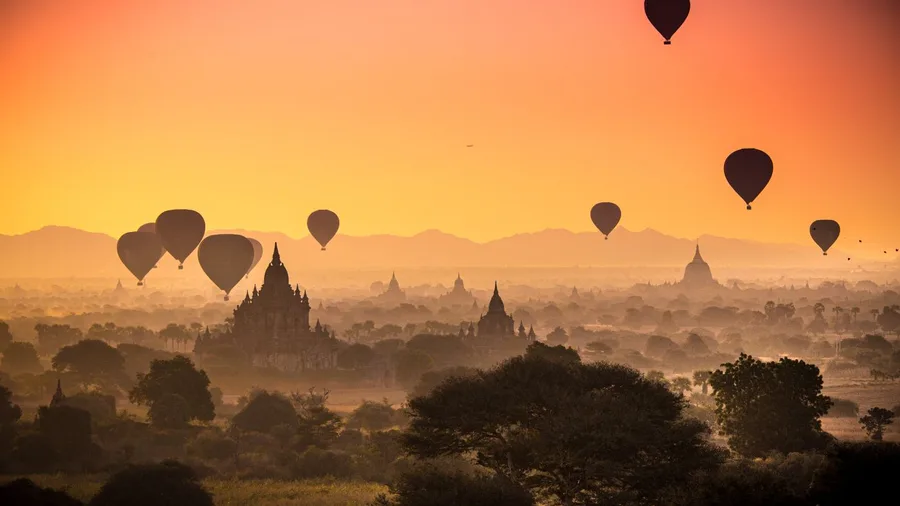
The catch comes first: balloon flights over Bagan run only October through April, and peak-season operators book out four to eight weeks in advance. Miss the window or the booking and you are on the ground – which is not the disaster it sounds like, but it does change the experience entirely.
From 300 to 500 feet up, the plain below reads as an unbroken field of temple spires stretching to every horizon, each one casting a long eastward shadow as the sun drops west – a density that no ground-level position reveals because the trees and pagoda walls block the sightline. Balloon Over Bagan and Oriental Ballooning are the main licensed operators; flights run 45 minutes to an hour and cost roughly $350 to $450 USD per person, with pricing that shifts seasonally, so confirm rates directly. The silence up there – no engine, just the burner firing occasionally – is what people consistently mention after, not the photography.
The free ground-level option is Shwesandaw Pagoda, whose tiered terraces give a 360-degree view across the plain and are worth the trip on their own terms. The crowd, though, arrives 90 minutes before sunset and fills the terraces early – the balloon does not simply improve the view, it sidesteps that problem entirely. If the balloon is not feasible, Shwesandaw earns its place. If it is feasible, book it before you book the flights.
12. Salar de Uyuni, Bolivia: Reflected Sky at Sunset
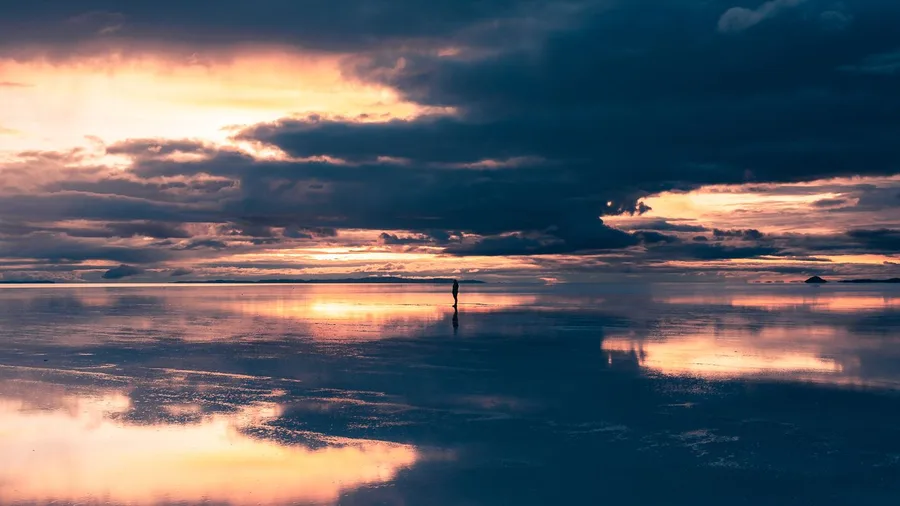
Ten thousand square kilometers of flooded white flat, and the horizon simply stops existing. Between January and March, seasonal rain lays down a layer of water sometimes no deeper than your ankle – 5 or 10 centimeters across parts of the world’s largest salt flat – and at sunset the surface turns into a perfect mirror. The sun drops toward its own double, reflected directly below it, and the sky wraps fully around you in every direction. The only way to know which way is down is to look at your feet.
Locals and guides know that the dry season version – May through November, no water, no mud – delivers something different but worth the trade: the exposed salt crust cracks into white hexagons that go pale gold and then pink as the light fades against a sky that at 3,656 meters altitude is a shade of blue you won’t find at sea level. To reach the center of the flat takes 1.5 to 2 hours by jeep from the edge, so a sunset run means leaving Uyuni town by early afternoon. Most tours fold the flat into two or three days alongside the colored lagoons and geysers nearby. Spend a day at lower altitude before you arrive – altitude sickness at 3,656 meters is real, and the flat is not a place to be horizontal with a headache.
💡 Tip: Acclimatize for at least one full day in a lower-altitude town before arriving in Uyuni at 3,656m. Altitude sickness on the trip highlight is avoidable with one day of patience.
13. Mykonos, Greece: Windmills Above Little Venice
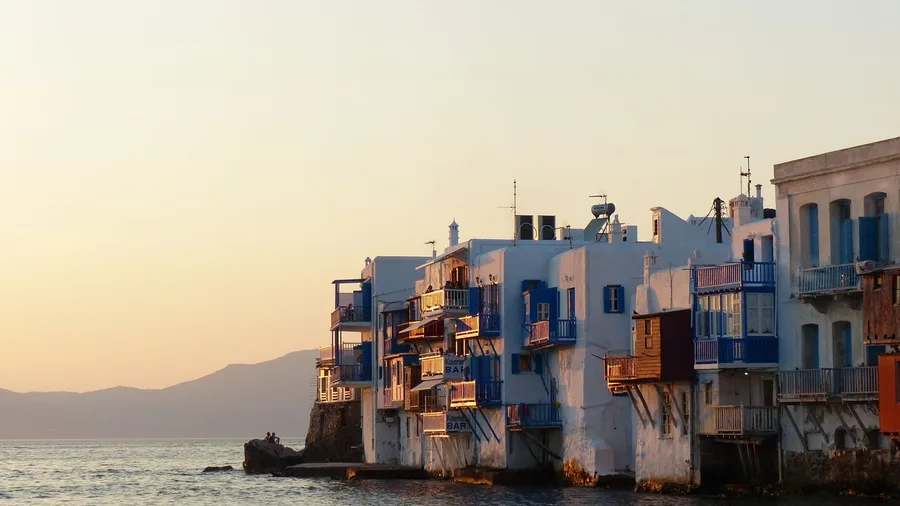
Mykonos delivers a genuine west-facing sunset over open Aegean water – the spectacle is real, but the evening is social first. Santorini is a geological event: caldera geometry concentrating amber light, the rock cycling through color long after the disc disappears. Mykonos is a beautiful sunset framed by 16th-century windmill silhouettes on the hill above Alefkandra, with one of the Mediterranean’s most animated waterfronts running directly below it.
Kato Mili windmill hill gives the best angle: free, elevated, unobstructed to the west, and 30 minutes early holds a position outside peak summer. The Little Venice bars directly below – tables cantilevered over the Aegean – make a drink and the sunset the same event. In September the crowds ease, the light falls around 7:30pm, and no strategy is required to see it well.
14. Cape Town, South Africa: Lion’s Head Above the Atlantic
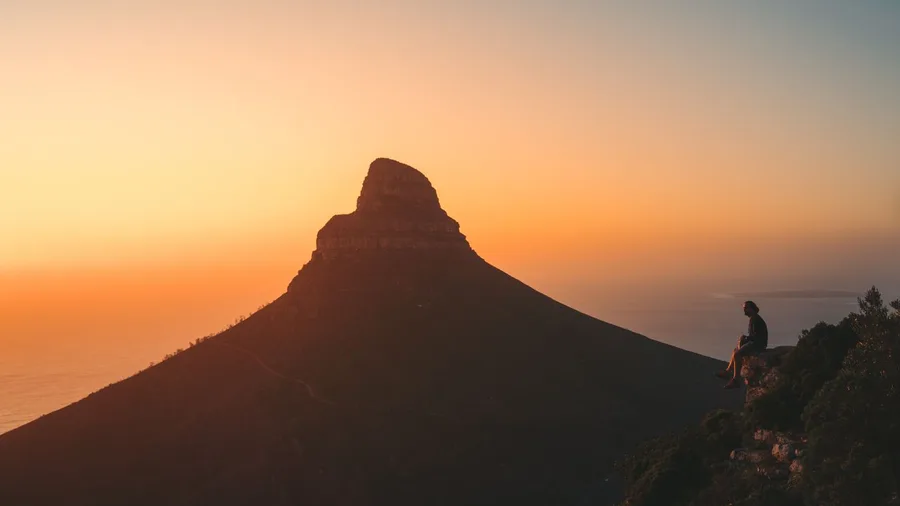
Some sunsets reward you for doing nothing more than showing up. This one asks a little more – roughly 1.5 hours of uphill walking, a single scramble on iron chains bolted into the rock face, and a 5km round trip that will have most average-fit travelers breathing hard but never genuinely struggling. The Lion’s Head saddle, not the technical full summit, is the target: high enough to matter, accessible enough that the hike feels earned rather than punishing.
What you get at the saddle is the thing no other stop on this list offers: two separate sunsets in one turn of the head. Face west and the Atlantic stretches to the horizon, the sun dropping into open ocean with nothing blocking it. Pivot 180 degrees and Table Mountain’s flat-topped profile is catching the last orange light on its eastern face – a warm amber wash across two kilometers of sheer cliff. The light on both sides is moving simultaneously, and you spend the full 40-minute sequence rotating between them.
Before you go up, stop at one of the cafes along Kloof Street, roughly 10 minutes’ drive from the trailhead, and pick up a takeaway coffee or a local craft beer from a bottle shop – a cold Windhoek or a Cape-brewed Darling Brew sitting in your pack tastes considerably better at altitude than it has any right to. There is no vendor at the saddle, no bar cantilevered over the water. The reward is self-catered, and that is part of the point.
Every person in your group needs a headlamp in their bag before the ascent starts – not shared between two people, every person. The descent in full dark on loose rock without one is genuinely hazardous, and sunset at the saddle means you are walking back down after last light no matter what. This is the practical detail most trip reports leave out, and it has ruined the evening for more than a few unprepared hikers.
If the hike is not an option – injury, kids, or simply not the day for it – Bloubergstrand beach sits about 25km north of the city center across Table Bay and delivers the classic Cape Town composition at zero physical cost: a flat sandy beach, the full Table Mountain silhouette above the Atlantic, and a sky that goes deep orange over open water. It is a different experience, less earned and more exposed to wind, but the view is real. March through May gives the best conditions for either option: the southeast wind that hammers the Cape in summer has eased, the skies are cleaner than at any other point in the year, and the December crowds on Lion’s Head have thinned to almost nothing – April light in particular has a quality that the harsher summer sun never produces.
Frequently Asked Questions
Which of these sunsets can you see on a single day trip without staying overnight?
Key West (Mallory Square), the Grand Canyon South Rim, and Mykonos (Kato Mili windmills) are all accessible without an overnight stay. The Grand Canyon and Key West are the most practical — free to access, no permit required, and no special accommodation needed to reach the viewpoint.
Is the Santorini sunset actually better than any other Greek island sunset?
For the specific caldera-and-open-water combination, yes. The concave geometry concentrates the light and the white walls amplify it — no other Greek island reproduces that. Mykonos has a better sunset than most people expect, but it does not match Oia’s 20-minute afterglow sequence.
Do you need to book the Haleakala sunset in advance?
Yes. National Park summit reservations are now required and must be made through the official park system. During June through August slots fill weeks ahead. The sunset reservation process is separate from the more famous sunrise system — check the Haleakala National Park website directly for current requirements before your visit.
When is the best time of year to see the Uluru sunset?
April through October, when temperatures are cooler and the midday heat does not make the afternoon drive unpleasant. The color sequence is the same year-round, but summer (December through February) at Uluru is extreme heat with later sunset times — the experience is the same, the comfort level is not.
Is the Salar de Uyuni mirror effect guaranteed in January?
Not guaranteed, but January through March is the only window when it is possible. Water depth varies year to year and section to section across the flat. Your best source for current conditions is the jeep tour agency in Uyuni town the day before you go out.
Is the Lion’s Head hike in Cape Town safe to do near sunset?
The trail is well-marked, popular, and generally safe for fit hikers. The practical issue is descending after dark without a headlamp — the rocky path makes this dangerous. Carry your own light, go with at least one other person if possible, and check local trail conditions before visiting.
Sorting the Fourteen by How You Actually Like to Travel
Sort by how you actually want to travel. Effortless and social: Key West and Mykonos. Active and earned: Lion’s Head and Haleakala, both of which pay off in direct proportion to the effort they ask. Landmark spectacle with clear answers about whether the hype holds: Angkor Wat and Uluru. Wildlife as the frame: the Serengeti sundowner and, for something with no earthly equivalent, Lofoten. Extreme landscape with logistics as part of the experience: Salar de Uyuni and the Atacama.
You probably arrived here with Santorini and the Grand Canyon already in mind. Both are on the list, both earn their place, and both come with specific reasons you might choose something less obvious instead. That is the point.
Pick the one entry that matches how you actually travel, find the week when the light is best at that location, and build everything else – flights, accommodation, any permits or reservations – around that date. Not around when the fares happen to be cheap. Book the west-facing room first.
Position Yourself Before You Book Anything
Use PhotoPills or The Photographer's Ephemeris to check the exact sunset direction at your chosen location on your arrival date. It takes three minutes and changes every decision that follows.