I Slept in an Abandoned Village No One Talks About

Most people who sleep in ghost towns take the softened version – the restored saloon with a bar downstairs, the guided lantern tour that ends at a heated car. I drove 18 miles of washboard dirt into the Nevada basin with no reservation, no guide, and a sleeping bag rated for temperatures the forecast was already promising.
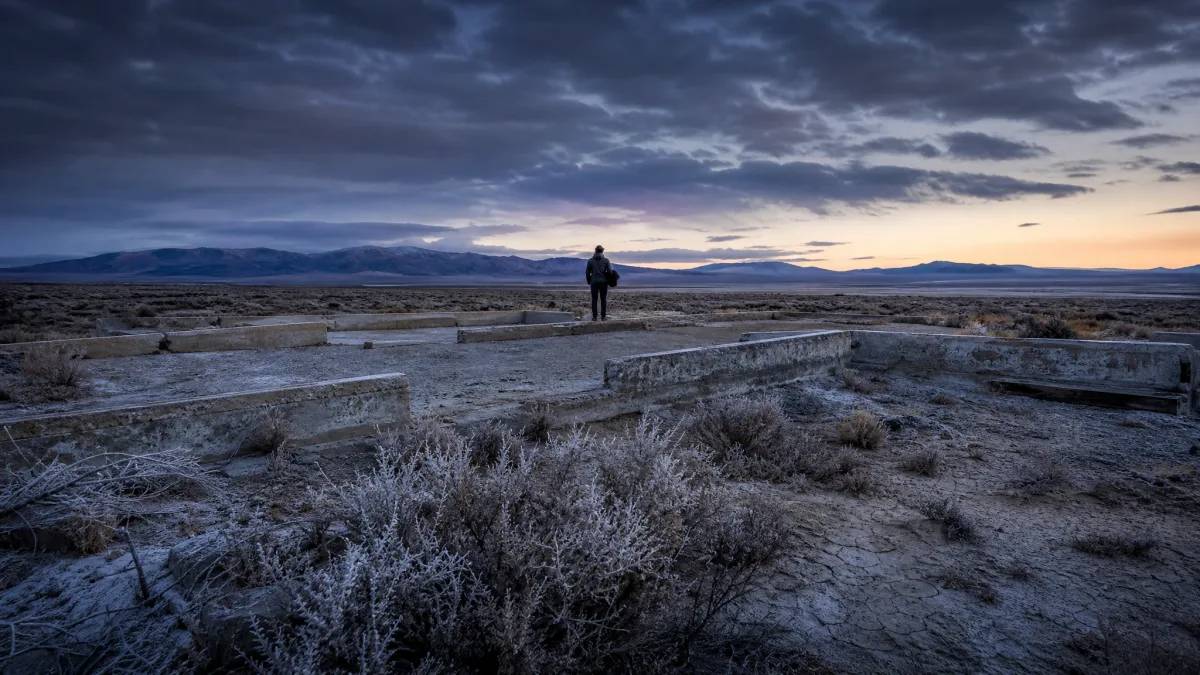
At 8 a.m. on Saturday the frost on the concrete was still hard. A full city-block hotel foundation sitting in open desert with no town around it, no interpretive sign, no other human being visible in any direction. That is what Metropolis, Nevada actually is.
The assumption most travelers carry is that any abandoned place worth the drive has already been found and listed. Metropolis is the proof that the interesting ones have not. It is a failed irrigation colony in Elko County, sitting on free BLM land 18 miles north of Wells, and it does not appear on any road-trip roundup I could locate.
This article gives you the exact place, the exact road, the overnight lows, and the specific moment – Friday arrival to Sunday departure, October, 28 degrees at night – that made two cold nights in a roofless ruin feel like a correct decision rather than a miscalculation. By the end you will know whether you are the person this trip is built for. If you are, you will also know what to do first.
Metropolis, Nevada — Quick Planning Facts
No Algorithm Surfaces This Place on Its Own
Finding Metropolis took three separate tools and about two hours of deliberate digging – none of which involved a travel site, a social feed, or a road-trip listicle.
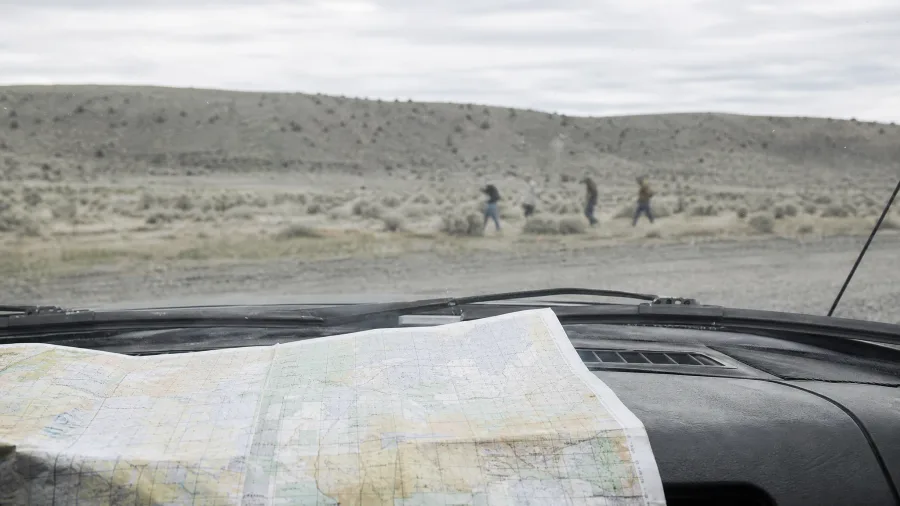
The chain went like this: BLM Nevada’s surface-management map confirmed the land is open public ground in Elko County, which meant free dispersed camping with no permit. A ghost-town enthusiast database matched the place name to a grid coordinate. Then satellite view settled the only question that mattered before committing to the drive – standing walls were still present, and the road running north from Wells looked intact and continuous. That three-step sequence is not complicated, but it requires knowing to run it at all, and most people never do.
The Wikipedia stub exists – failed irrigation colony, gone by the mid-1930s – but it links to nothing useful, and nothing useful links back to it. No highway sign points toward the site. Cell coverage ends shortly after you leave I-80 and does not return until 8 miles south on the way home.
That is exactly why the site was empty on a Saturday in October when every listed campground within range had neighbors. The obscurity is the point. A place that takes effort to locate performs its own quiet filter long before the road does – the kind of traveler who cross-references a BLM map against satellite imagery on a Tuesday night is also, probably, the kind who will find the drive worth making.
Metropolis by the Numbers
The Dirt Road Filters Out Ordinary Cars
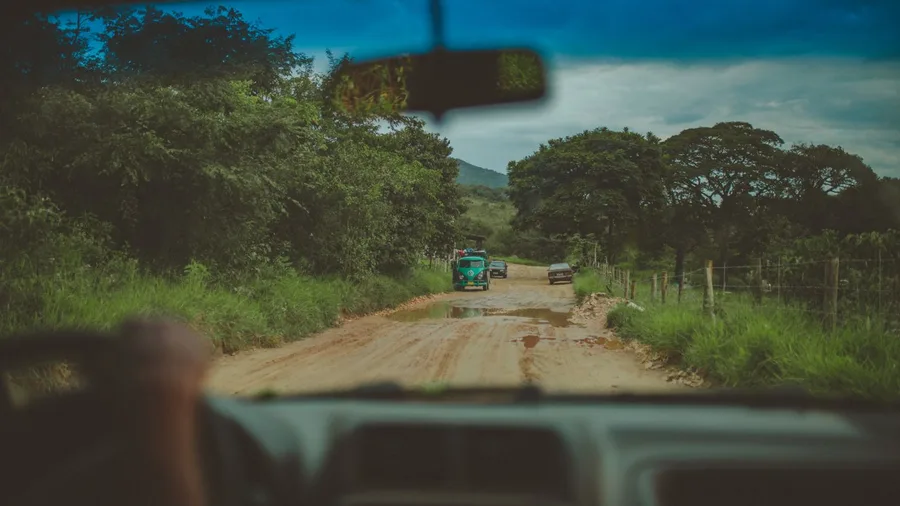
You do not need a truck. You do need to be honest about what you are driving.
The road north from Wells is CR 749-18 miles of it, officially classified as graded gravel, which is accurate the way “used car” is accurate. In practice it is corrugated washboard that rattles loose anything not secured in your boot, with one cattle gate requiring a full stop to unlatch and re-latch, and two dry creek crossings that look trivial in October but would stop a standard vehicle cold in snowmelt or after heavy rain. I drove it in an all-wheel-drive crossover with reasonable ground clearance and arrived without incident, though the last four miles shook the car hard enough that I checked the roof rack twice. A low-clearance sedan or a typical compact rental will not make it without risk of grounding out on the washboard ridges.
No tow service reaches the site. The nearest help is Wells, which means 18 miles of that same road between you and a recovery truck – and once you factor in the call, the drive out, and the wait, you are looking at three to four hours minimum, in a place with no shade and no cell signal.
Load everything in Wells before you leave: fuel, food, water, anything you forgot. There is nothing between the I-80 exit and the ruins, and no version of a quick run back that does not cost half a day.
⚠️ COMMON MISTAKE
Wells Is Your Last Chance — Treat It That Way
Every supply you need for two nights at Metropolis — fuel, water, food — comes from Wells, NV. There is no convenience store, no tap, and no ranger station north of I-80. Fill the tank, load at least 6 liters of water, and buy three days of food before you turn onto CR 749.
The Ruins Are Sparse Concrete, Not Cinematic Stone
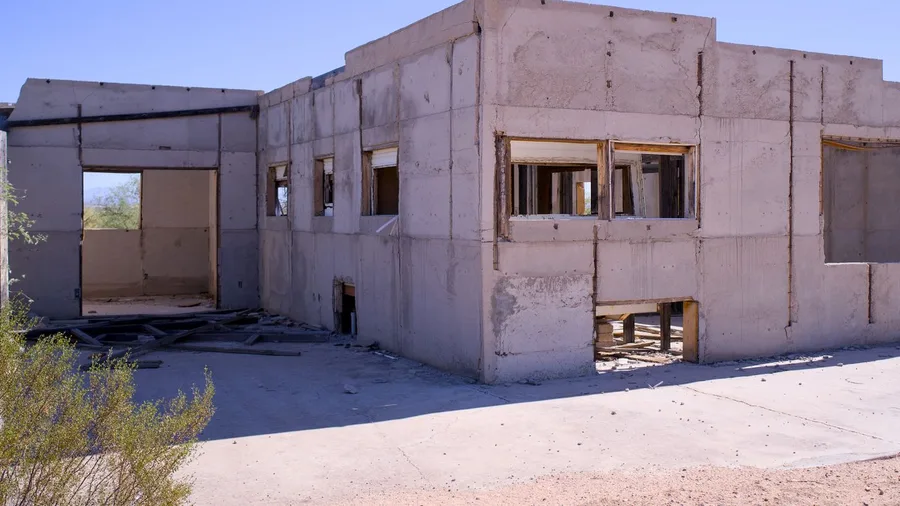
After 18 miles of washboard with no sign that anything is out there, arrival resets your expectations in a direction you probably did not anticipate: the ruins are smaller, flatter, and more stripped-down than almost any ruin photograph you have ever seen.
Metropolis left behind concrete. Foundation slabs, cellar pits dug into the basin floor, and one roofless schoolhouse shell – nothing built from stone, nothing carrying the texture of a collapsed interior. The hotel foundation is the largest piece: roughly 40 by 60 feet of continuous pad with room divisions still readable as low ridges running across the surface. The scale is genuinely arresting. The texture is nearly blank.
The schoolhouse walls stand about 8 feet – tall enough to walk inside, tall enough to understand the room’s dimensions and feel what the space once held. But there is no roof line, no window frame, no floor detail. Nine decades of Nevada weather removed everything except the structure’s outline.
If you need visible decay to feel the weight of a place – peeling surfaces, broken glass, the drama of a collapsed interior – Metropolis will not deliver it. The site offers scale, silence, and the particular quality of a place so thoroughly emptied that absence becomes the thing you are reading. That is either exactly what you came for, or it is not – and it is better to know which before the drive.
What Metropolis Left Standing
🏨 Hotel foundation
Blank concrete only — no walls, no fixtures, no debris to read. Largest single piece on site.
🏫 Schoolhouse walls
Two complete exterior walls, two partial — enough to walk the perimeter, not enough to shelter in wind.
🕳️ Stone cellar pits
Edges flush with ground level and easy to miss in low light — worth a slow first walk before dark.
🪦 Pioneer cemetery
~40 legible headstones, fenced perimeter intact. Legally protected — stay outside the fence line.
📷 Photography realism
No collapsed interiors, no peeling surfaces. Wide shots work; close-up decay shots do not exist here.
What to calibrate for
Every structure is a shell or a slab — bring a wide-angle lens and low expectations for texture, high ones for silence.
The Cemetery Is the One Part That Has Been Tended
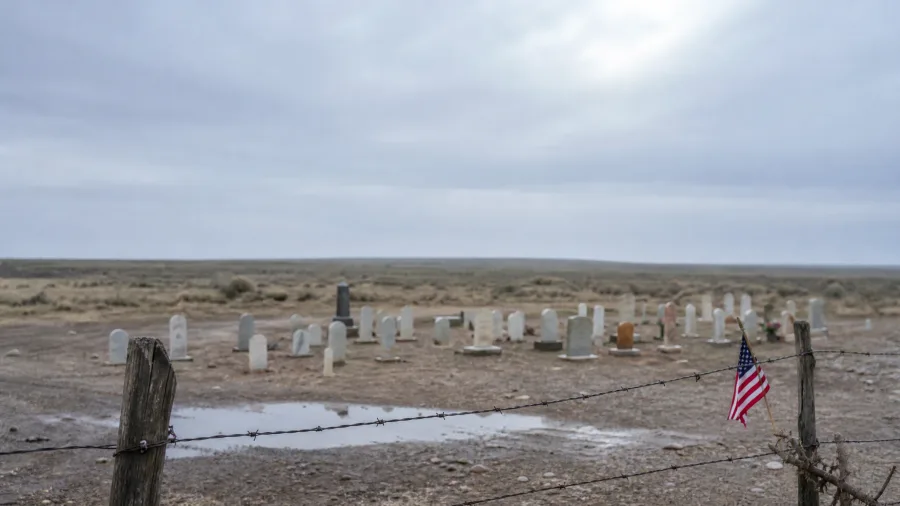
The concrete tells you nothing personal. The cemetery does.
A low wire fence marks the perimeter – easy to miss from the hotel foundation, visible once you walk the site’s eastern edge. Step through the gate and you’re looking at around 40 headstones, most still upright, most still readable. The dates cluster tight: 1910 to 1918, the whole life of the colony compressed into eight years of stone.
What stops you is the child’s marker. A lifespan of under two years, name weathered but legible. Next to it, an early homesteader whose death date comes before the town reached anything resembling a peak. The math of those dates does more work than any interpretive sign could – this place failed fast, and people paid for it.
Someone knows that. Near a fence post, a small American flag has been placed – recently enough to still be bright. No name on it, no note. The site is not entirely abandoned in the human sense, and knowing that changes how you stand there.
Treat it accordingly. This is a legally active burial ground: stay on the path, don’t step on graves, don’t move anything, and latch the gate behind you. The rest of Metropolis asks nothing of you. This part does.
Cemetery — What the Prose Did Not Cover
The Silence Is the Real Attraction, Not the Structures
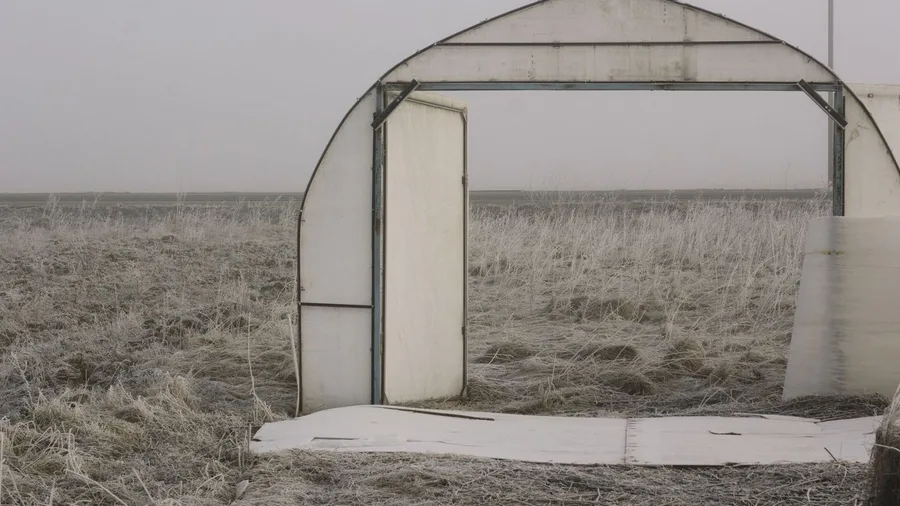
Walk back from the cemetery fence to the middle of the hotel foundation and stop moving. What you hear is almost nothing – and that almost-nothing is the whole point of the drive.
By mid-afternoon on a Saturday with no other visitors present, the audible range at Metropolis is: wind crossing the concrete slabs, one hawk circling a thermal above the basin, and the faint flex of tent fabric twenty feet away. That is the complete inventory. No road noise, no voices, no mechanical hum of any kind.
It does not feel like quiet. It feels like pressure – a physical accumulation that builds over the first hour until the brain stops waiting for the next sound and accepts that no sound is coming. You cannot photograph it and you cannot describe it in a way that transfers. You can only be there long enough for it to arrive.
A 20-minute roadside stop does not get you there. The shift happens somewhere in the second hour, after the light starts to angle and the shadows from the schoolhouse walls lengthen across the basin floor. This is what people drive three hours across Nevada to find – not the concrete, not the headstones – and it is only available to whoever stays still long enough to let it settle.
The quiet at Metropolis does not hit you when you arrive. It accumulates. The first 20 minutes you are still carrying the noise of the drive. By the end of the first hour something settles. A day visit never gets you past the arrival noise. That is the structural argument for staying overnight even before you factor in the dawn light.
Temperature Drops 30 Degrees Once the Sun Goes

The silence deepens after dark, but the night has its own condition that arrives fast and without negotiation: 61 degrees at 4 p.m., 28 degrees on a basic thermometer at 2 a.m. – a 33-degree drop in ten hours.
That swing is not unusual for high-desert October in Elko County, but it is easy to underestimate from the warmth of a late afternoon. I carried a 15°F-rated bag. That was the correct call. A 32°F bag – the kind that feels like dramatic overkill when you’re loading the car in daylight – would have made the second half of both nights genuinely miserable.
The northwest wind that runs all day does not stop at sunset.
A tent pitched in the open will flex and breathe heat out all night. The foundation walls are low – some sections barely knee height – but even a foot of concrete break on the windward side makes a measurable difference. Spend ten minutes when you arrive scouting the layout and position your tent accordingly before you unpack anything else.
October is the outer edge of what standard three-season gear can handle here. November through March at this elevation requires serious cold-weather kit – the kind most people do not own and should not improvise. If your sleeping bag is rated to 32°F and October is the only window you have, bring a liner, or push the trip to late September.
Gear That Works at Metropolis vs. Gear That Fails
Right Kit for October
- 15°F-rated sleeping bag — not 32°F
- 3-season tent with full rain fly
- 6 liters of water minimum for 2 nights
- Camp pitched against a low windbreak wall
- Headlamp with spare batteries — zero ambient light
What Will Ruin the Night
- 32°F-rated bag (leaves you shivering by 2 a.m.)
- Single-wall shelter or bivy in 15–20 mph northwest wind
- Fewer than 4 liters of water (no source exists on site)
- Tent fully exposed to open northwest — loses heat all night
- Low-clearance car on CR 749 in any wet or icy conditions
There Is No Water, No Signal, and No Rescue Margin
The cold gear solves one problem; the site’s complete absence of infrastructure is a different category of problem entirely.
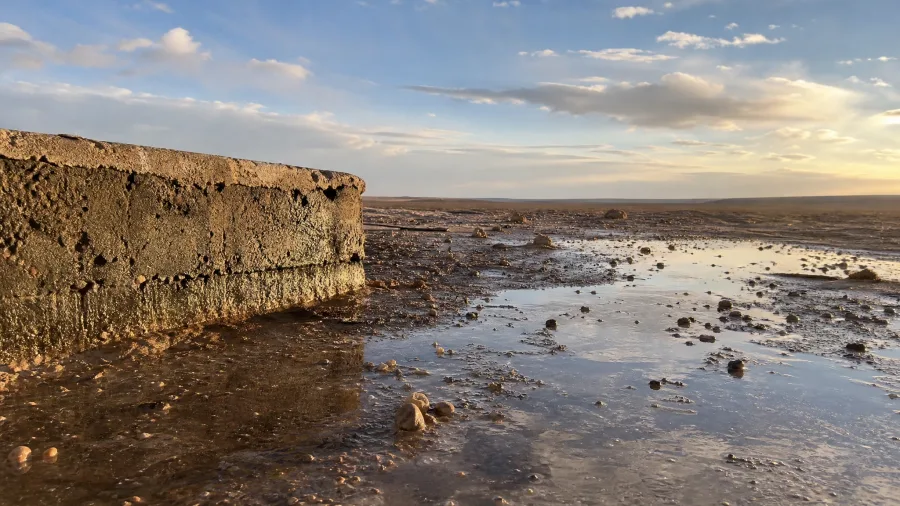
There is no water at Metropolis – not a tap, not a creek, not a tank. I carried 4 liters for two days and finished close to the bottom of the last bottle on Sunday morning. That is enough, but the margin is thin enough that one stomach bug, one extra hiking hour, or one hotter-than-forecast afternoon would have made it uncomfortable. Six liters is the number I would carry again for a two-night stay.
Signal dropped out within a mile of the I-80 turnoff and did not return until roughly 8 miles south on the drive back Sunday. For something like 44 hours, no message in or out was possible – not a text, not a map refresh, nothing. That is not unusual for remote BLM land in Nevada, but it is worth sitting with before you commit to the road.
No ranger patrols the site. No camp host. I saw no other vehicle from Friday afternoon to Sunday morning. If a tent stake through a hand, a twisted ankle on a cellar pit, or a car that won’t start on a 28-degree morning: the nearest person who could help is 18 miles of corrugated dirt away, and they don’t know you’re there unless you told them.
That last part is the one preparation that costs nothing and changes everything. Before I turned off I-80, I called a contact from a Wells gas station parking lot, gave them the GPS coordinates of the site, confirmed I was leaving Sunday, and said plainly: if you don’t hear from me by noon Sunday, call the Elko County Sheriff. The call took four minutes. It is the difference between a remote camp and a reckless one.
🛡️ Before You Leave Wells — Safety Prep in Order
Check tires and pack jumper cables
18 miles of corrugated dirt is hard on valve stems. A flat or dead battery at 28°F with no one coming is the scenario worth spending 90 seconds on before you leave pavement.
Fill the tank and buy anything you forgot
Wells is the last stop for fuel, food, and water. CR 749 has nothing, and neither does the site. Once you turn off I-80, the list is closed.
Download offline maps while you still have signal
Search 'Metropolis Nevada ruins' in Gaia GPS and cache the satellite layer. Signal drops within a mile of the I-80 turnoff and does not return until roughly 8 miles south on the drive back.
Look up the Elko County Sheriff non-emergency number and give it to your contact
The prose covers what to say — your contact also needs the number to call. Don't leave that step to them to figure out on Sunday when they're worried.
Leave a dated note on your dashboard
Write your name, destination, return date, and contact's number on paper and leave it visible inside the car. If someone finds the vehicle before your contact acts, they know exactly who to reach.
Sleep Comes in Fragments, Interrupted by Your Own Attention
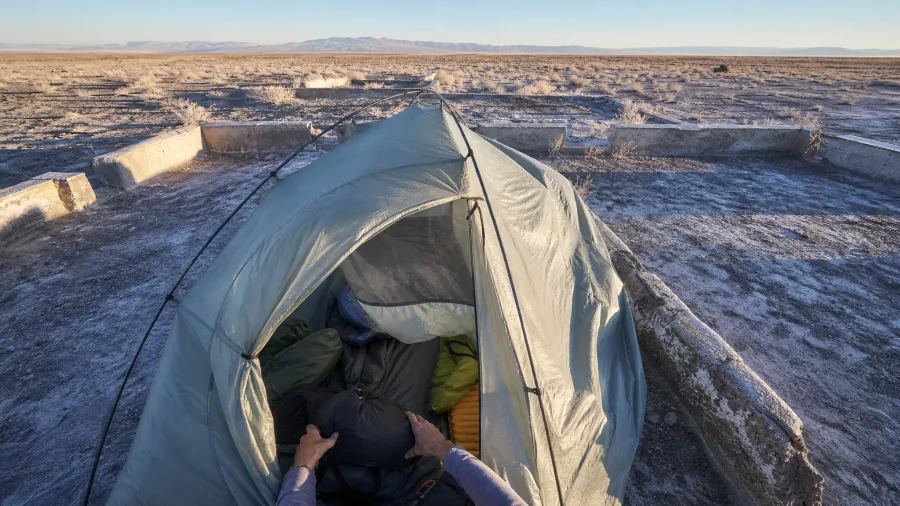
Once the logistics are settled before dark – water counted, tent staked into a wind shadow, contact called – the night becomes its own thing. Not frightening, exactly, but not restful in the way a campground is restful.
On the first night, coyotes started somewhere north of the site around midnight – not close, but directionally clear, which the brain treats differently than ambient noise. Around 3 a.m. the wind picked up and the tent walls began flexing in a slow, irregular rhythm. Then, once, a single knock from the direction of the foundation slab. Almost certainly the concrete contracting as it cooled. The brain did not accept that explanation immediately and filed the sound for later review.
This is not dread. It is closer to the heightened alertness of the first night in any unfamiliar backcountry place – the condition where the brain declines to fully stop monitoring and sleep arrives in 90-minute windows instead of one continuous stretch. You wake, confirm nothing has changed, and go back under.
By the second night it was different. The coyotes were expected. The tent-wall sound had a name. The foundation knock, if it came, was thermal contraction. Sleep was longer and less interrupted – which is the practical reason two nights is the right number rather than one. A single night at Metropolis means paying the full alertness cost and leaving before the benefit compounds.
What the site offers, and what catches some visitors sideways, is that it provides nothing to think about except what you bring. No audio tour, no interpretive sign, no campfire conversation. Eight hours of dark with only your own attention for company.
Morning Light Makes the Argument for Coming
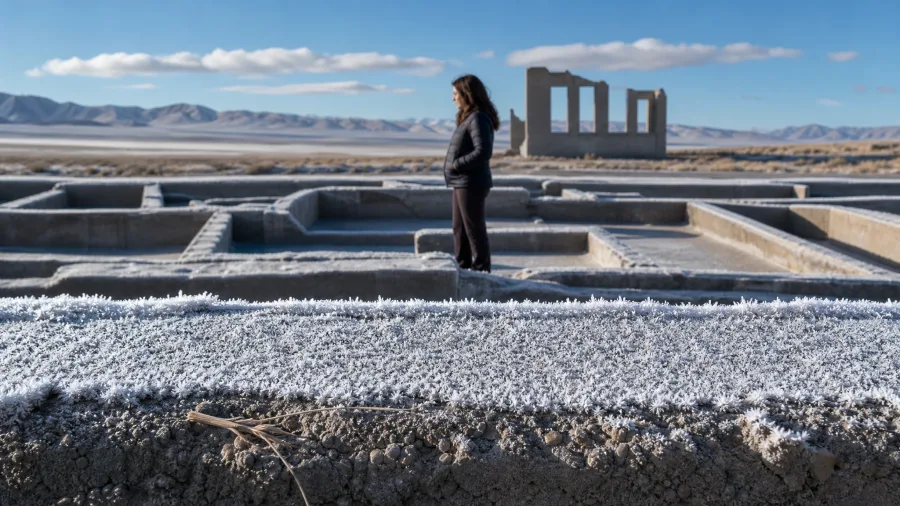
Whatever the night costs in sleep, the account settles in full about 20 minutes after sunrise.
On the second morning: frost on the hotel foundation, white and even across the whole pad. The schoolhouse walls threw shadows west across the basin floor – long, hard shadows that made the ruin read as architecture for the first time. No wind yet. The low angle of the light caught the interior room divisions in the concrete, the low ridges I had walked over for two days without fully registering, and suddenly the floor plan of a 1910 hotel was legible from 30 feet away.
That light lasts about 40 minutes. Once the sun clears the horizon by a few degrees, the shadows shorten and the foundation goes flat again – a grey slab, not a building. A day visitor pulling off CR 749 at 9 a.m. will not see what I saw. They will see what I saw on the drive in: sparse concrete, open sky, not much.
The frost, the shadows, and the silence at that hour are not atmosphere layered on top of the experience. They are the experience – the specific return on two cold nights and an 18-mile dirt road. They are also non-transferable. No photograph I took at that light showed what standing in it felt like, and I tried.
The site has one great hour. It belongs to whoever slept there.
This Trip Self-Selects for a Specific Kind of Traveller
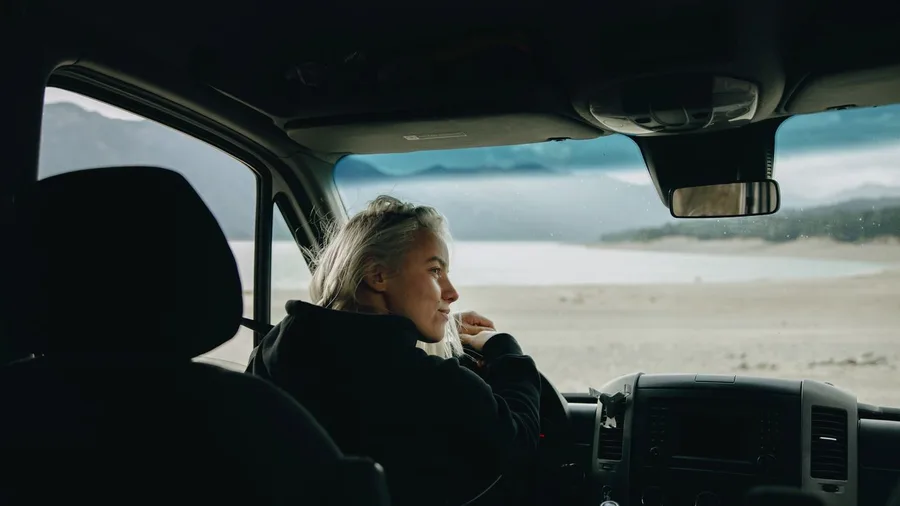
That sunrise belongs to a specific kind of person, and the question worth asking before you book two nights in a roofless concrete ruin is whether you are actually that person.
The trip works for solo travellers or pairs who have camped on dispersed BLM land before, who know from experience that being unreachable overnight is quiet rather than frightening, and who do not need a place to narrate its own significance. Metropolis offers none of the usual scaffolding – no interpretive signs, no maintained trail, no dramatic architecture to do the emotional work on your behalf. What it offers instead is 18 miles of washboard road, 28-degree lows, and eight hours of dark with nothing to focus on but your own thoughts.
If your honest reaction to that sentence is mild dread, that is useful information.
The visitors this site disappoints are not unprepared in any technical sense. They bring the right gear, they find the right coordinates, they make the drive without incident – and then they stand on the hotel foundation at noon, confirm that it is a concrete slab, and feel cheated. The payoff here is not photogenic, not shareable, and not delivered in daylight. It accumulates in stillness, over time, at a temperature that requires a 15-degree-rated bag to survive comfortably.
Calling Metropolis an acquired taste is accurate but too gentle. It is a container for the visitor’s own attention, and if that attention has nothing much to bring, the container stays empty. Reading that as a flaw means the 18-mile washboard just saved you two cold, underwhelmed nights.
Frequently Asked Questions
Is it legal to camp at Metropolis, Nevada?
Yes. Metropolis sits on Bureau of Land Management land in Elko County, where dispersed camping is free and requires no permit or reservation. The standard BLM 14-day limit in one location applies. The pioneer cemetery is an active historic burial ground and must be treated accordingly — no disturbance of graves or markers under any circumstances.
Do you need a 4WD truck to reach Metropolis?
Not necessarily, but high clearance helps significantly. I drove a standard AWD crossover in dry October conditions without incident. The 18-mile corrugated road will punish low-clearance vehicles, and the two dry creek crossings become impassable in wet or icy conditions. Do not attempt it in a typical rental sedan, and check recent weather before you commit to the turn-off.
How far is Metropolis from Elko, Nevada or Twin Falls, Idaho?
Metropolis is roughly 2.5 hours from Elko and about 3 hours from Twin Falls, both via I-80. Wells, Nevada is the practical staging point — 18 miles south of the site. From Las Vegas you are looking at close to 7 hours; from Salt Lake City, around 4.5 hours. The site is genuinely remote from any major population centre.
Is there anything to see beyond the ruins and cemetery?
The ruins and the cemetery are the site. There are no interpretive signs, no museum, no maintained trails. The experience is the landscape itself — the scale of the foundation, the silence, the quality of the light at specific times of day. If those things do not sound like enough to justify the drive, that is useful information to have before you make it.
What is the best time of year to visit Metropolis?
Late September through mid-October is the practical window: dry roads, manageable temperatures, and the low-angle light that makes the ruins read well. Summer brings heat and occasional afternoon thunderstorms on the high desert. November through March means overnight lows well below 20°F at this elevation, potential road closures from ice and snow, and real cold-weather gear requirements.
Are there other visitors or camps at the site?
On my October weekend visit I had the site entirely to myself for both nights. The complete absence of an online profile keeps foot traffic minimal. That said, it is open public land — solitude is likely but not guaranteed. If you arrive to find another camper, standard dispersed camping courtesy applies: set up at a respectful distance and give the site room.
Who Gets the Payoff and What to Do in the Wells Parking Lot
Metropolis is the right trip for an experienced dispersed camper who finds something in negative space, historical austerity, and genuine remoteness – the kind of person who can spend eight hours of dark with their own attention and call that a good night. It is the wrong trip for anyone who needs photogenic ruins, signal, or a site that explains itself. Both reactions are reasonable. They just belong to different people.
The single preparation that separated a memorable two nights from a potentially reckless one was not the 15-degree sleeping bag or the four liters of water or the windbreak tent pitch. It was the four minutes I spent in a Wells gas station parking lot before turning onto CR 749 – texting GPS coordinates, a Sunday morning return date, and a clear instruction to call the Elko County Sheriff if noon passed without word.
Do that first. Before the road, before the ruins, before anything else. And if you are the right person for this trip, you will be standing on that hotel foundation at first light on a Sunday in October, frost still hard on the concrete, the basin absolutely empty in every direction – and that will be the only confirmation you need.
Read the Logistics Section Before You Point the Car at Wells
The gear, the road conditions, and the safety prep are all covered in the sections above, in the order you need them. One read-through before you leave saves a multi-hour problem 18 miles from the nearest town.